Private Label, White Label, Wholesale partnerships available - EU, USA and UK - Free shipping from €75

Guide to Handling Biohazards: Lab Safety Protocols
Explore our comprehensive guide to handling biohazards, ensuring safety in labs. Follow protocols for protection and compliance.
TL;DR:
- Biohazard handling involves the controlled management of infectious biological agents in laboratories to ensure safety and regulatory compliance. Proper PPE, engineering controls like biosafety cabinets, rigorous risk assessments, and validated decontamination protocols are essential for protecting staff and the environment. Waste must be accurately segregated and treated with validated methods such as autoclaving or chemical disinfection before disposal.
Biohazard handling is defined as the controlled management of biological agents that pose a risk of infection or harm to humans, animals, or the environment. Safe biohazard work in laboratory settings requires strict adherence to OSHA 29 CFR 1910.1030, CDC biosafety guidelines, and NIH standards covering risk assessment, personal protective equipment, containment, decontamination, and regulated waste disposal. This guide to handling biohazards covers each phase in sequence, from pre-work preparation through final waste documentation, giving laboratory personnel and safety professionals a structured reference for maintaining compliance and protecting staff.
What PPE and containment controls does biohazard safety require?
Personal protective equipment forms the first line of defense in any biohazard safety program. The correct selection depends on the biosafety level (BSL) of the agent involved, the procedure being performed, and the route of potential exposure. Wearing the wrong glove type or skipping eye protection is not a minor oversight. It is a compliance failure with direct consequences for worker health and institutional liability.
The standard PPE ensemble for BSL-1 and BSL-2 work includes:
- Gloves: Nitrile or latex, changed between tasks and before touching shared surfaces or equipment
- Eye protection: Safety glasses or splash goggles when aerosol or splatter risk exists
- Respiratory protection: N95 respirators or higher when working with airborne agents or open cultures
- Lab coat: Fluid-resistant, worn only inside the lab and removed before entering common areas
- Face shield: Required when handling large volumes of infectious material
Safety controls are hierarchical: primary barriers like biological safety cabinets (BSCs) and PPE shield workers, backed by administrative workflows designed to physically prevent exposure rather than rely on human reaction. BSCs are the primary engineering control for work with infectious agents. Class II Type A2 cabinets are the standard for most BSL-2 work, providing HEPA-filtered airflow that protects both the worker and the sample. Cleaning and disinfecting the BSC interior before and after each session is mandatory, not optional.
Administrative controls complete the containment hierarchy. These include restricting lab access to trained personnel, posting biohazard signage at all entry points, and designing workflows that minimize the number of times a worker handles infectious material. Laboratory signage and organized waste disposal mechanisms significantly reduce accident risks. That reduction comes from removing ambiguity. When every container, door, and surface is clearly labeled, workers make fewer assumptions.
Pro Tip: Clean the BSC with 70% isopropyl alcohol or an appropriate disinfectant before and after use, and always work from clean to contaminated areas within the cabinet to prevent cross-contamination of samples.
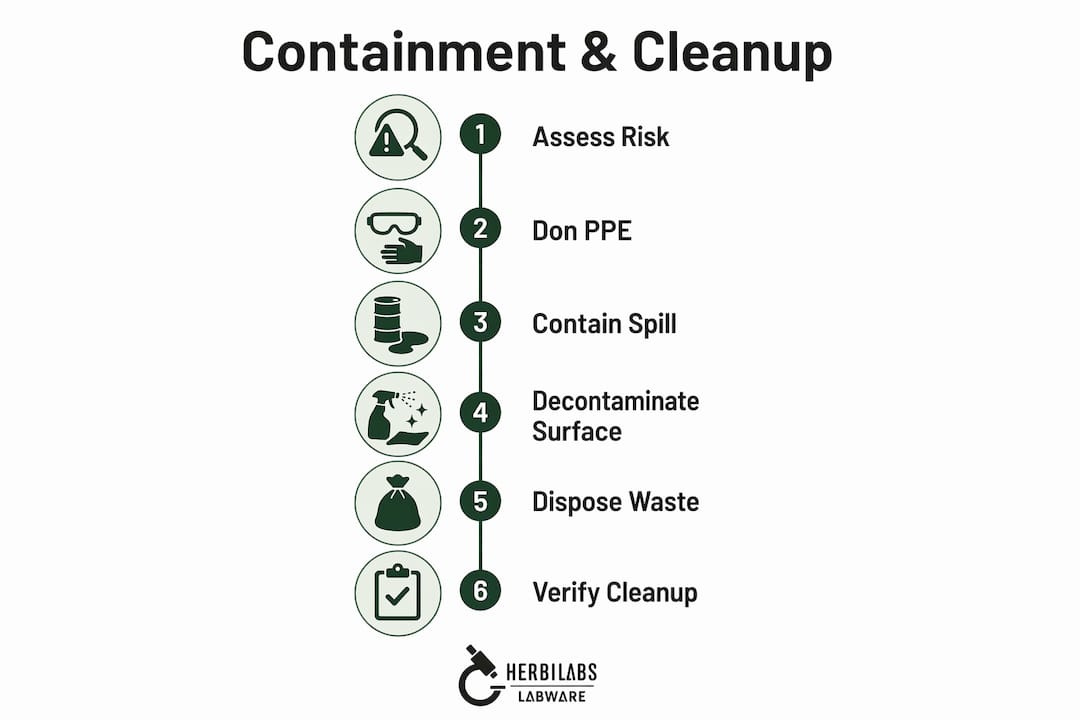
How do you conduct a risk assessment before biohazard work?
A documented risk assessment is the mandatory first step before any biohazard work begins. Documented risk assessments and competency testing are required for safe biohazard work authorization, and updated procedures with staff testing are required for full accreditation. Skipping this step does not just create a safety gap. It creates a regulatory gap that auditors will find.
A thorough pre-work risk assessment follows this sequence:
- Identify the agent. Classify the biological agent by BSL (1 through 4) based on CDC and NIH guidelines. Confirm its transmission routes, infectious dose, and available treatments.
- Assess the procedure. Determine whether the task generates aerosols, involves sharps, or requires open handling of cultures. Higher-risk procedures require upgraded controls.
- Evaluate the space. Confirm that ventilation meets requirements for the BSL, that directional airflow moves from clean to contaminated zones, and that the lab has a hands-free sink for handwashing.
- Verify equipment. Check that BSCs have current certification, autoclaves are validated, and all PPE is in stock and within its service life.
- Document and approve. Record the assessment in writing, have it reviewed by the institutional biosafety officer, and file it with the standard operating procedure (SOP) for the work.
- Test staff competency. Require personnel to demonstrate correct donning and doffing of PPE, proper BSC technique, and spill response before they work independently.
Biosafety requires ongoing education, updated manuals, trained staff with periodic competency tests, and well-maintained equipment to sustain quality laboratory services. Competency testing is not a one-time event. Annual re-testing, triggered re-training after incidents, and documented sign-offs are the standard for accredited facilities.
What are the step-by-step protocols for biohazard containment and cleanup?
Professional biohazard remediation is a structured multi-phase process lasting 3 to 48 hours depending on contamination severity. Surface decontamination takes 3–12 hours, and post-remediation verification takes 12–48 hours. That time range reflects the difference between a contained bench spill and a large-scale infectious release. Both require the same disciplined sequence.
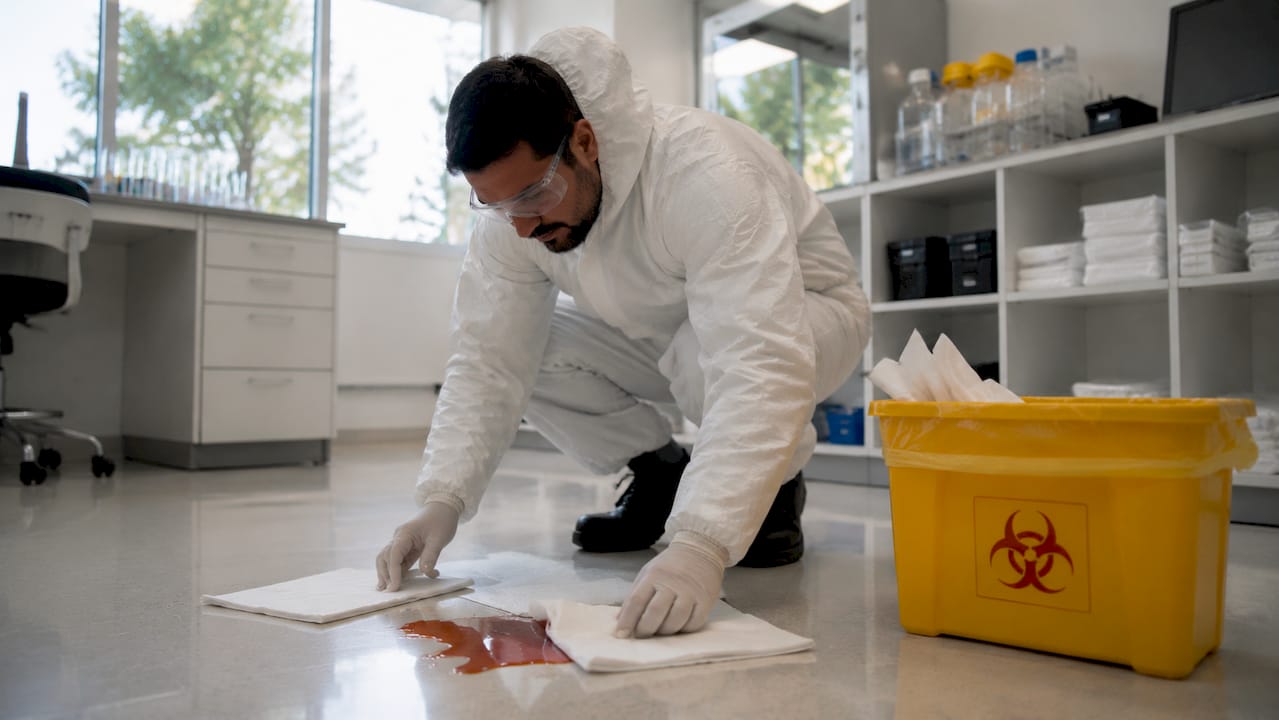
Immediate spill response
The first 60 seconds after a biohazard spill determine whether contamination stays localized. Cover the spill with absorbent material immediately. Alert others in the area and restrict access. Do not attempt to clean without full PPE in place.
Surface decontamination
Standard cleaning products cannot neutralize bloodborne pathogens. Pathogens like Hepatitis B, HIV-1, and MRSA require EPA-registered tuberculocidal disinfectants per OSHA standards. The decontamination sequence is:
- Remove bulk organic material using absorbent pads or paper towels, working from the outer edge inward
- Apply an EPA-registered tuberculocidal disinfectant at the manufacturer’s recommended concentration
- Allow full contact time (dwell time) as specified on the product label, typically 10 minutes
- Wipe the area clean and apply a second disinfectant pass
- Treat HVAC vents and surrounding surfaces if aerosol generation occurred
Surface decontamination protocols require removing organic load first, then applying disinfectant with proper dwell time, and completing a final disinfection pass including HVAC treatment. Skipping the organic load removal step reduces disinfectant efficacy significantly because proteins in blood or tissue physically shield pathogens from the active chemical.
Waste segregation during cleanup
All contaminated materials from the cleanup must be segregated immediately:
- Solid waste (gloves, absorbent pads, disposable PPE) goes into red biohazard bags
- Sharps go directly into puncture-resistant sharps containers, never into regular waste
- Liquid waste is collected in sealed containers for chemical disinfection before drain disposal
- Reusable equipment is bagged and transported to the autoclave for sterilization
For guidance on broader waste handling procedures, the lab waste disposal guide from Herbilabs covers segregation and treatment steps aligned with current biosafety protocols.
Post-remediation verification
ATP bioluminescence testing provides a quantitative baseline confirming no measurable organic contamination after remediation. This verification step takes 12–48 hours and establishes clearance baselines for insurance and legal documentation. ATP testing detects adenosine triphosphate, the energy molecule present in all living cells. A reading above the clearance threshold means the decontamination was incomplete and the process must restart.
Pro Tip: Document every step of the cleanup with timestamps, disinfectant lot numbers, and ATP readings. This record is your primary defense in any regulatory audit or insurance claim.
Self-cleanup of biohazard sites is a major compliance risk because untrained personnel cannot meet OSHA decontamination thresholds, and attempting it can void institutional insurance coverage. For large-scale contamination events, licensed professional remediation is the required path. For commercial and healthcare settings, professional biohazard site cleanup protocols provide a useful reference for compliance benchmarks.
How should biohazardous waste be safely disposed of?
Biohazardous waste and medical waste are not the same category, and treating them identically creates compliance failures. Biohazardous waste is material contaminated with infectious agents or potentially infectious material. Medical waste is a broader category that includes sharps, pathological waste, and pharmaceutical waste. Each category has distinct container requirements, treatment methods, and disposal pathways.
Solid biohazardous waste must be sterilized by autoclaving before disposal. Liquid waste requires approved chemical disinfection, with sodium hypochlorite (bleach) being a CDC-recommended option at appropriate concentrations. The key distinction is that autoclaving renders solid material non-infectious through validated steam sterilization, while liquid waste treated with bleach can be disposed of via the sanitary sewer in most jurisdictions, subject to local regulations.
Institutions are moving away from incineration, favoring validated inactivation methods for rendering materials non-infectious before disposal. Autoclaving is now the preferred method for BSL-1 and BSL-2 solid waste because it is verifiable through biological indicators and chemical integrators, and it produces no air emissions. Incineration remains required for BSL-3 and BSL-4 waste and for pathological waste in many states.
Compliance with waste disposal regulations requires:
- Using red biohazard bags for solid infectious waste, with secondary containment for transport
- Labeling all containers with the universal biohazard symbol and the agent or risk category
- Maintaining autoclave logs with cycle parameters, load contents, and biological indicator results
- Contracting with a licensed medical waste vendor for off-site disposal when required
- Retaining disposal manifests for a minimum of three years per OSHA and EPA requirements
Key Takeaways
Safe biohazard handling requires a documented, sequential approach covering risk assessment, PPE selection, engineering controls, decontamination, and regulated waste disposal, with no phase skipped or abbreviated.
| Point | Details |
|---|---|
| Risk assessment comes first | Document agent classification, procedure risks, and staff competency before any work begins. |
| PPE and BSCs work together | Engineering controls like BSCs reduce exposure; PPE covers residual risk that cabinets cannot eliminate. |
| Decontamination requires correct chemistry | Use EPA-registered tuberculocidal disinfectants with full dwell time. Standard cleaners do not neutralize bloodborne pathogens. |
| Verify cleanup with ATP testing | ATP bioluminescence testing provides a quantitative clearance baseline for regulatory and insurance documentation. |
| Waste treatment is method-specific | Autoclave solid biohazardous waste; chemically disinfect liquid waste. Document every cycle and disposal manifest. |
What years of lab safety work actually taught me
The most persistent problem in laboratory biosafety is not ignorance. It is overconfidence. Personnel who have worked with BSL-2 agents for years often develop a casual relationship with their PPE. They pull gloves on loosely, skip the second disinfectant pass because the spill “looked small,” or reach across the BSC cabinet to retrieve a sample, disrupting the protective airflow in the process.
Cross-contamination risks arise from improper glove use, such as wearing gloves while using shared equipment or crossing arms during cabinet work, which disrupts the laminar airflow that makes the BSC effective. This is the kind of failure that does not show up in incident reports because nothing visibly went wrong. The exposure happened silently.
PPE does not substitute for disciplined procedural adherence. Safety programs fail when human behavior lapses occur, and regular supervision with competency checks is what prevents those lapses from becoming incidents. The labs I have seen maintain the strongest safety records are not the ones with the most expensive equipment. They are the ones where supervisors treat a glove protocol deviation the same way they treat a data integrity issue: as something that gets documented, discussed, and corrected.
The practical lesson is to design your systems so that the safe behavior is also the easiest behavior. If the biohazard waste bag is inconveniently located, workers will delay disposal. If the BSC is positioned so that reaching across it is the natural motion, workers will do it. Physical design prevents more exposures than any amount of training alone.
— Ragnar
Herbilabs supports safe lab reagent handling
Maintaining biosafety standards extends to every reagent and diluent used in the lab, not just the infectious agents themselves. Herbilabs supplies research-grade bacteriostatic water, sterile diluents, and reconstitution solutions manufactured to strict purity standards, giving laboratory personnel one less variable to manage when working in controlled environments.
Proper reagent handling is part of the broader biosafety picture. Herbilabs provides detailed guidance on safe reagent handling and labware sanitization to help labs maintain compliance at every step. For researchers who need high-purity reconstitution solutions that meet the demands of a controlled research environment, the Herbilabs shop carries a full range of lab-grade products with wholesale pricing available for institutions and resellers.
FAQ
What is the first step in any biohazard handling protocol?
A documented risk assessment is the mandatory first step. It classifies the agent by biosafety level, identifies procedure-specific hazards, and confirms that personnel, equipment, and space meet the requirements before work begins.
Which disinfectants are required for biohazard cleanup?
EPA-registered tuberculocidal disinfectants are required for surface decontamination involving bloodborne pathogens. Standard cleaning products cannot neutralize pathogens like Hepatitis B, HIV-1, or MRSA to OSHA-required thresholds.
How is biohazardous waste treated before disposal?
Solid biohazardous waste is sterilized by autoclaving using validated steam sterilization cycles. Liquid waste is chemically disinfected, typically with sodium hypochlorite at CDC-recommended concentrations, before drain disposal.
What does ATP bioluminescence testing confirm after cleanup?
ATP bioluminescence testing confirms that no measurable organic contamination remains after remediation. The results establish a quantitative clearance baseline used for regulatory compliance, insurance documentation, and legal records.
Can laboratory staff clean up a biohazard spill without professional help?
Minor bench spills within a trained lab’s scope can be handled internally using documented spill response procedures and correct PPE. Large-scale contamination events require licensed professional remediation, as self-cleanup cannot reliably meet OSHA decontamination thresholds and may void institutional insurance.