Private Label, White Label, Wholesale partnerships available - EU, USA and UK - Free shipping from €75

How to get bac water fast in Europe with no customs delays
Discover tips for fast shipping bac water Europe no customs delays. Ensure timely deliveries and avoid frustrating customs issues with EU suppliers.
TL;DR:
- Sourcing bac water from outside Europe risks customs seizure, delays, and quality issues.
- EU-based suppliers ensure faster, predictable delivery and compliance, reducing operational disruptions.
- Verify EU suppliers through community recommendations, documentation, and quality standards like COA and GMP.
Waiting on a bac water shipment that never arrives is not just frustrating. It can derail an entire research timeline. Researchers across Europe increasingly report customs seizures, unexplained delays, and outright lost orders when sourcing bacteriostatic water (bac water) from US or Canadian vendors. Community discussions on forums like GLP-1 research groups confirm that EU vendors are strongly preferred for avoiding these exact headaches. This article walks you through the real risks of non-EU sourcing, how to identify legitimate EU suppliers, what quality benchmarks actually matter, and how to lock in fast, compliant delivery every time.
Table of Contents
- Why ordering bac water from outside Europe is risky
- How to find trusted EU suppliers for bac water
- Bac water quality: What separates premium from questionable sources?
- Ensuring fast delivery (and no customs delays) with EU-based suppliers
- What most researchers miss about sourcing bac water in Europe
- Where to get compliant, fast-shipped bac water for your lab
- Frequently asked questions
Key Takeaways
| Point | Details |
|---|---|
| EU sources prevent delays | Buying bac water from inside Europe keeps your order fast and avoids customs interference. |
| Check documentation carefully | Only order from vendors with real COA, HPLC, and sterility proof for genuine, safe bac water. |
| New EU rules increase costs | From July 2026, expect all non-EU bac water orders to face new taxes and customs delays. |
| Premium products save time | Investing in quality, documented bac water reduces research risk and saves you more in the long run. |
Why ordering bac water from outside Europe is risky
To understand why sourcing within Europe matters, let’s look at the actual risks and costs of importing from outside the EU.
Bac water is sterile water preserved with 0.9% benzyl alcohol, used to reconstitute lyophilized peptides and proteins for research. It sounds simple, but getting it across international borders is anything but. Shipments from the US and Canada regularly encounter problems at EU customs checkpoints. The issue is not always about legality. It is about documentation, classification, and the discretion of individual customs officers.
Here is what can go wrong when you order from a non-EU source:
- Seizure or destruction: Parcels containing injectable-grade solutions without proper pharmaceutical documentation are frequently flagged. Customs may seize the shipment and destroy it without compensation.
- Indefinite delays: Even if your order is not seized, it can sit in a customs holding facility for weeks. For time-sensitive research, this is effectively the same as losing the order.
- Quality uncertainty: Non-EU imports carry seizure risk and the quality of overseas bac water is frequently questioned in research communities. Without EU-regulated manufacturing oversight, contamination or incorrect benzyl alcohol concentration is a genuine concern.
- No recourse: Most non-EU vendors selling to European customers operate in a gray area. If your order is seized, you typically have no refund and no replacement.
- Hidden costs: Duties, VAT, and brokerage fees can add 20 to 40 percent to the final cost of a non-EU order, even when it does arrive.
“Ordering from US sources is a gamble. The package may arrive, or it may not. EU-based vendors eliminate that uncertainty entirely.” — Researcher community consensus on European bac water sourcing forums.
The regulatory landscape is also shifting fast. EU e-commerce rules changing in July 2026 will eliminate the €150 duty-free threshold that previously allowed low-value non-EU imports to slip through without customs scrutiny. After that date, every non-EU parcel, regardless of declared value, will be subject to VAT assessment and potential customs inspection. For researchers who have been relying on that loophole to import bac water cheaply from overseas, this is a significant change. Orders that previously arrived without issue may suddenly face delays, additional charges, or rejection.
When you factor in the risk of seizure, quality uncertainty, hidden costs, and the upcoming regulatory tightening, buying bac water in Europe from an EU-based supplier is not just more convenient. It is the only approach that makes sense for serious researchers who need predictable supply chains.
How to find trusted EU suppliers for bac water
Given these hurdles with non-EU sources, how can you reliably source authentic bac water without customs headaches?
Finding a trustworthy EU supplier takes more than a quick Google search. The market includes legitimate lab-grade vendors, pharmacy distributors, and unfortunately some questionable resellers who offer little transparency. Here is a structured approach to shortlisting the right supplier for your research needs.
-
Start with community-verified sources. Research forums and peptide communities are your best starting point. EU vendors like R31NK and Helus Lab are frequently recommended by experienced researchers for providing authentic bac water without the risks associated with US imports. These recommendations come from people who have tested the products and received consistent, timely deliveries.
-
Request product documentation before ordering. Any legitimate EU supplier should be able to provide a COA (Certificate of Analysis), which documents the exact composition and purity of the product. Look specifically for HPLC (High Performance Liquid Chromatography) data confirming benzyl alcohol content at 0.9%, sterility test results, and pH verification. If a vendor cannot or will not provide these documents, move on.
-
Prioritize established brands when available. Hospira is widely regarded as the gold standard for bac water in research settings. When a European vendor carries Hospira products, that is a strong quality signal. Not every EU supplier stocks it due to distribution constraints, but it is worth asking.
-
Verify the supplier’s physical location and registration. A legitimate EU-based lab or distributor will have a verifiable business address, VAT registration, and ideally some form of regulatory certification. Do not rely solely on a website claiming to be EU-based. Check the registered address, look for an EU VAT number, and confirm that orders ship from within the EU.
-
Assess customer support responsiveness. Send a pre-purchase inquiry asking about documentation, shipping methods, and return policy. A vendor who responds promptly with detailed, professional answers is far more likely to be reliable than one who gives vague or delayed responses.
Pro Tip: Before committing to a new supplier, order a small quantity first. This lets you assess packaging quality, delivery speed, and documentation accuracy before placing a larger bulk order for your 28-day bac water workflow.
Once you have a shortlist of two or three verified suppliers, cross-reference them against labware sourcing tips and community feedback to make your final decision. Consistency matters as much as initial quality. A supplier who delivers excellent product once but is unreliable on the second or third order creates more disruption than a moderately priced, highly consistent alternative.
Bac water quality: What separates premium from questionable sources?
Once you have found a supplier, rigorous quality control is essential. Here is how to spot the difference between premium and questionable bac water.
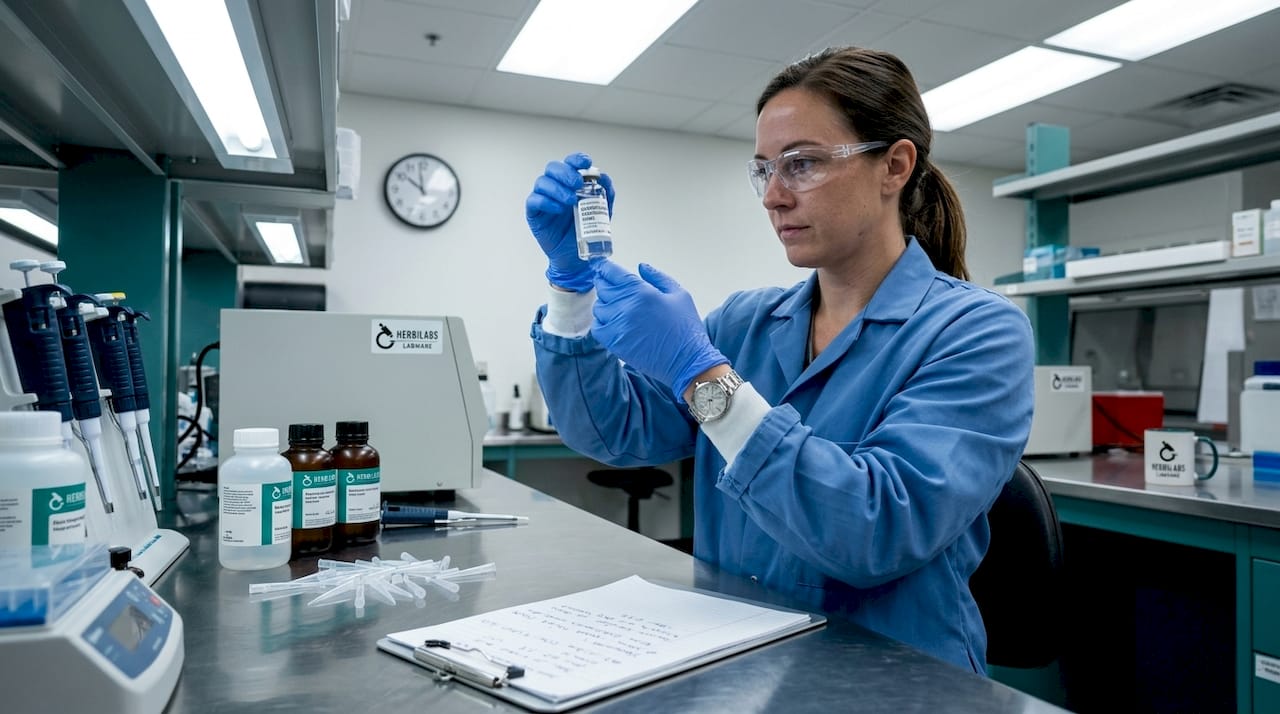
Not all bac water is equal. The difference between a research-grade product and a poorly manufactured alternative can affect peptide stability, reconstitution accuracy, and ultimately the validity of your results. Understanding what quality actually looks like in practice helps you make better procurement decisions.
Minimum quality standards for research-grade bac water:
- GMP or ISO certification: Good Manufacturing Practice (GMP) and ISO standards ensure that the manufacturing environment, processes, and testing protocols meet defined quality benchmarks. Products made outside these frameworks carry higher contamination risk.
- Benzyl alcohol at exactly 0.9%: This is the critical preservative concentration. Too low and the product loses antimicrobial effectiveness. Too high and it becomes cytotoxic. Prefer vendors with COA/HPLC documentation confirming this exact concentration.
- Sterile glass vials: Pharmaceutical-grade bac water should be packaged in borosilicate glass vials with rubber stoppers rated for multi-use puncture. Plastic containers or single-use vials designed for sterile water are not appropriate substitutes.
- Correct pH range: Research-grade bac water should maintain a pH between 4.5 and 7.0. Significant deviation affects the stability of reconstituted peptides.
| Quality factor | Premium EU-sourced bac water | Generic or cheap imports |
|---|---|---|
| Benzyl alcohol | 0.9% verified by HPLC | Often unverified or estimated |
| Sterility testing | Documented, batch-specific | Rarely provided |
| Packaging | Borosilicate glass, multi-dose | Variable, sometimes plastic |
| COA availability | Provided on request or download | Absent or generic |
| Manufacturing standard | GMP/ISO certified | Unknown or unverified |
| Regulatory compliance | EU-compliant | Non-EU, variable |
Forums consistently warn against cheap overseas bac water due to potential contamination and inconsistent benzyl alcohol levels. The risk is not hypothetical. Contaminated reconstitution solutions can degrade peptides, introduce endotoxins, or produce results that cannot be replicated. For any researcher who values data integrity, the cost of a premium EU-sourced product is trivial compared to the cost of a failed experiment.
Pro Tip: Do not confuse bac water with sterile water for injection. They look similar but serve different purposes. For a detailed breakdown, see bac vs sterile water to understand why the benzyl alcohol content in bac water is essential for multi-dose research use.
If you are new to evaluating these products, the what is bac water guide provides a solid foundation for understanding what you are actually buying and why each quality parameter matters.
Ensuring fast delivery (and no customs delays) with EU-based suppliers
With a vetted supplier and high-quality product, here is how you guarantee fast, customs-free delivery of your bac water.
Speed and reliability are not just conveniences for researchers. They are operational requirements. A delayed shipment mid-protocol can mean discarding prepared samples, repeating reconstitution steps, or postponing experiments by days or weeks. EU-based suppliers eliminate the biggest source of delay entirely: international customs.
| Shipping scenario | Typical delivery time | Customs risk | Cost predictability |
|---|---|---|---|
| EU supplier to EU researcher | 1 to 3 working days | None | High |
| UK supplier to EU researcher | 2 to 5 working days | Low to moderate | Moderate |
| US/Canada to EU researcher | 7 to 21+ days | High | Low |
| Non-EU Asia to EU researcher | 10 to 30+ days | Very high | Very low |
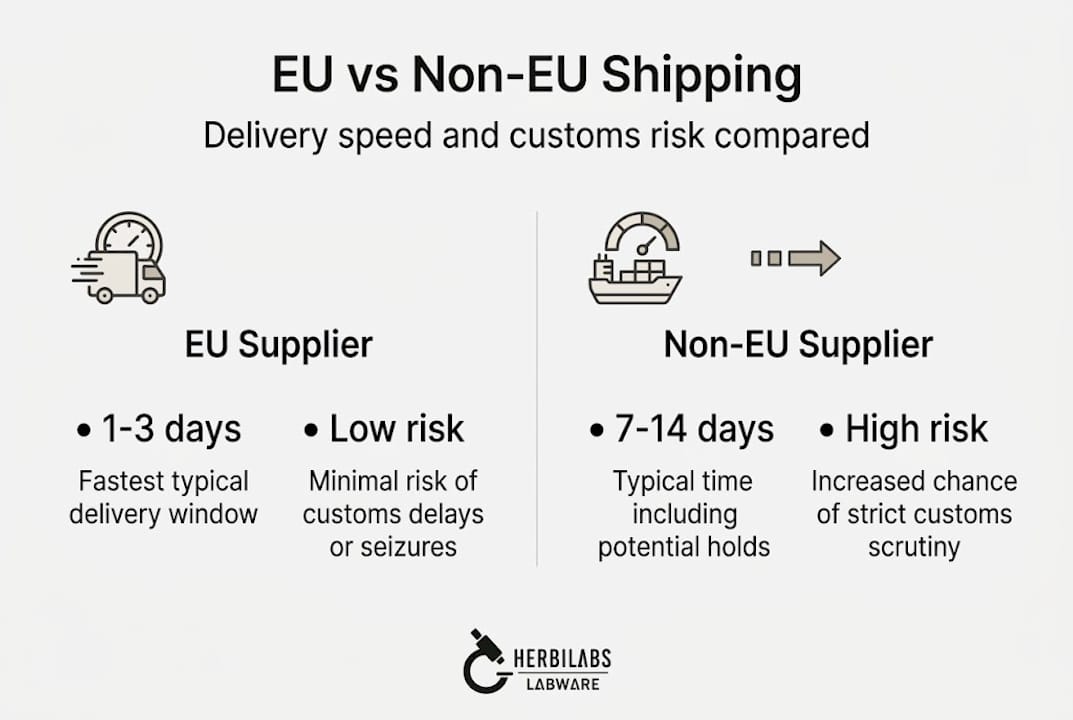
Community-recommended EU vendors consistently deliver within this 1 to 3 day window when orders are placed before midday. That kind of predictability is what makes research scheduling possible.
Here is what to check before placing your order to ensure fast, reliable delivery:
- Shipping method and carrier: Reputable EU suppliers use tracked courier services such as DHL, DPD, or UPS. Avoid vendors who ship via standard untracked post for any research-grade product.
- Order cutoff times: Most EU labs have a same-day dispatch cutoff, typically noon or 2 PM. Ordering before this window means your bac water ships the same day.
- Packaging integrity: Bac water vials should arrive in padded, temperature-appropriate packaging. Check that vials are individually secured and that the rubber stopper shows no signs of puncture or damage.
- Tracking and communication: You should receive a tracking number at the time of dispatch. If a supplier does not provide tracking, that is a significant red flag.
Even within the EU, some cross-border shipments can face minor delays at certain checkpoints. To minimize this risk, ensure your supplier includes appropriate commercial invoices and product descriptions with each shipment. While bac water shipped between EU member states does not require import documentation, clear labeling prevents any unnecessary inspection.
For answers to common logistical questions, the bac water EU FAQ covers delivery expectations, storage on arrival, and handling requirements in detail. And once your order arrives, proper storage is critical. Review storing bac water safely to ensure your product maintains its integrity from delivery through to use.
What most researchers miss about sourcing bac water in Europe
The practical steps above cover the mechanics of finding a good supplier and getting fast delivery. But there is a broader issue that rarely gets discussed directly in research communities.
Most researchers treat bac water procurement as a low-priority task. They focus their attention on the peptides, the protocols, and the data. Bac water is just a diluent, right? That attitude is exactly where procurement errors happen. The real cost of a customs seizure is not the price of the lost product. It is the compounded cost of delayed results, repeated reconstitution, and the irreproducibility that follows when you switch between batches from different sources mid-study.
Researchers who compare lab diluents carefully before committing to a supply chain understand something important: consistency in your reconstitution solution is as critical as consistency in your peptide source. Switching suppliers mid-protocol introduces variables you cannot control for. That is why the researchers who get the most reliable results tend to be the ones who locked in a single, documented EU supplier early and stuck with them.
Cutting corners to save a few euros on bac water almost always costs more in the long run. The trouble-free approach, prioritizing in-EU, documented sources with verified quality, is not the cautious option. It is the efficient one.
Where to get compliant, fast-shipped bac water for your lab
To avoid customs troubles and focus purely on research, here is where to find reliable, fast-shipping bac water in Europe.
Herbilabs supplies research-grade bac water manufactured to strict purity standards, shipped from within the EU for fast, customs-free delivery. Every batch comes with full documentation including COA and sterility data, so you know exactly what you are working with. Whether you need a single vial or bulk quantities for ongoing research, you can explore the full range and order bac water online directly. For guidance on product selection and usage, the bac water best practices guide covers everything you need, and the bac water FAQs page addresses the most common researcher questions about delivery, storage, and compatibility.
Frequently asked questions
Why do non-EU bac water shipments get seized at customs?
US sources risk seizure because injectable-grade solutions often lack the pharmaceutical import documentation EU customs requires, making them easy targets for inspection and confiscation.
How fast can I get bac water delivered within the EU?
EU vendors ship fast and can typically deliver bac water within 1 to 3 working days, with tracked next-day options available from many suppliers when orders are placed before their daily cutoff time.
What new EU import rules affect bac water in 2026?
The €150 duty-free threshold ends in July 2026, meaning all non-EU bac water orders will be subject to VAT assessment, potential duties, and increased customs scrutiny regardless of declared value.
How do I know a bac water supplier is legitimate?
Prefer vendors with COA/HPLC documentation, a verifiable EU-based address, and consistent positive reviews from research communities to confirm you are dealing with a legitimate, quality-focused supplier.