Private Label, White Label, Wholesale partnerships available - EU, USA and UK - Free shipping from €75

How to Review Lab Product Quality: A QA Guide
Learn how to review lab product quality effectively. This QA guide details essential steps to ensure compliance and reliable results.
TL;DR:
- Lab product quality review is a structured evaluation of production data and documentation to confirm product consistency. Regulatory bodies require these reviews, and they help distinguish reliable labs from those with costly errors or failed audits. Proper assessment of data, supplier qualification, and adherence to frameworks like the Six Cs or ISO standards ensures effective quality management.
Lab product quality review is defined as a structured, periodic evaluation of production data, testing outcomes, supplier compliance, and regulatory documentation to confirm that a product consistently meets its intended specifications. For quality assurance professionals and independent researchers, this process is not optional. Regulatory bodies including the FDA and EU GMP authorities mandate it. Knowing how to review lab product quality with rigor separates labs that produce reliable results from those that generate costly deviations, failed audits, and compromised research. This guide covers the frameworks, data sources, supplier vetting criteria, and step-by-step workflows that make quality reviews effective.
What are the essential components of a lab product quality review?
A formal Product Quality Review (PQR) requires a structured, periodic review of batch records, test results, deviations, stability data, and market feedback to verify continuing product quality. The FDA mandates annual record review under 21 CFR 211.180(e), while EU GMP requires rolling reviews without a fixed annual cutoff. Both frameworks demand the same core inputs, even if the timing differs.
The critical data sources for any lab product quality assessment include:
- Batch production and laboratory testing records: Every batch record must show that the product was manufactured and tested within specification. Gaps or unsigned entries are immediate red flags.
- Major deviations and out-of-specification (OOS) results: These must be documented, investigated, and resolved. Unresolved OOS results invalidate a review.
- Validation and change control documentation: Any change to a method, material, or process requires documented validation before the change is accepted.
- Stability studies: Stability data confirms that a product maintains its quality attributes over its intended shelf life. Missing stability data is a common audit finding.
- Packaging component changes: Changes to container closure systems affect product integrity and must be reviewed separately.
- Market feedback, complaints, and recalls: Post-market data closes the loop between manufacturing and real-world performance.
Collecting all six categories before starting a review prevents the most common failure mode: incomplete data sets that force a review to be repeated or flagged as non-compliant.
How to evaluate the quality and reliability of lab equipment suppliers?
Supplier qualification is a prerequisite for any credible lab product quality assessment. A supplier that cannot demonstrate consistent quality will introduce variability that no internal quality control method can fully correct.
The most reliable approach uses a professional scorecard with weighted criteria. Multi-criteria scorecards that weight quality, service reliability, certification compliance, and total cost of ownership outperform price-only evaluations. A minimum total score of 70% is the recommended threshold for considering a vendor viable. Vendors below that threshold require remediation or replacement before they are used in regulated workflows.
The evaluation process should follow this sequence:
- Request and verify certificates directly. Always verify accreditation certificates through official accreditation body portals, not vendor-supplied PDFs. Relying on vendor documents is one of the most common audit non-conformities.
- Distinguish calibration from verification. Calibration adjusts instrument output to meet a reference standard. Verification confirms that performance meets specifications without adjustment. Both require traceable documentation. Confusing the two is a frequent pitfall during audits.
- Assess method validation specificity. Generic method validation certificates do not automatically apply to your sample matrix. Verify that the lab’s validation covers your specific sample type before accepting results.
- Score total cost of ownership. Purchase price is one line item. Maintenance contracts, consumable costs, downtime history, and technical support response times determine the real cost of a supplier relationship.
- Evaluate supply chain resilience. A supplier with a single-source raw material and no contingency plan is a quality risk, regardless of their current performance.
Pro Tip: Involve at least three internal stakeholders (QA, operations, and finance) when completing a supplier scorecard. Single-reviewer scorecards miss operational blind spots that only surface during actual use.
Which quality control frameworks support effective lab product quality review?
Established frameworks give quality reviews structure and defensibility. Without a recognized framework, reviews become subjective and difficult to defend during audits.
The Six Cs of lab quality
The Six Cs framework defines the criteria that reliable laboratory testing must satisfy: consistency, correctness, coherence, clarity, conformance, and concordance. Conformance specifically involves audits and validations that confirm results match testing intentions. Labs that apply all six criteria build data integrity that holds up under external scrutiny. For biopharma researchers, applying the Six Cs to drug screening workflows adds a layer of systematic quality that ad hoc reviews cannot replicate.
ISO/IEC 17025 requirements
ISO/IEC 17025 requires planning for test results before, during, and after testing. This includes staff competence verification, calibration traceability, method validation, and control of records. A competence matrix that maps personnel authorization to specific test methods, with defined review intervals, is the practical tool that keeps accreditation current. Labs that treat ISO/IEC 17025 as a one-time certification rather than an ongoing management system lose accreditation during surveillance audits.
The 12-component laboratory quality management system
The Laboratory Quality Management System (LQMS) framework, developed through CLSI and WHO guidance, identifies 12 core components that every quality system must address.
| LQMS Component | Primary Quality Function |
|---|---|
| Organization and personnel | Defines authority, roles, and competence requirements |
| Equipment and reagents | Governs calibration, maintenance, and acceptance criteria |
| Assessments (internal and external) | Enables continual improvement through audits and proficiency testing |
| Documentation and records | Maintains traceability and supports regulatory review |
| Occurrence and complaint management | Captures deviations and drives corrective action |
| Customer satisfaction | Closes the feedback loop between lab output and end-user needs |
Standardized internal and external assessments are the mechanism that converts this framework from a document into a functioning quality system. Labs that skip external assessments lose the independent perspective that catches systemic blind spots.
Standard Operating Procedures (SOPs) anchor all 12 components. An SOP that has not been reviewed within its defined review cycle is treated as obsolete during audits, regardless of whether the underlying process has changed. Reviewing lab quality control practices against the LQMS framework annually keeps SOPs current and audit-ready.
How to conduct a step-by-step lab product quality review?
A quality review that follows a defined sequence produces consistent, defensible outputs. Reviews conducted without a fixed workflow produce inconsistent findings and miss recurring issues.
Preparation
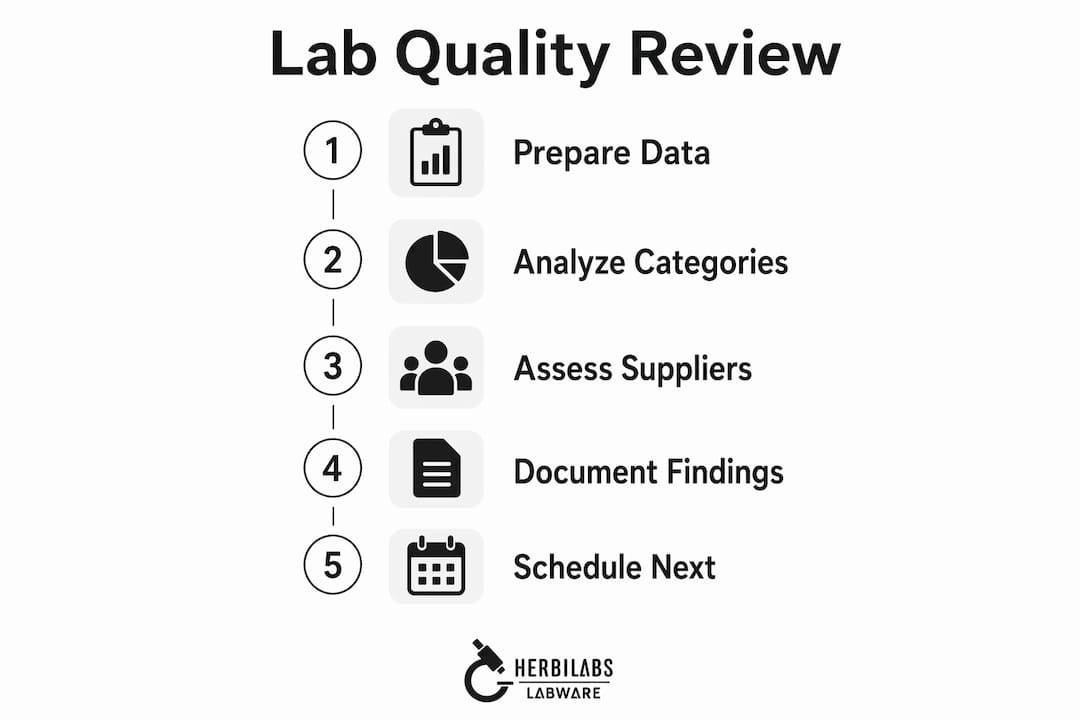
Gather all required data before the review begins. This means batch records, OOS investigations, deviation logs, stability reports, change control records, and supplier qualification files. Incomplete data sets are the leading cause of review delays. Set a data cutoff date and communicate it to all contributing departments at least two weeks in advance.

Analysis phase
Work through each data category systematically. Review batch records for completeness and specification compliance. Examine deviation trends, not just individual events. A single deviation may be acceptable. Three deviations of the same type in one review period signal a process failure. Assess test method performance using PARCCS parameters: Precision, Accuracy, Representativeness, Completeness, Comparability, and Sensitivity. These parameters determine whether analytical data is usable for its intended purpose.
| Review Area | Key Questions | Common Pitfall |
|---|---|---|
| Batch records | Are all entries complete, signed, and within spec? | Unsigned entries treated as compliant |
| Deviations | Are trends visible across the review period? | Reviewing events in isolation |
| Stability data | Does data cover the full shelf life claim? | Missing time points accepted without investigation |
| Supplier qualification | Are scores current and certificates verified? | Expired certificates not flagged |
| Change control | Are all changes validated before implementation? | Changes implemented before validation is complete |
Supplier assessment integration
Supplier qualification data must feed directly into the product quality review. A product that passed all internal tests but was manufactured using an unqualified supplier’s raw material is not compliant. Cross-reference supplier scores against the batches reviewed in the same period.
Documentation and corrective actions
Every finding requires a written disposition. Acceptable findings close with a statement of conformance. Non-conformances require a Corrective and Preventive Action (CAPA) with an owner, a due date, and a verification step. Reviews without CAPAs are incomplete.
Pro Tip: Schedule your next review date at the close of the current review. Regulatory inspectors look for evidence of planned, systematic review cycles. An ad hoc review schedule signals a reactive quality culture.
Review frequency
The FDA requires annual reviews under 21 CFR 211.180(e). EU GMP allows rolling reviews but expects the same data completeness. High-risk products or those with recurring deviations warrant more frequent interim reviews. Aligning review frequency with risk level is a best practice that regulators recognize and reward. Pairing your review schedule with a lab compliance checklist keeps the process anchored to current regulatory expectations.
Key Takeaways
Effective lab product quality review requires integrating regulatory mandates, structured frameworks, verified supplier data, and documented corrective actions into a single repeatable process.
| Point | Details |
|---|---|
| Regulatory review is mandatory | FDA 21 CFR 211.180(e) requires annual reviews; EU GMP mandates rolling reviews with equivalent data. |
| Six Cs framework guides assessment | Apply consistency, correctness, coherence, clarity, conformance, and concordance to every review cycle. |
| Supplier scorecards set the threshold | Use weighted multi-criteria scorecards and require a minimum 70% score before accepting any vendor. |
| Verify certificates independently | Always check accreditation through official body portals, not vendor-supplied documents. |
| CAPAs close every non-conformance | Every finding requires a documented corrective action with an owner, due date, and verification step. |
What I’ve learned from years of watching quality reviews fail
Most quality reviews fail at the same point: the gap between data collection and meaningful analysis. Labs gather the required documents, check the compliance boxes, and produce a report that satisfies the format of a review without delivering its purpose. The review becomes a filing exercise rather than a quality tool.
The Six Cs framework and ISO/IEC 17025 exist precisely because checklists alone do not catch systemic problems. Conformance audits and external assessments force labs to see what internal reviewers normalize over time. The lab that has processed the same deviation type six times in two years does not see it as a trend. An external auditor sees it immediately.
Supplier vetting is the area I see cut most aggressively when timelines are tight. A supplier scorecard completed by one person under deadline pressure is not a qualification. It is a document that creates the appearance of qualification. The 70% minimum threshold only means something when the scoring is honest and the inputs come from people who actually use the equipment or reagents.
Data integrity is the hardest problem. Analytical data that fails PARCCS parameters is not automatically disqualifying, but it requires a documented usability evaluation before it enters a review. Labs that skip that step and include questionable data in their PQR are building on a foundation that will not survive an FDA inspection.
The labs that get this right treat quality review as a management tool, not a compliance burden. They use review findings to drive purchasing decisions, retrain personnel, and renegotiate supplier contracts. That is the difference between a quality system that improves a lab and one that merely documents it.
— Ragnar
Herbilabs and the standard for research-grade lab products
Quality reviews depend on the quality of the products being reviewed. When the reagents and reconstitution solutions entering your workflow are manufactured to verified purity standards, your review process starts from a defensible baseline.
Herbilabs supplies bacteriostatic water, sterile diluents, and reconstitution solutions manufactured under strict quality controls for research institutions, universities, and independent researchers across the UK and Europe. Every product is designed to meet the purity demands that rigorous lab product quality assessment requires. Researchers who need reliable lab-grade reagents for peptide research and reconstitution workflows will find Herbilabs’ product range built around the same standards this guide describes. For answers to common reagent quality questions, the bacteriostatic water FAQ covers purity, storage, and application in detail.
FAQ
What is a Product Quality Review (PQR)?
A PQR is a structured, periodic evaluation of batch records, test results, deviations, stability data, and market feedback to confirm continuing product quality. The FDA requires it annually under 21 CFR 211.180(e); EU GMP requires rolling reviews.
How often should lab product quality reviews be conducted?
The FDA mandates annual reviews for pharmaceutical products, while EU GMP allows rolling reviews with equivalent data completeness. High-risk products or those with recurring deviations warrant more frequent interim reviews.
What is the minimum acceptable supplier scorecard score?
A minimum total score of 70% on a weighted multi-criteria scorecard is the recommended threshold for considering a vendor viable. Vendors below this score require remediation before use in regulated workflows.
What does ISO/IEC 17025 require for lab quality reviews?
ISO/IEC 17025 requires planning for test results before, during, and after testing, covering staff competence, calibration traceability, method validation, and record control. A competence matrix mapping personnel to test methods is the practical tool for maintaining accreditation.
Why should accreditation certificates be verified independently?
Relying on vendor-supplied PDFs is one of the most common audit non-conformities. Accreditation certificates must be verified directly through official accreditation body portals to confirm current status and avoid audit findings.