Private Label, White Label, Wholesale partnerships available - EU, USA and UK - Free shipping from €75

What Is Research-Grade Water? Standards and Lab Uses
Discover what research-grade water is and its importance in scientific experiments. Learn how purity standards impact reproducible results.
TL;DR:
- Research-grade water meets strict purity standards based on ASTM and CLSI guidelines, essential for reproducible scientific results. Matching the water grade to the specific application prevents contamination, reduces waste, and protects analytical systems from degradation. Proper maintenance and monitoring of water systems ensure sustained quality and reliable experiment outcomes.
Research-grade water is ultrapure or highly purified water that meets stringent, standardized purity requirements for reliable scientific experimentation. The two primary frameworks governing its quality are ASTM D1193-24 and CLSI GP40-A4, which define specific thresholds for resistivity, total organic carbon (TOC), bacterial counts, and trace contaminants. These parameters are not arbitrary. A single ionic contaminant or endotoxin spike can invalidate a PCR run, skew an LC-MS result, or corrupt a cell culture. Understanding what scientific grade water actually means, and which grade your protocol demands, is the first practical step toward reproducible results.
What is research-grade water, and how is it classified?
Research-grade water is not a single product. It is a category of purified water defined by measurable purity criteria, and the grade you need depends entirely on your application.
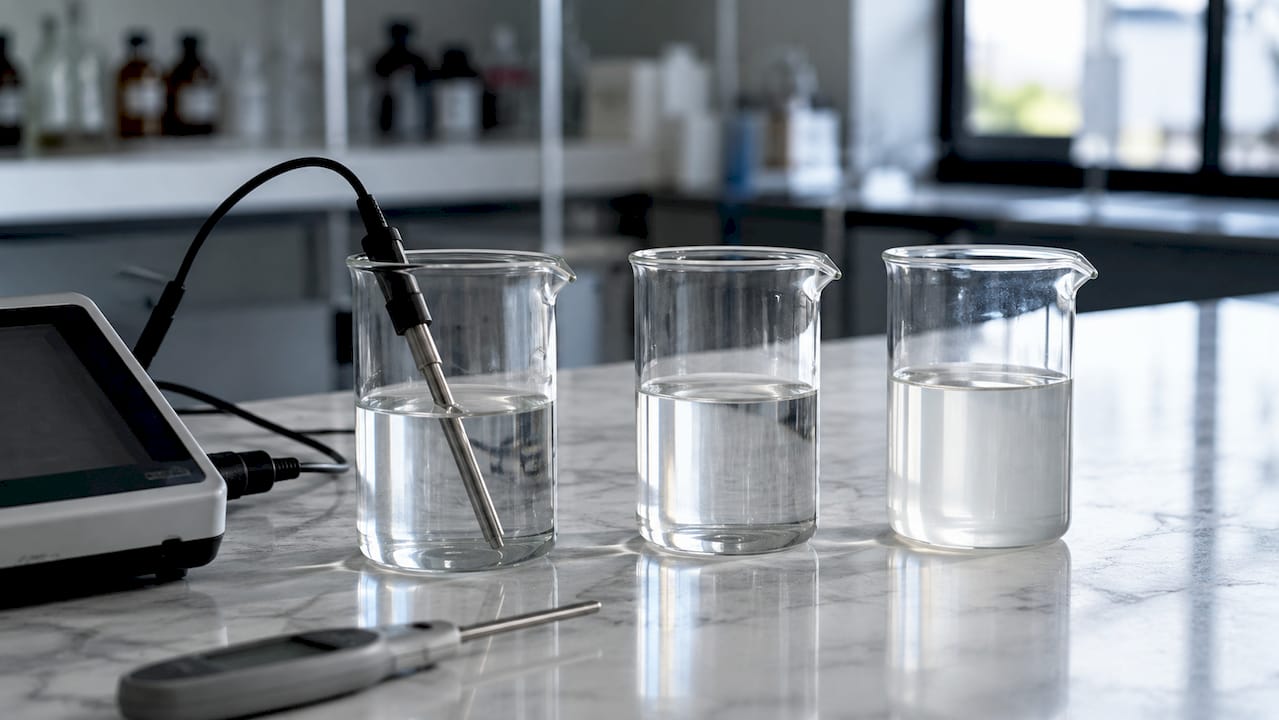
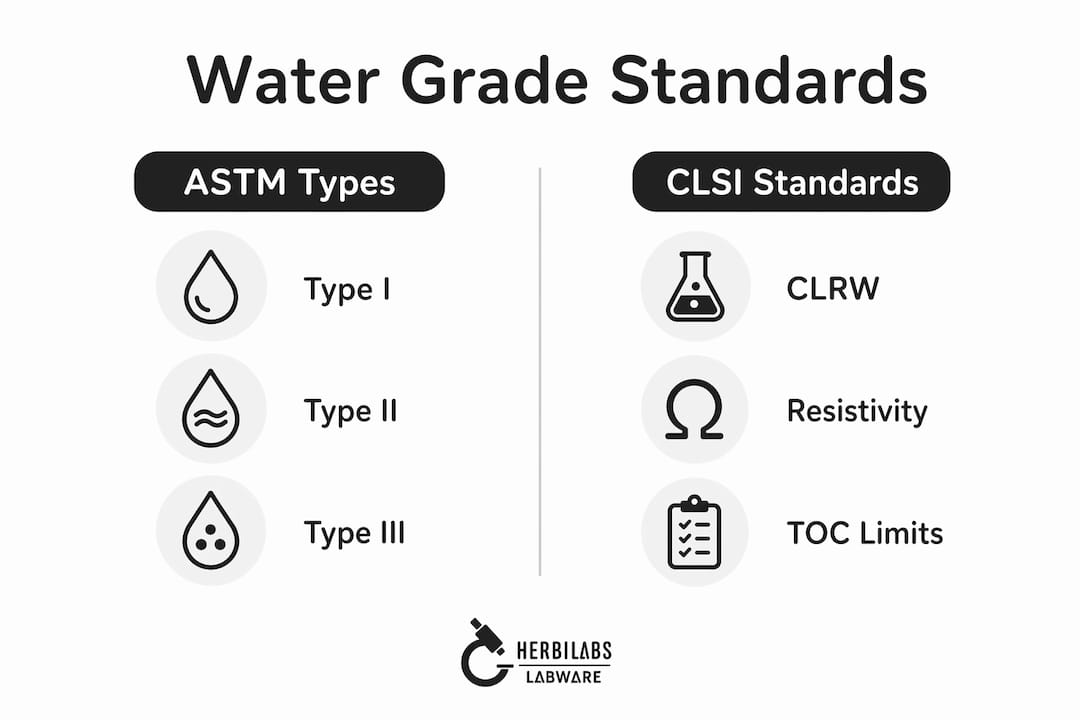
ASTM D1193-24 establishes three functional water types. Type I ultrapure water carries a resistivity of 18.2 MΩ·cm and a TOC below 5 ppb. Type II water sits above 1.0 MΩ·cm resistivity with TOC below 50 ppb. Type III ranges from 0.05–4.0 MΩ·cm resistivity and allows TOC below 200 ppb. Each tier reflects a different tolerance for ionic and organic contamination.
The CLSI GP40-A4 standard adds a clinical dimension. Clinical Laboratory Reagent Water (CLRW) requires resistivity above 10 MΩ·cm and bacterial counts below 10 CFU/mL. CLRW also caps silica at 0.05 mg/L, because silica interferes directly with photometric and ion-selective detection in clinical analyzers. Standard deionization alone does not reliably remove silica to that level.
A critical point that many researchers miss: water grade labels are functional specifications, not a linear purity ranking. Type III water is not simply “worse” than Type I. It is appropriate for different tasks. Matching the grade to the experimental requirement, rather than defaulting to the highest grade available, is the correct approach.
| Grade | Resistivity | TOC | Bacterial limit | Typical use |
|---|---|---|---|---|
| ASTM Type I | 18.2 MΩ·cm | <5 ppb | <0.03 EU/mL endotoxin | HPLC, LC-MS, PCR, cell culture |
| ASTM Type II | >1.0 MΩ·cm | <50 ppb | <100 CFU/mL | Buffer prep, media preparation |
| ASTM Type III | 0.05–4.0 MΩ·cm | <200 ppb | Not specified | Glassware rinsing, autoclave feed |
| CLSI CLRW | >10 MΩ·cm | <500 ppb | <10 CFU/mL | Clinical chemistry analyzers |
Pro Tip: Check your instrument manufacturer’s water specification before ordering. Many clinical analyzers specify CLRW explicitly, and substituting Type I water without verifying silica content can still cause interference.
How do researchers produce and maintain water purity?
Producing research-grade water requires layered purification. No single technology achieves Type I quality on its own.
A standard production sequence for Type I ultrapure water combines reverse osmosis, UV oxidation, ion exchange, and ultrafiltration. Reverse osmosis removes the bulk of dissolved solids. UV oxidation breaks down organic molecules. Ion exchange polishes ionic content to achieve the 18.2 MΩ·cm resistivity target. Ultrafiltration removes particles, colloids, and endotoxins to below 0.03 EU/mL.
The production process is only half the challenge. Purity degrades immediately after dispensing. Atmospheric CO2 dissolves into water within minutes, forming carbonic acid and dropping resistivity. Organic contaminants from container walls, airborne particles, and handling equipment add further load. This is why the “use-it-immediately” principle is not optional for Type I water. It is a physical necessity.
Maintaining purity across a lab workflow requires more than a good purification system. Follow these practices to protect water quality at the point of use:
- Dispense only what you need. Never pre-fill containers and store Type I water for later use. Resistivity drops measurably within an hour of exposure.
- Use dedicated, closed containers. Polypropylene or PTFE vessels with sealed caps prevent atmospheric contamination and leaching from plasticizers.
- Monitor TOC and resistivity continuously. Resistivity alone misses organic contaminants. A full quality monitoring routine includes both parameters at regular intervals.
- Replace UV lamps and filters on schedule. UV lamp output degrades over time. A lamp running at reduced intensity fails to oxidize organics fully, allowing TOC to creep upward without triggering a resistivity alarm.
- Flush the system before use. Purification systems that sit idle overnight accumulate microbial growth in stagnant loops. A 5-minute flush before the first draw of the day removes that load.
Pro Tip: Label every container with the time of dispensing. If water sits for more than 30 minutes before use in a sensitive assay, dispense a fresh aliquot. The cost of a second draw is negligible compared to a failed experiment.
What are the practical applications of different water grades?
Selecting the wrong water grade creates two distinct problems: under-specification contaminates sensitive assays, and over-specification wastes resources and can damage equipment.
Type I ultrapure water is the correct choice for any application where trace contaminants directly affect the result. HPLC and LC-MS mobile phase preparation, PCR master mix preparation, cell culture media, and preparation of standard solutions for trace metal analysis all require Type I. The water quality in experimentation directly determines the signal-to-noise ratio in these techniques. A TOC of 50 ppb in an LC-MS mobile phase introduces a measurable background that can mask low-abundance analytes.
Type II water covers the broad middle ground of laboratory work. Buffer preparation, microbiological growth media, and reagent preparation for general chemistry all fall within Type II specifications. The lower ionic content prevents interference in most colorimetric and spectrophotometric assays without the cost and handling demands of Type I.
Type III water suits routine tasks where trace contamination does not affect the outcome. Glassware rinsing, autoclave feed, and water bath fill are the standard applications. Using Type I water for glassware rinsing is not just wasteful. The aggressive ion-scavenging character of ultrapure water can leach ions from glass surfaces, which then contaminate the next experiment conducted in that vessel.
The practical mapping looks like this:
- HPLC, LC-MS, PCR, cell culture: Type I only
- Buffer and media preparation: Type II
- Reagent preparation for general chemistry: Type II
- Clinical chemistry analyzers: CLRW
- Glassware rinsing, autoclave feed, water baths: Type III
Matching grade to task also protects your purification system. Running Type I water through high-volume, low-sensitivity applications depletes polishing resins and UV lamp hours faster, increasing maintenance costs without any analytical benefit.
What are the most common misconceptions about research-grade water?
The most damaging misconception in lab water management is treating research-grade water as a stable reagent. Experts consistently warn that researchers store dispensed ultrapure water in open beakers or loosely capped bottles for hours, then use it in sensitive assays without re-checking quality. Water is not a shelf-stable chemical. Its purity is a snapshot, not a fixed property.
A second misconception is that resistivity is a complete quality indicator. Resistivity measures ionic content only. A water sample can read 18.2 MΩ·cm and still carry organic contamination well above the 5 ppb TOC limit if the UV oxidation stage is failing. Monitoring both TOC and resistivity is the only way to confirm true Type I quality.
The right question is not “what grade is this water?” but “does this water’s chemical profile fall within the tolerance limits of my specific method?” Researchers who match water specifications to method requirements, rather than defaulting to the highest available grade, produce more consistent data and spend less on consumables.
A third error is assuming that a higher grade is always safer. Overusing ultrapure water in routine tasks depletes expensive polishing stages, increases system maintenance frequency, and can introduce contamination through the aggressive leaching behavior of ion-depleted water on container and glassware surfaces.
The fix is a written water-use policy for the lab. Assign each application a water grade, post it near the dispensing station, and train every researcher on the rationale. This single step eliminates most grade-misuse errors and protects both data quality and budget.
Pro Tip: For labs handling purity standards in sensitive equipment, the same principle applies: match the purity specification to the sensitivity of the process, not to a general assumption that “more pure is always better.”
Key Takeaways
Research-grade water quality is defined by measurable parameters under ASTM D1193-24 and CLSI GP40-A4, and matching the correct grade to each application is the single most effective way to protect data integrity.
| Point | Details |
|---|---|
| Grade is a functional specification | ASTM Types I, II, and III describe application suitability, not a simple purity hierarchy. |
| Type I degrades immediately | Ultrapure water loses resistivity within minutes of dispensing; use it immediately and never store open aliquots. |
| Resistivity alone is insufficient | TOC monitoring is required alongside resistivity to confirm true ultrapure water quality. |
| Match grade to application | Reserve Type I for HPLC, LC-MS, and PCR; use Type III for glassware rinsing and autoclave feed. |
| CLRW has unique silica limits | CLSI GP40-A4 caps silica at 0.05 mg/L to prevent interference in clinical chemistry analyzers. |
Why lab water management is harder than it looks
I have reviewed lab protocols from university research groups, independent peptide researchers, and clinical labs across Europe. The water section is almost always the weakest part. Researchers who are meticulous about reagent storage and instrument calibration routinely dispense Type I water into an open beaker, walk away for 20 minutes, and then use it for a PCR setup without a second thought.
The problem is that water quality failure is silent. A contaminated reagent often smells wrong or looks cloudy. Degraded ultrapure water looks identical to fresh ultrapure water. The failure shows up three days later as unexplained assay variability, and by then the root cause is nearly impossible to trace.
What I find most underappreciated is the system maintenance angle. Labs invest in high-quality purification systems and then run them past UV lamp replacement intervals or skip filter integrity checks for months. The system still produces water that reads 18.2 MΩ·cm on the resistivity display, but TOC is quietly climbing. The lab water quality checklist approach, where you verify multiple parameters on a scheduled basis, is the only reliable safeguard.
My recommendation: treat your water purification system like a piece of analytical instrumentation, not like a tap. Log maintenance, verify performance with external standards periodically, and build water quality checks into your standard operating procedures. The researchers who do this consistently produce cleaner data with fewer repeat experiments.
— Ragnar
Research-grade water products from Herbilabs
Purity at the point of use matters as much as the grade specification on paper. Herbilabs supplies bacteriostatic water and sterile reconstitution solutions manufactured to strict purity standards in a dedicated facility, with rigorous quality control at every production stage.
Whether you need a reliable diluent for peptide reconstitution or a sterile solution for sensitive research applications, Herbilabs products are produced for researchers who cannot afford contamination failures. The Herbilabs shop carries a full range of research-grade water products with secure ordering and wholesale pricing for institutions and resellers. For answers to common questions about water specifications and safe handling, the bacteriostatic water FAQ is a practical starting point.
FAQ
What is research-grade water, exactly?
Research-grade water is purified water that meets defined purity standards, primarily ASTM D1193-24 or CLSI GP40-A4, for resistivity, TOC, bacterial counts, and trace contaminants. The specific grade required depends on the sensitivity of the application.
How does research-grade water differ from distilled water?
Distilled water removes many contaminants through evaporation and condensation but does not meet the resistivity or TOC thresholds required for Type I or Type II research-grade water. Distillation alone cannot achieve the 18.2 MΩ·cm resistivity of Type I water.
Why does Type I water degrade so quickly?
Type I ultrapure water absorbs atmospheric CO2 within minutes of exposure, forming carbonic acid and reducing resistivity. Organic contaminants from container surfaces and airborne particles also accumulate rapidly, raising TOC above the 5 ppb limit.
Can I use the same water grade for all lab tasks?
No. Using Type I water for glassware rinsing wastes resources and can leach ions from glass surfaces. Type III water is the correct choice for rinsing and autoclave feed, while Type I is reserved for HPLC, LC-MS, PCR, and cell culture.
Is resistivity enough to verify water quality?
Resistivity measures ionic contamination only. A water sample can read 18.2 MΩ·cm and still carry organic contaminants above the Type I TOC limit of 5 ppb. Accurate quality verification requires monitoring both resistivity and TOC together.