Private Label, White Label, Wholesale partnerships available - EU, USA and UK - Free shipping from €75

The Role of Preservatives in Lab Solutions Explained
Discover the crucial role of preservatives in lab solutions. Learn how they ensure stability and reliability in your research outcomes.
TL;DR:
- Preservatives in lab solutions do more than prevent microbial growth; they also inhibit oxidation, pH shifts, and chemical degradation.
- Selecting the appropriate preservative depends on factors like solution pH, chemical compatibility, and validated challenge testing to ensure stability.
Most researchers treat preservatives as background noise in formulation design. They’re listed on a spec sheet, noted in a protocol, and then largely forgotten. That framing is a costly mistake. The role of preservatives in lab solutions extends well beyond preventing microbial growth. Preservatives maintain chemical and microbial stability simultaneously, protecting your solutions from oxidation, pH drift, and emulsifier breakdown as much as from bacterial contamination. Understanding what they actually do, and how to select them correctly, is the difference between reliable data and compromised results.
Table of Contents
- Key takeaways
- The role of preservatives in lab solutions
- Types of preservatives used in labs and how they work
- Factors guiding preservative selection and validation
- Practical guidance for maximizing preservative effectiveness
- My take on where researchers get preservatives wrong
- How Herbilabs supports your preservation needs
- FAQ
Key takeaways
| Point | Details |
|---|---|
| Preservatives do more than kill microbes | They also prevent oxidation, pH shifts, and chemical degradation that silently corrupt lab solutions. |
| Preservative choice depends on pH | Weak acid preservatives like benzoates only work in acidic conditions, so solution pH dictates your options. |
| Hurdle technology improves efficacy | Combining multiple preservatives at lower concentrations broadens coverage while reducing individual toxicity. |
| Validation requires challenge testing | Antimicrobial Effectiveness Testing over 28 days is the accepted standard for confirming preservative performance. |
| Storage conditions affect preservative function | Temperature, water activity, and contamination during handling all impact how well preservatives perform over time. |
The role of preservatives in lab solutions
If you’ve ever opened a reconstituted peptide solution to find visible turbidity or an unexpected pH reading, you’ve witnessed preservative failure firsthand. Preservatives prevent contamination and degradation across four distinct failure modes: microbial proliferation, chemical oxidation, pH destabilization, and emulsifier breakdown. Each of these can independently invalidate your results, but they rarely attack alone.
The antimicrobial function gets the most attention, and for good reason. Aqueous solutions provide the exact conditions bacteria, yeast, and mold need to proliferate. Without a preservative system, a single contamination event from a non-sterile pipette tip or a brief exposure to ambient air can result in a solution that looks fine but carries a significant microbial load.
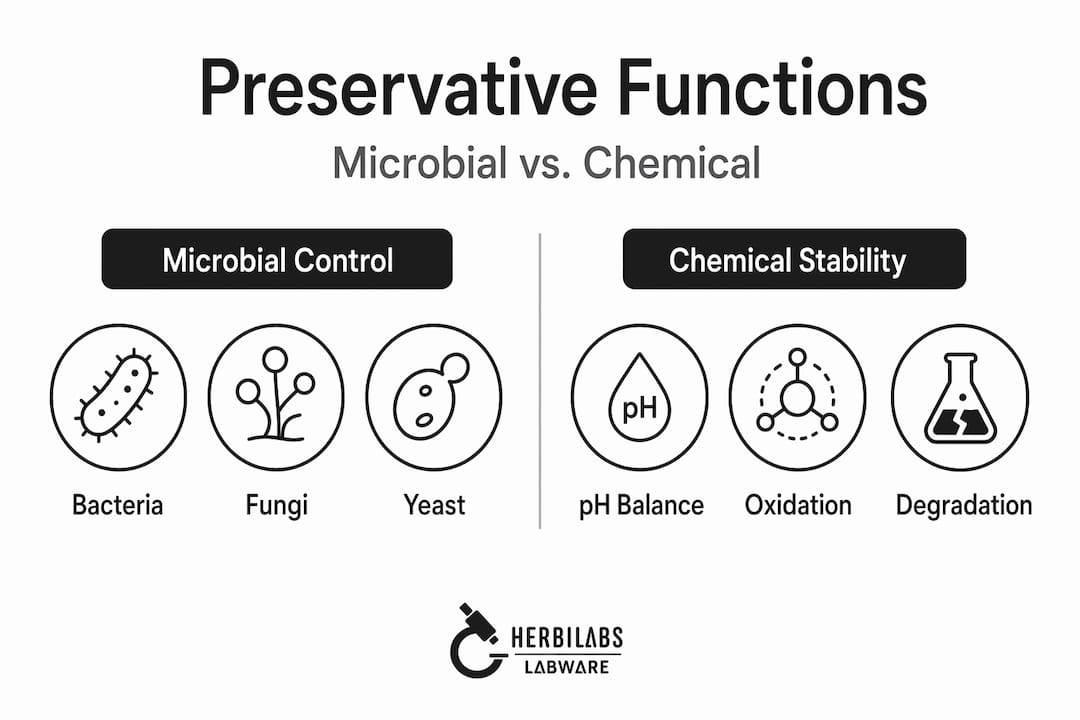
What researchers underestimate is the chemical protection side. Many active research compounds are vulnerable to oxidation. Preservatives that include antioxidant mechanisms, or are used alongside antioxidants, intercept free radical reactions before they degrade your compound. The importance of preservatives in labs is therefore both microbiological and chemical, and collapsing that to “prevents bacteria” misses half the picture.
Pro Tip: When formulating aqueous solutions for multi-dose use, account for all four stability failure modes before selecting a preservative. A preservative that controls microbial growth but allows oxidation still results in a degraded product.
- Antimicrobial protection covers bacteria, yeast, and fungi
- Antioxidant activity intercepts free radical reactions that degrade active compounds
- pH buffering stability prevents drift that can alter compound behavior
- Emulsifier integrity is maintained, preventing phase separation in complex formulations
Types of preservatives used in labs and how they work
The function of preservatives in solutions depends entirely on their biochemical mechanism. Selecting the wrong class for your formulation is not just ineffective. It can actively interfere with your assay or introduce unwanted chemical interactions. Here is a breakdown of the major types of preservatives used in labs, their mechanisms, and their appropriate use contexts.
| Preservative | Mechanism | Best pH range | Common lab use |
|---|---|---|---|
| Parabens (methyl, propyl) | Membrane disruption, enzyme inhibition | 4.0 to 8.0 | Multi-dose aqueous solutions |
| Benzalkonium chloride | Cell membrane lysis | 4.0 to 10.0 | Ophthalmic, injectable diluents |
| Phenol | Protein denaturation | 5.0 to 8.0 | Protein-based biologics, vaccines |
| Sodium benzoate | Metabolic interference | 2.5 to 4.5 | Acidic buffers, sample matrices |
| Sorbic acid | Enzyme inhibition | 3.0 to 6.0 | Culture media, reagent solutions |
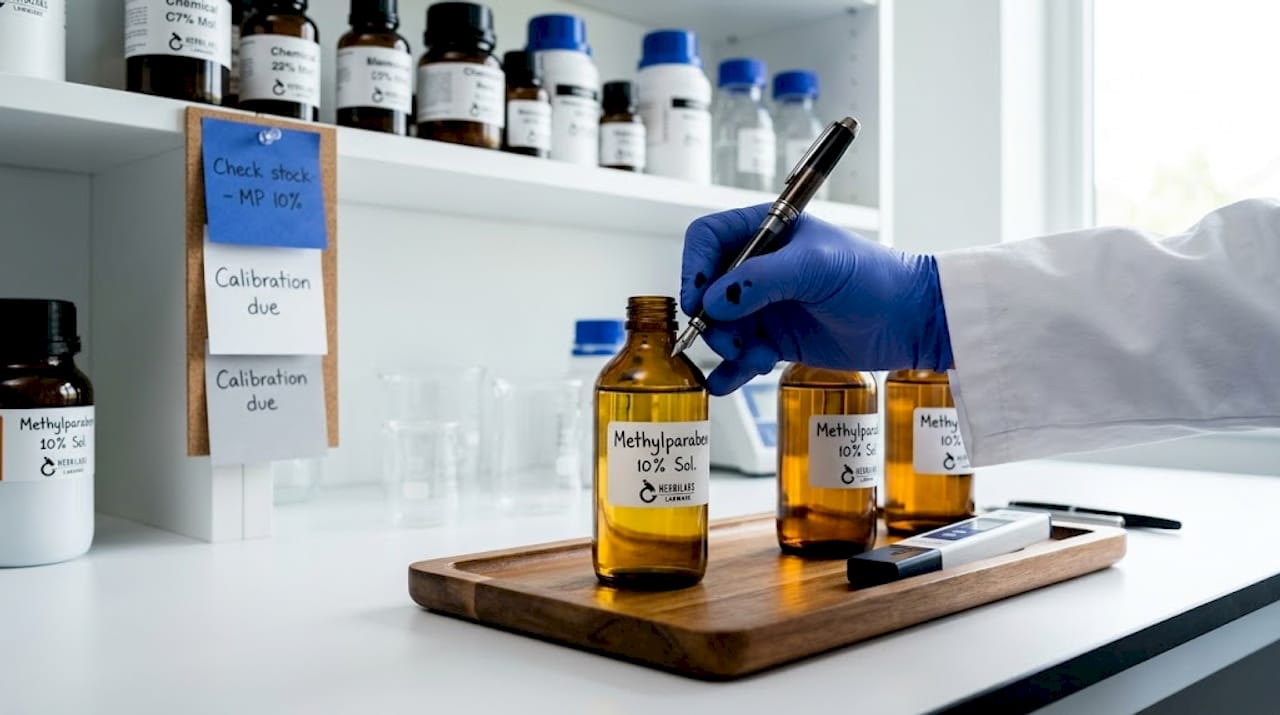
Parabens remain among the most extensively studied preservative options in pharmaceutical and lab contexts. Methylparaben and propylparaben combined at a 10:1 ratio and concentrations of 0.1% to 0.3% deliver broad-spectrum antimicrobial coverage with well-characterized safety profiles. Their activity spans gram-positive and gram-negative bacteria as well as fungi, which is why they appear so frequently in multi-dose injectable formulations.
Benzalkonium chloride (BAC) operates differently. It’s a quaternary ammonium compound that physically destroys microbial cell membranes on contact. BAC is the preservative used in bacteriostatic water, and its wide pH tolerance makes it particularly useful in lab diluents where you cannot always control formulation pH precisely.
The role of chemicals in preservation also includes how those chemicals are combined. Hurdle technology deliberately combines multiple preservatives at sub-inhibitory concentrations so that each agent targets a different microbial vulnerability. The cumulative stress on the microorganism exceeds what any single compound could achieve alone, and the individual doses stay low enough to reduce toxicity concerns.
One detail that trips up researchers: preservative efficacy is highly pH-dependent. Sodium benzoate is essentially inactive at neutral pH but highly effective in acidic environments. If your buffer sits at pH 7.0, benzoate-based preservation is not protecting you. Knowing the pH of your working solution is a prerequisite for any preservative selection decision.
Pro Tip: Never assume a preservative that worked in one formulation will perform equivalently in another. Even minor pH, ionic strength, or solute differences can significantly alter efficacy. Verify through challenge testing for each distinct formulation.
Factors guiding preservative selection and validation
Understanding how preservatives impact lab solutions in practice requires working through several selection criteria systematically. Getting this right before scale-up saves you from discovering compatibility issues halfway through a study.
-
Assess solution pH first. Confirm the exact working pH of your formulation and cross-reference it with the active pH range for your candidate preservatives. A mismatch here renders the preservative functionally useless.
-
Evaluate chemical compatibility. Some preservatives interact with formulation components. Parabens can complex with certain proteins or cyclodextrins, reducing both the preservative concentration available in solution and the activity of the target molecule.
-
Check regulatory concentration limits. Compendial sources such as the USP and European Pharmacopoeia specify maximum allowable concentrations for each preservative class. Research-grade applications may have more flexibility, but knowing these limits informs safe concentration choices.
-
Consider water activity. Preservatives function in the aqueous phase of a solution. High solute concentrations can partition preservatives into non-aqueous phases or alter their effective concentration in the water fraction, reducing efficacy even when the nominal concentration looks correct.
-
Run Antimicrobial Effectiveness Testing before finalizing your formulation. AET involves 28-day monitoring against defined microbial challenges including Staphylococcus aureus, Pseudomonas aeruginosa, Candida albicans, and Aspergillus brasiliensis. A preservative that passes AET has proven, not assumed, efficacy.
-
Run challenge testing for each formulation variant. Challenge testing inoculates the product with target microbes and monitors microbial survival over 28 days. Minor reformulations that change solute concentration, pH, or co-solvents require a fresh test because preservative behavior changes with formulation context.
-
Factor in storage temperature and shelf life requirements. Some preservatives are temperature-sensitive and lose potency faster under refrigeration than at ambient temperatures. Know your expected storage conditions before committing to a preservative system.
The importance of preservatives in labs goes hand in hand with rigorous validation. Correct preservative selection requires matching the biochemical mechanism to the actual microbial threats and environmental conditions present in your specific formulation, not adopting a generic solution because it worked for a different application.
Practical guidance for maximizing preservative effectiveness
Applying what you know about how preservatives impact lab solutions comes down to consistent discipline during preparation, storage, and use. Even the best-validated preservative system fails when handling practices introduce variables it was never tested against.
- Prepare solutions under aseptic conditions. Preservatives inhibit microbial growth. They are not a substitute for clean preparation technique. Sterile handling practices reduce the initial bioburden so preservatives can maintain control rather than fight a losing battle against heavy contamination.
- Store reconstituted solutions at the validated temperature. For peptide research solutions, storage at 2 to 8°C generally supports a shelf life of up to 30 days, with some sensitive compounds requiring use within 14 days. Deviating from storage temperature can accelerate both microbial challenge and chemical degradation simultaneously.
- Minimize headspace oxygen exposure. Oxygen in the vial headspace accelerates oxidative degradation, especially in protein-based or peptide solutions. Consider nitrogen or argon backfilling during closure to extend stability.
- Watch for visual signs of preservative failure. Turbidity, unexpected color shifts, particulate formation, or off-odors all signal that something has gone wrong. These are not cosmetic issues. They indicate real changes in solution chemistry or microbial contamination that will affect your results.
- Track open-vial use times. Even a well-preserved solution has a finite window once opened. Log the date and time of first access and discard according to validated use-by periods. Preservatives become progressively depleted with each puncture and exposure event.
- Use quality-controlled reagents from the start. Starting with reagents that have been manufactured to compendial purity standards and tested preservative concentrations eliminates one of the most common sources of unexplained variability in preserved solution performance.
For reconstituted peptide solutions, bacteriostatic water containing 0.9% benzyl alcohol is the standard diluent precisely because it balances antimicrobial protection with peptide compatibility. Understanding why that specific diluent is chosen, rather than sterile water, is the kind of practical preservative knowledge that improves protocol quality across your entire research workflow.
My take on where researchers get preservatives wrong
I’ve reviewed more failed protocols than I can count, and the pattern is almost always the same. Researchers treat preservatives as something the formulation chemist handled upstream, not something they need to understand actively. That works until it doesn’t, and when it fails, the failure is usually traced back to a decision nobody knew they were making.
In my experience, the most common mistake is using a preserved solution beyond its validated window because “it still looks fine.” Visual clarity is not a reliable indicator of microbial or chemical integrity. A solution can carry a significant gram-negative contamination load and still appear crystal clear. You cannot see Pseudomonas with the naked eye.
What I’ve found genuinely useful is thinking about preservation as a system with a budget. Every handling event, temperature excursion, and air exposure spends from that budget. The preservative is not infinitely renewable. Once you internalize that framing, the discipline around storage and use timing follows naturally without having to micromanage every researcher on your team.
The emerging interest in hurdle-based preservative systems is genuinely exciting from a practical standpoint. Lower individual concentrations mean reduced risk of compound interference in sensitive assays, which has historically been one of the strongest arguments against preserved solutions in certain biological applications. Getting the chemistry right from the start matters more than any downstream troubleshooting.
— Ragnar
How Herbilabs supports your preservation needs
When the function of preservatives in solutions determines the reliability of your entire research workflow, the quality of your starting materials is not a place to cut corners. Herbilabs manufactures bacteriostatic water and sterile diluents to strict purity standards, with verified benzyl alcohol concentrations designed to deliver consistent antimicrobial protection across multi-dose use.
Whether you’re working through bacteriostatic water FAQs or selecting between preserved and preservative-free diluents for a specific peptide protocol, Herbilabs provides the product information and research-grade supply chain to support informed decisions. For those comparing options, a detailed look at bacteriostatic vs sterile water explains exactly where preservation changes outcome. Explore the full range of reconstitution solutions at Herbilabs to find the right preserved diluent for your application.
FAQ
What is the primary role of preservatives in lab solutions?
Preservatives serve a dual function in lab solutions: they prevent microbial growth from bacteria, yeast, and fungi, and they protect against chemical degradation including oxidation and pH drift. Both functions directly affect solution stability and the reliability of research results.
Which preservative is most commonly used in bacteriostatic water?
Benzalkonium chloride and benzyl alcohol are the most widely used preservatives in bacteriostatic water for lab applications. Benzyl alcohol at 0.9% concentration is standard in research diluents used for peptide reconstitution because of its broad antimicrobial activity and compatibility with aqueous solutions.
How do you validate preservative efficacy in a lab solution?
Antimicrobial Effectiveness Testing (AET) is the accepted validation method, involving 28-day microbial monitoring against specified challenge organisms. Challenge testing uses controlled inoculation to confirm that the preservative inhibits microbial growth to compendial specification.
Why does pH affect preservative performance so significantly?
Many preservatives are weak acids whose activity depends on existing in their uncharged protonated form, which only occurs at low pH. Sodium benzoate, for example, is highly effective in acidic conditions but loses its antimicrobial activity at neutral pH, making pH assessment a mandatory first step in preservative selection.
How long can a preserved reconstituted peptide solution remain stable?
Stability depends on the preservative system, storage temperature, and compound sensitivity. Most preserved peptide solutions stored at 2 to 8°C remain stable for up to 30 days, though sensitive compounds may require use within 14 days. Always follow the validated protocol for your specific formulation.