Private Label, White Label, Wholesale partnerships available - EU, USA and UK - Free shipping from €75

How to Store Reconstitution Solutions Safely: A Lab Guide
Learn how to store reconstitution solutions safely with our step-by-step lab guide. Protect your peptide integrity and avoid costly errors!
TL;DR:
- Peptide solution storage depends on proper labeling, stable cold environments, and avoiding freeze-thaw cycles. Consistent protocols, including aliquoting and verifying manufacturer guidance, are crucial for experiment integrity. Clear labeling, regulated discard windows, and careful handling prevent data ambiguity and reagent waste.
Peptide research lives or dies on the integrity of your solutions. One poorly stored vial, one unlabeled tube, one missed discard window, and weeks of careful experimental work can collapse into ambiguous data and wasted reagent. Improper storage is consistently one of the leading causes of failed peptide experiments across European research settings, not because researchers are careless, but because storage guidance is scattered, inconsistent, and often written for pharmaceutical manufacturing rather than independent lab use. This guide closes that gap with practical, step-by-step protocols built specifically for researchers and serious peptide users.
Table of Contents
- What you need: Tools, storage environments, and best practices
- Step-by-step: How to store reconstitution solutions
- Discard windows, labeling, and manufacturer guidance
- Critical mistakes and troubleshooting in peptide solution storage
- The overlooked keys to safe and effective reconstitution solution storage
- Need reliable reconstitution solutions or labware?
- Frequently asked questions
Key Takeaways
| Point | Details |
|---|---|
| Refrigerate for short-term use | Most reconstitution solutions should be stored at 2–8°C unless otherwise specified. |
| Label every vial | Always include compound, concentration, solvent, and critical dates for safe storage tracking. |
| Follow discard windows strictly | Respect recommended discard periods such as the 28-day rule for bacteriostatic water. |
| Avoid repeated freeze–thaw cycles | Whenever possible, aliquot solutions and only freeze if product guidance confirms it’s safe. |
| Manufacturer instructions override | When product-specific storage instructions differ, always defer to the latest manufacturer or literature protocol. |
What you need: Tools, storage environments, and best practices
Before you touch a vial, your workspace and toolkit need to be ready. Rushing through preparation is where most storage errors begin. Getting organized upfront costs five minutes and saves you from irreproducible results later.
Essential tools and materials
At minimum, you should have these on hand before reconstituting any peptide solution:
- Sterile vials (borosilicate glass preferred for long-term stability)
- Low-bind syringes and needles (21–25 gauge for most reconstitution tasks)
- Alcohol swabs (70% isopropyl or ethanol)
- Waterproof permanent markers or printed labels
- A calibrated refrigerator holding a steady 2–8°C
- A freezer set to at least minus 20°C if you plan to aliquot for long-term storage
- Sterile parafilm or vial caps to seal vials after every access
- A light-blocking storage box or amber vials for light-sensitive compounds
Cutting corners on any of these materials compounds risk. A regular household fridge may fluctuate between 4°C and 10°C depending on where you place the vial. Door shelves are especially problematic. Place your solutions in the back of a middle shelf where temperature is most stable.
Why refrigeration at 2–8°C is the standard
Refrigeration slows molecular degradation without the structural risks of freezing. Peptide storage protocols confirm that reconstituted solutions are generally stored refrigerated at 2–8°C for short-term use, with longer-term storage achieved by aliquoting and freezing. The distinction matters. The refrigerator is your working environment for active solutions. The freezer is for prepared aliquots you won’t access for days or weeks.
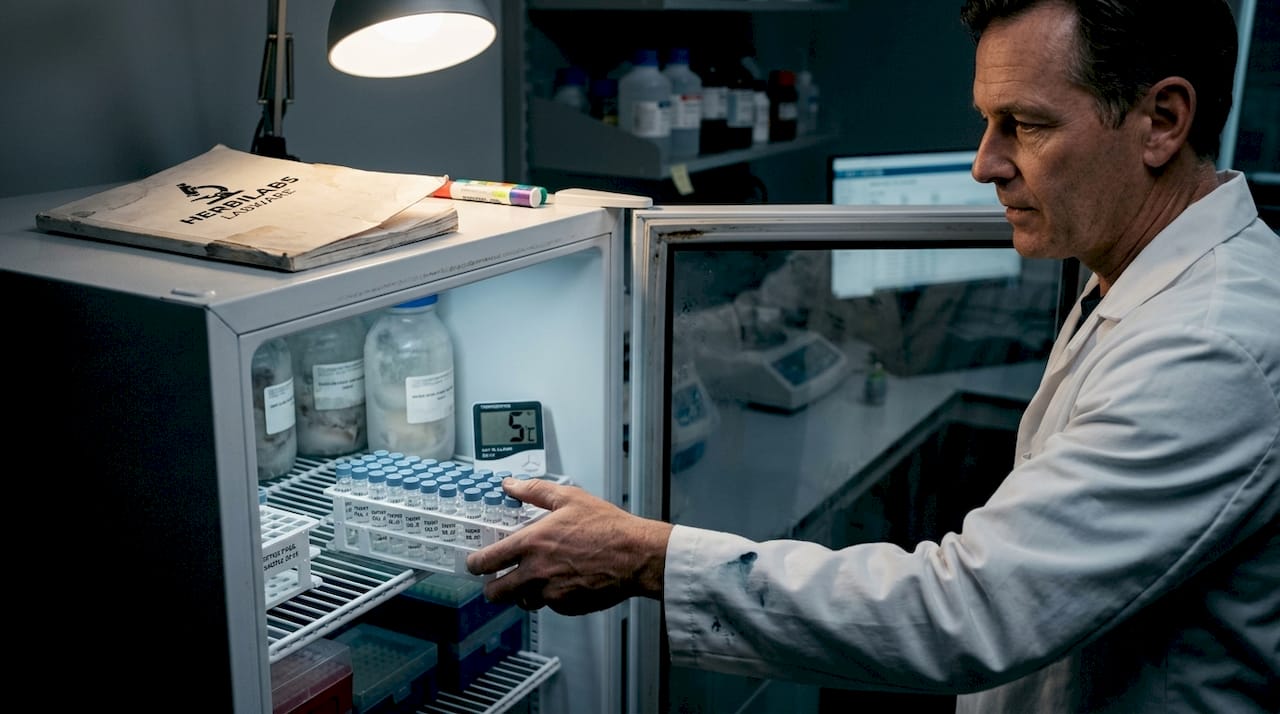
Thermal variation accelerates the breakdown of peptide bonds, particularly in aqueous solutions. Even brief excursions above 8°C, such as leaving a vial on the bench for 20 minutes while you prepare the rest of your protocol, add up over repeated days of use.
Aliquoting: When and why it matters
If you’ve reconstituted more solution than you’ll use in a few days, aliquot immediately. Divide your batch into single-use volumes using sterile technique, then freeze those individual vials. This approach prevents the two biggest enemies of solution quality: repeated freeze-thaw cycles and repeated needle access.
For guidance on preparing research solutions safely, work in clean environments, pre-label all empty vials before filling, and never touch the rubber stopper or needle tip with bare hands.
Pro Tip: Label every vial before you fill it. Trying to write on a cold, condensation-covered vial after filling leads to smeared labels, which is how compound identity gets lost.
Quick reference: Storage environment comparison
| Storage method | Temperature | Best for | Typical duration |
|---|---|---|---|
| Refrigerated | 2–8°C | Short-term working solutions | Up to 28 days |
| Frozen aliquots | Minus 20°C | Long-term reserve stock | Weeks to months |
| Frozen (minus 80°C) | Minus 80°C | Highly sensitive peptides | Months to years |
| Room temperature | 18–25°C | Lyophilized (dry) peptides only | Until reconstituted |
For a full breakdown of safe storage for peptides including reagents and vial types, the Herbilabs storage guide covers temperature management across a range of research scenarios.
Step-by-step: How to store reconstitution solutions
With your equipment and environment set, here’s how to actually handle reconstitution solutions from start to finish.
Step 1: Prepare your workspace. Wipe down your work surface with 70% isopropyl alcohol and allow it to dry. Gather all materials before opening anything. Contamination most often enters at the setup stage, not during the actual transfer.
Step 2: Label all vials before filling. Record at minimum: compound name, concentration, solvent used, date of reconstitution, and the first-use date if different from reconstitution.
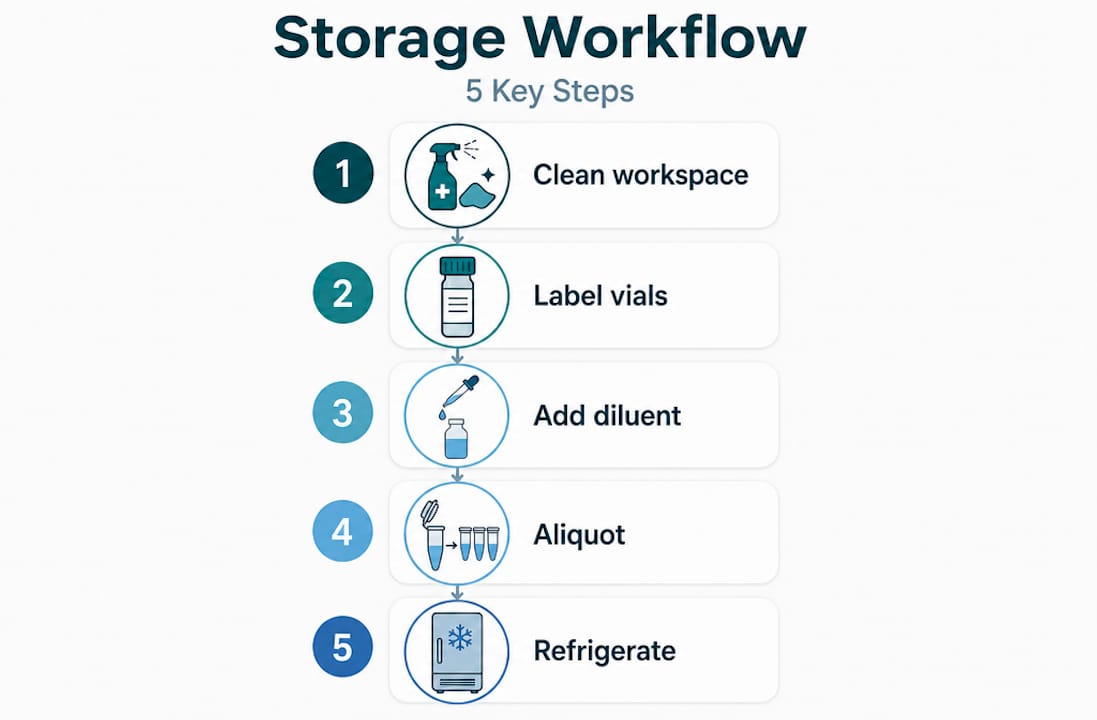
Step 3: Reconstitute using sterile diluent. Add your bacteriostatic water or sterile diluent slowly and gently to avoid foaming or mechanical shearing of the peptide. Swirl gently rather than vortexing.
Step 4: Aliquot for longer storage. If your batch is larger than a single session’s use, immediately draw up single-use volumes into pre-labeled sterile vials. Seal each with parafilm or a sterile cap.
Step 5: Seal and refrigerate at 2–8°C. The working vial goes directly into your calibrated refrigerator. Frozen aliquots go into the freezer. Do not leave either at room temperature while you deal with other tasks.
Step 6: Protect light-sensitive compounds. Some peptides degrade under ambient or UV light exposure, sometimes within hours. Amber vials or aluminum foil wrapping are standard solutions. As noted in peptide reconstitution guidance, labeling vials with compound identity, concentration, solvent, and reconstitution and first-use dates enforces correct discard windows and prevents mix-ups.
Step 7: Follow aseptic technique for every subsequent draw. Clean the stopper with a fresh alcohol swab each time. Use a new needle for every access. Minimize the number of punctures per vial.
“Use aseptic technique and sterile containers for each draw, and minimize repeated needle access to reduce contamination and preserve integrity.” Aseptic peptide handling
Following this workflow as a checklist rather than a memory exercise reduces error rates significantly. Print it out and keep it near your workspace if that helps consistency across sessions.
For hands-on guidance with lab sterilization tips, Herbilabs covers how to maintain clean conditions throughout the reconstitution process.
Pro Tip: Set a recurring calendar reminder on reconstitution day to automatically flag the discard date. Relying on memory alone is the single most common reason solutions get used past their safe window.
Discard windows, labeling, and manufacturer guidance
After you’ve stored the solutions, you need to know when they expire and how to record that information for reliable lab practices.
The 28-day rule explained
For most bacteriostatic water-based reconstitution workflows, the 28-day discard window applies from the date of first puncture. Bacteriostatic water contains 0.9% benzyl alcohol, which inhibits bacterial growth and extends the functional window of the solution. However, it is not a permanent preservative. After 28 days, the risk of microbial contamination and degradation of the dissolved peptide both increase to a point where the solution should not be trusted for research use.
This 28-day rule applies to the diluent vial itself, not just the reconstituted solution. Even if your reconstituted peptide vial is within date, if the bacteriostatic water used to prepare it was first opened more than 28 days ago, that batch is compromised.
For more detail on 28-day discard best practices, tracking first-use dates across multiple diluent vials is an easy system to build when labels are consistent.
When the 28-day rule doesn’t apply
Not every compound follows the same timeline. Some peptides have shorter stability windows in solution regardless of the diluent used. Others may have literature-supported stability beyond 28 days under specific freezing conditions. Manufacturer discard guidance makes clear that parenteral drugs specify exact stability windows based on temperature and administration timing, and these cannot be generalized across compounds.
Always check the following sources before committing to any discard window:
- Manufacturer data sheet for the specific compound
- Peer-reviewed stability studies for the peptide class
- Diluent manufacturer guidelines for the reconstitution solution itself
The key concept is that you’re working with two separate stability windows simultaneously: one for the diluent and one for the peptide. The shorter window always wins.
Labeling best practices
A properly labeled vial should tell you everything you need without opening any notes app or memory recall. Use this format as a standard:
- Compound name and purity source
- Concentration (e.g., 1 mg/mL)
- Solvent used (e.g., bacteriostatic water)
- Date of reconstitution
- First-use date
- Calculated discard date (reconstitution date + 28 days, or product-specific window)
For guidance on using bacteriostatic water in structured lab protocols, clear labeling is consistently highlighted as a foundational step rather than an optional courtesy.
Discard window comparison table
| Scenario | Recommended discard window | Key variable |
|---|---|---|
| Bacteriostatic water diluent | 28 days from first puncture | First-use date |
| Reconstituted working solution (refrigerated) | 28 days or product-specific | Product data sheet |
| Frozen aliquot (minus 20°C) | Weeks to months | Compound stability |
| Reconstituted injectable drug | Per manufacturer specification | Temperature and timing |
Critical mistakes and troubleshooting in peptide solution storage
Knowing the protocols isn’t enough. Learning from common mistakes keeps your solutions reliable and reproducible.
Mistake 1: Repeated freeze-thaw cycles
This is the single most damaging storage behavior. Every freeze-thaw cycle creates mechanical stress on peptide bonds, promotes aggregation, and risks structural degradation. If you freeze a reconstituted solution, use the full aliquot in a single session. Never refreeze a thawed vial. As noted in UK laboratory practice, researchers should avoid freezing reconstituted solutions unless the manufacturer or literature explicitly supports it, since freezing can cause physical and chemical changes in the solution.
Mistake 2: Repeated needle access
Each time you puncture a vial stopper, you introduce a small but real contamination risk. Over five, ten, fifteen punctures, particulate matter from the stopper accumulates in the solution and the seal integrity degrades. The practical solution is to reuse bacteriostatic water vials only within a defined number of accesses, and always with a fresh, sterile needle each time.
Mistake 3: Ignoring compound-specific stability data
General guidance is exactly that: general. Some peptides are highly sensitive to oxidation, pH shifts, or specific temperature ranges. Peptide stability nuances vary substantially between compound classes, and defaulting to a blanket 28-day rule without checking your specific product’s data sheet is a protocol error.
Mistake 4: Labeling lapses
Missing labels, or labels with incomplete information, create a research integrity problem that no amount of careful storage recovers. If you can’t confirm what’s in a vial, you cannot use it responsibly.
Recognizing signs of instability
Know when to discard without hesitation. These are reliable visual warning signs:
- Cloudiness or turbidity in what should be a clear solution
- Visible particulate matter floating or settled at the bottom
- Color change from the expected baseline
- Unusual odor when opening the vial
“Peptides reconstituted in bacteriostatic water that show visible particulate matter or cloudiness should not be used, as these are indicators of contamination or degradation.”
Understanding the difference between bacteriostatic vs sterile water is also relevant here, since the choice of diluent affects both stability and the visual baseline you’re working from.
Pro Tip: Photograph your freshly reconstituted solution in good lighting and store the image with your lab notes. This gives you a reliable visual baseline to compare against over the storage period.
The overlooked keys to safe and effective reconstitution solution storage
Most storage guides stop at protocols, and that’s exactly the problem. Protocols are only as good as the habits built around them, and habits are built around clarity, not complexity.
After working with researchers and independent peptide users across Europe, one pattern stands out: labeling failures cause more lost experiments than equipment failures. A centrifuge rarely gives out mid-study. A label smears the first week and goes unnoticed until the third, when you can no longer confirm which compound is in which vial. Investing in a proper label printer, or even a set of waterproof label sheets, outperforms any premium refrigerator upgrade in terms of real-world error prevention.
There’s also the problem of inherited protocols. Many researchers running peptide studies today are working from protocols written years ago for different compound classes or different formulations. These protocols get passed between labs, copied into new notebooks, and treated as authoritative when they may be outdated or simply wrong for the reagents now in use. This is not a criticism of how science works; it’s a structural reality that every independent researcher needs to account for by independently verifying storage and stability data for each new product or batch.
The contrarian insight here is this: the most dangerous storage assumption is that your situation fits the general rule. Peptide chemistry is diverse enough that a stability window appropriate for one compound can be completely wrong for another, even within the same peptide family. Product-specific verification, sourced from the manufacturer and current literature, is always the final authority.
For a detailed, in-depth peptide storage guide covering multiple reagent types and storage scenarios, we recommend reviewing the full Herbilabs resource alongside the manufacturer data sheet for your specific compound.
Need reliable reconstitution solutions or labware?
For researchers who want the foundation of good storage practice to start with a quality product, sourcing matters. A well-prepared storage protocol built around a substandard diluent still produces unreliable results.
Herbilabs offers EU-compliant sterile reconstitution solutions and bacteriostatic water manufactured to strict purity standards in a dedicated facility, specifically designed to support the kind of rigorous storage protocols described in this guide. Whether you need a sterile reconstitution solution for your current project or guidance on safe bacteriostatic water storage for multi-week protocols, Herbilabs provides the products and information resources to support both. Browse the bacteriostatic water FAQs for answers to the most common diluent and storage questions from the peptide research community.
Frequently asked questions
How long can I store reconstituted peptide solutions in the fridge?
Reconstituted solutions stored at 2–8°C are generally appropriate for short-term use, but the exact window depends on the compound’s stability profile and the manufacturer’s specifications.
Can I freeze reconstituted solutions for long-term storage?
Only freeze pre-divided aliquots if the manufacturer or scientific literature specifically supports it, as freezing reconstituted solutions can cause physical and chemical degradation in many peptides.
What does the 28-day rule mean for bacteriostatic water?
The 28-day discard window applies from the date of first puncture of a bacteriostatic water vial, after which contamination risk and preservative efficacy are no longer reliable.
What do I need to write on each vial label?
At minimum, label vials with the compound identity, concentration, solvent, reconstitution date, and first-use date to maintain safe tracking and accurate discard timing.
Do all peptides follow the same storage guidelines?
No. Peptide stability varies significantly by compound chemistry, meaning oxidation-sensitive or highly reactive peptides may have shorter stability windows than general guidance suggests, requiring individual product verification.