Private Label, White Label, Wholesale partnerships available - EU, USA and UK - Free shipping from €75

Why Choose UK Peptide Supplies for Your Research
Discover why choose UK peptide supplies for reliable quality, regulatory clarity, and logistic advantages. Ensure your research success today!
TL;DR:
- Choosing UK peptide supplies offers regulatory clarity, detailed batch-specific documentation, and reliable cold-chain logistics that ensure consistency and integrity in research. These factors reduce compliance risks and enable better reproducibility compared to lower-tier or non-UK suppliers, which often lack comprehensive verification and shipping standards. Consequently, UK suppliers provide a safer, higher-quality foundation for accurate and compliant peptide-based research.
If you are sourcing peptides for active research and wondering why choose UK peptide supplies over alternatives from mainland Europe or the US, the answer rarely comes down to one single factor. It comes down to a combination of regulatory positioning, documented quality control, and practical logistical advantages that together make UK suppliers a defensible, reliable choice. Most researchers assume supply quality is roughly equivalent across regions. That assumption is expensive when it derails a study.
Table of Contents
- Key takeaways
- Why choose UK peptide supplies: the regulatory foundation
- Quality assurance standards you should demand
- Logistical advantages that protect your samples
- How to evaluate a UK peptide supplier
- UK suppliers vs. other European suppliers
- My perspective on supplier selection in practice
- How Herbilabs supports your peptide research workflow
- FAQ
Key takeaways
| Point | Details |
|---|---|
| Regulatory clarity matters | UK RUO suppliers operate under a defined legal framework, reducing compliance risk for research institutions. |
| Batch-specific COAs are non-negotiable | Generic or representative paperwork can mask batch variation that directly compromises reproducibility. |
| Cold-chain management is often overlooked | Same-day dispatch with professional cold storage protects peptide integrity from facility to your lab. |
| Mass spec confirms what HPLC cannot | HPLC purity alone does not verify molecular identity. Mass spectrometry is required to confirm correct structure. |
| Supplier vetting is a skill worth developing | Knowing the red flags separates trustworthy vendors from those that look compliant on the surface. |
Why choose UK peptide supplies: the regulatory foundation
The phrase “research use only” carries real legal weight in the UK. RUO peptides are not licensed for human use, and UK suppliers who maintain strict research-use positioning do so deliberately to stay legally compliant under UK medicines law. That positioning protects you as a researcher, not just the supplier.
What makes this relevant for European labs is the enforcement environment. The MHRA does not pursue suppliers simply for selling peptides. It pursues suppliers making medicinal or therapeutic claims, which creates a structural incentive for legitimate UK peptide vendors to maintain clean, compliant communications. You benefit from that incentive.
This contrasts with some non-UK suppliers, particularly those operating in grayer regulatory environments, where RUO labeling can be nominal rather than operational. Consider what that gap means in practice:
- A supplier with no enforcement risk has no structural reason to enforce the research-only boundary
- Researchers sourcing from non-compliant suppliers may inherit liability if the supply chain is later scrutinized
- Institutions with ethics board oversight or grant funding are especially exposed when their reagent sourcing is ambiguous
“Strict avoidance of therapeutic claims by UK RUO suppliers reduces regulatory risk for both supplier and researcher, supporting a compliant and stable peptide market.” (source)
For any researcher working within a formal institutional setting, the benefits of UK peptide suppliers start at the legal layer, before you ever open a vial.
Quality assurance standards you should demand
This is where many researchers first encounter the real gap between UK peptide vendors and lower-tier alternatives. The advantages of UK peptide sources are most visible in their documentation.
Batch-specific COAs should include HPLC purity, mass spectrometry identity confirmation, endotoxin results, residual solvent data, and traceability. Typical HPLC purity from reputable UK sources runs at 99.0 to 99.7%, accompanied by full chromatograms and mass-spec confirmation. That documentation level is what lets you trust the material going into your assay.
Here is a comparison of what you should expect versus what some suppliers actually provide:
| Documentation element | Reputable UK supplier | Lower-tier supplier |
|---|---|---|
| HPLC purity certificate | Batch-specific with raw chromatogram | Generic or representative only |
| Mass spectrometry data | Observed mass within 1 Da of theoretical | Absent or superficial |
| Endotoxin testing | Batch-level results included | Rarely provided |
| Third-party lab verification | Common among top vendors | Inconsistent or missing |
| Traceability to raw materials | Documented | Often absent |
The mass spectrometry point deserves particular attention. HPLC purity signifies a single dominant peak but does not confirm molecular identity. Two structurally similar impurities can produce identical HPLC profiles. Mass spectrometry is the tool that differentiates them, and the observed mass should fall within 1 Da of theoretical for standard peptides to confirm correct structure.
Examples of UK peptide vendors setting this standard include suppliers that provide third-party verified COAs with complete documentation, demonstrating a quality floor that strengthens consistent reagent quality across your research program.
Pro Tip: Ask your supplier specifically for the raw chromatogram file, not just the purity percentage. Representative COAs can conceal batch variation. Batch-specific raw data cannot.
Logistical advantages that protect your samples
The operational argument for UK peptide supplies is less philosophical and more immediate. Time in transit at the wrong temperature is time your peptide is degrading.

Orders placed before 4:00 pm GMT ship same day, with next working day delivery across the UK. Professional cold storage from the point of receipt to the point of dispatch includes walk-in cold rooms and lab-grade refrigeration. That is not a marketing claim. It is an operational infrastructure investment that directly affects what arrives at your door.
The logistical advantages of UK peptide sources compound when you consider international alternatives:
- Overseas shipments from US peptide suppliers or Asian manufacturers add transit days, sometimes stretching to a week or more
- Each additional transit day increases the probability of a cold-chain failure, especially during summer months or customs holds
- UK-based dispatch allows rapid reaction if a batch mismatch or quality issue is flagged, versus waiting weeks for replacement from overseas
For European researchers, the customs calculation has also shifted post-2020. UK suppliers shipping to EU member states now face additional documentation requirements, but UK peptide companies operating since 2012 have built the export processes to handle this reliably. The key is working with a supplier that has the infrastructure to manage it, not one that treats cross-border shipping as an afterthought.
Pro Tip: Request your supplier’s cold-chain documentation before ordering. Ask specifically how products are stored between receipt and dispatch, and what packaging is used for temperature-sensitive shipments. A supplier that can answer this in detail has thought about it seriously.
How to evaluate a UK peptide supplier
Knowing the advantages of UK peptide sources matters less if you cannot tell the compliant suppliers from those that simply claim compliance. Here is a practical vetting process:
- Request batch-specific COAs before purchase. If a supplier cannot provide one or offers a representative COA instead, treat that as a disqualifying red flag.
- Check for mass spectrometry data. HPLC purity alone is not sufficient for confident identity confirmation. The COA should include mass-spec results with theoretical versus observed mass comparison.
- Scan the supplier’s website and communications for therapeutic language. Any implied or direct health claims about the peptides they sell indicate a regulatory compliance problem. Legitimate UK RUO vendors stay disciplined about this.
- Look for third-party lab involvement. Independent verification is harder to fake than in-house testing and indicates a supplier willing to be accountable to an external standard.
- Assess customer support responsiveness. A supplier that responds to technical questions quickly and knowledgeably before a sale will respond the same way if you have a batch quality concern after a sale.
You can also reduce risk by reading lab supply best practices before committing to a new vendor. Red flags to avoid include vague pricing structures that do not separate research compounds from accessories, no clear country of manufacture, and documentation that cannot be traced to a specific production lot.
UK suppliers vs. other European suppliers
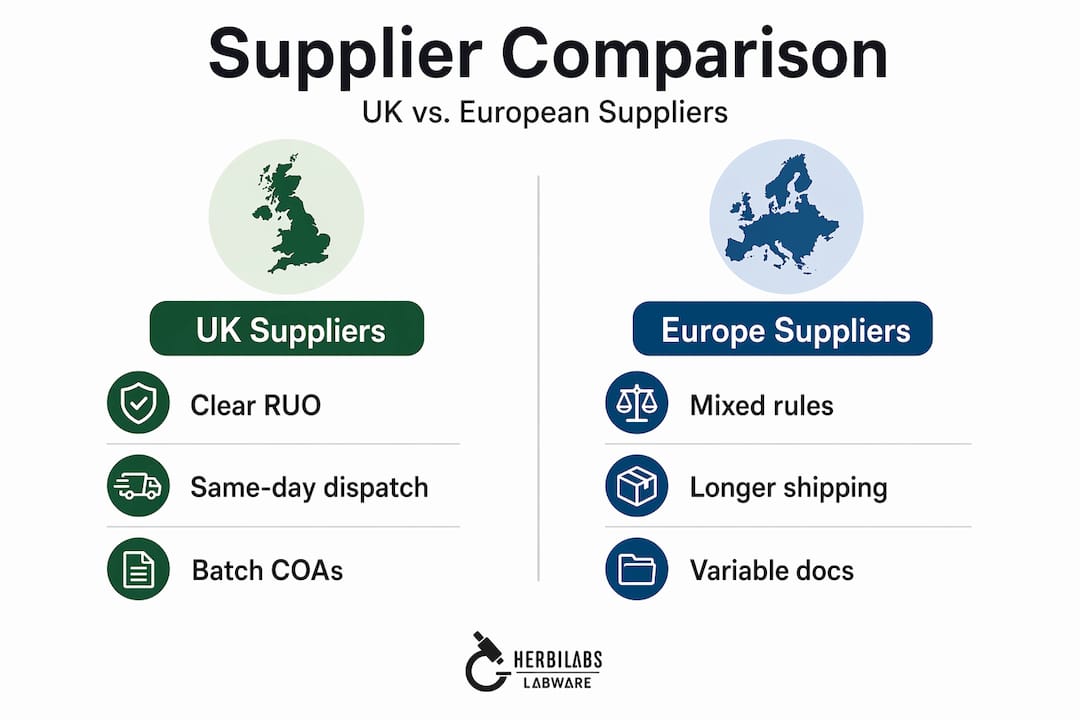
When performing a UK peptide supplier comparison against alternatives from Germany, the Netherlands, or non-EU vendors, several structural differences emerge.
| Factor | UK peptide suppliers | Other European suppliers |
|---|---|---|
| Regulatory framework | Clear RUO designation under UK medicines law | Variable; some countries lack equivalent enforcement |
| Quality documentation | Typically batch-specific with mass spec | Often batch-specific but mass spec inclusion varies |
| Dispatch speed | Next working day with cold-chain protocols | Comparable in some countries; inconsistent in others |
| Cold-chain standards | Walk-in cold storage; lab-grade refrigeration common | Varies significantly by supplier size |
| Customs for UK researchers | Direct, no import processing | Subject to customs handling from EU dispatch |
The top reasons for UK peptide purchases from a UK-based researcher’s standpoint are speed, accountability, and documentation quality. For European researchers, the calculation includes the fact that many leading UK vendors have refined their export logistics and the quality floor remains higher on average than many alternatives.
Reproducibility is the real measure. If two batches of the same peptide from the same supplier behave differently in your assay, you lose time, reagents, and confidence in your data. Batch-specific COAs with raw chromatogram data are the mechanism that catches that problem before it reaches your bench.
My perspective on supplier selection in practice
I have watched researchers make sourcing decisions based almost entirely on price, and I have seen what that costs them further down the line. The variability you accept at purchase becomes the variability you cannot explain in your results section.
In my experience, the researchers who get this right tend to do one thing differently: they treat their peptide supplier like a scientific partner, not a commodity vendor. They ask hard questions about documentation before ordering. They want to know where the peptide was synthesized, what QC the batch went through, and what the escalation path looks like if a problem arises.
UK suppliers, particularly those operating under strict RUO positioning, tend to hold up well under that kind of scrutiny. That is not because UK manufacturers are inherently superior. It is because the regulatory and reputational environment in the UK creates a higher floor for supplier behavior.
The cold-chain point is the one I see overlooked most often. Researchers focus on purity numbers and forget to ask how the product was stored and transported. A peptide with 99.5% purity that spent 36 hours in a warm customs facility is not the same product anymore. That is a sourcing risk that documentation alone cannot fix.
My advice: prioritize suppliers that can give you batch-specific paperwork and documented cold-chain handling over those offering lower prices with weaker documentation. The cost of a failed experiment exceeds any savings on the purchase price.
— Ragnar
How Herbilabs supports your peptide research workflow
If you are building a reliable peptide research workflow, the peptides are only part of the equation. The reconstitution solutions you use are equally critical. Herbilabs supplies research-grade bacteriostatic water and sterile diluents manufactured under strict purity controls in a dedicated facility, specifically to support researchers who need reconstitution solutions they can trust alongside their verified peptide supplies. With next working day delivery options and wholesale pricing for institutional and professional buyers, Herbilabs complements the UK peptide supply chain you have already vetted.
Explore the bacteriostatic water guide to understand the preparation standards, or review the bacteriostatic water FAQs for answers to the questions researchers ask most. When your peptides come with batch-level documentation, your reconstitution solutions should meet the same standard.
FAQ
What does “research use only” mean for UK peptide suppliers?
RUO peptides are not licensed for human use and are sold strictly for laboratory research. UK suppliers maintaining this designation avoid making therapeutic claims, keeping their products legally compliant under UK medicines law.
Why is mass spectrometry required alongside HPLC purity data?
HPLC purity confirms a dominant peak but cannot verify molecular identity. Mass spectrometry differentiates structurally similar impurities by confirming the observed mass matches the theoretical value, which HPLC alone cannot do.
What delivery timelines can UK peptide suppliers realistically offer?
Most established UK suppliers offer same-day dispatch for orders placed before 4:00 pm, with next working day arrival. Professional cold-chain handling at the dispatch facility protects peptide integrity during transit.
How do I spot a supplier offering inadequate documentation?
Watch for COAs labeled “representative” rather than batch-specific, missing mass spectrometry data, or an absence of raw chromatogram files. These are consistent indicators that the documentation does not reflect the actual batch you will receive.
Are UK peptide suppliers a better option for European researchers post-2020?
UK suppliers shipping to EU destinations now require export documentation, but established vendors have built these processes into their operations. The quality and regulatory advantages of UK sources still make them a strong choice for European researchers prioritizing verified, well-documented peptides.