Private Label, White Label, Wholesale partnerships available - EU, USA and UK - Free shipping from €75

Proper Lab Waste Disposal Guide for Researchers
Discover the proper lab waste disposal guide to ensure safety, compliance, and environmental protection in your research operations.
TL;DR:
- Proper lab waste disposal involves segregating, labeling, storing, and disposing of waste by hazard type to ensure safety and regulatory compliance.
- Effective management depends on strict adherence to protocols, including accurate waste identification, appropriate container use, proper storage, and thorough documentation.
Proper lab waste disposal is the process of segregating, labeling, storing, and disposing of laboratory waste according to hazard type and regulatory requirements to protect personnel, the public, and the environment. Effective lab waste disposal starts by sorting waste streams by hazard category and applying distinct handling procedures to each. This means chemical, biological, sharps, radioactive, nanomaterial, and general waste never share the same container or disposal pathway. Regulations from the EPA, OSHA, and the EU’s updated Waste Shipment Regulation all impose specific obligations on labs that generate these materials. Getting this right is not optional. It is the foundation of every compliant, safe research operation.
What does a proper lab waste disposal guide cover?
Most lab compliance failures stem from poor waste segregation and labeling discipline rather than from choosing the wrong disposal method. That single fact reframes how you should think about waste management. The method matters far less than the discipline applied before the waste ever leaves the bench. A proper lab waste management strategy covers six interconnected steps: identification, segregation, containerization, labeling, storage, and final disposal or treatment. Skip or rush any one of them and the entire chain of compliance breaks down.
Safety Data Sheets (SDS) are the starting point for every waste identification decision. Before you can segregate a chemical waste stream correctly, you need the SDS for every reagent involved. The SDS tells you the hazard class, incompatibilities, and whether the material qualifies as a listed or characteristic hazardous waste under EPA definitions. Labs that skip this step routinely mix incompatible chemicals in the same container, which creates secondary hazards and automatic regulatory violations.
How to segregate and identify different lab waste streams
Segregation is the most consequential decision in the entire waste management process. Get it wrong at the source and no downstream procedure can fully correct it. The five primary waste streams in a research lab are chemical waste, biological or biohazardous waste, sharps waste, radioactive waste, and general non-hazardous waste. Nanomaterial waste is increasingly treated as a sixth, separate category with its own handling requirements.
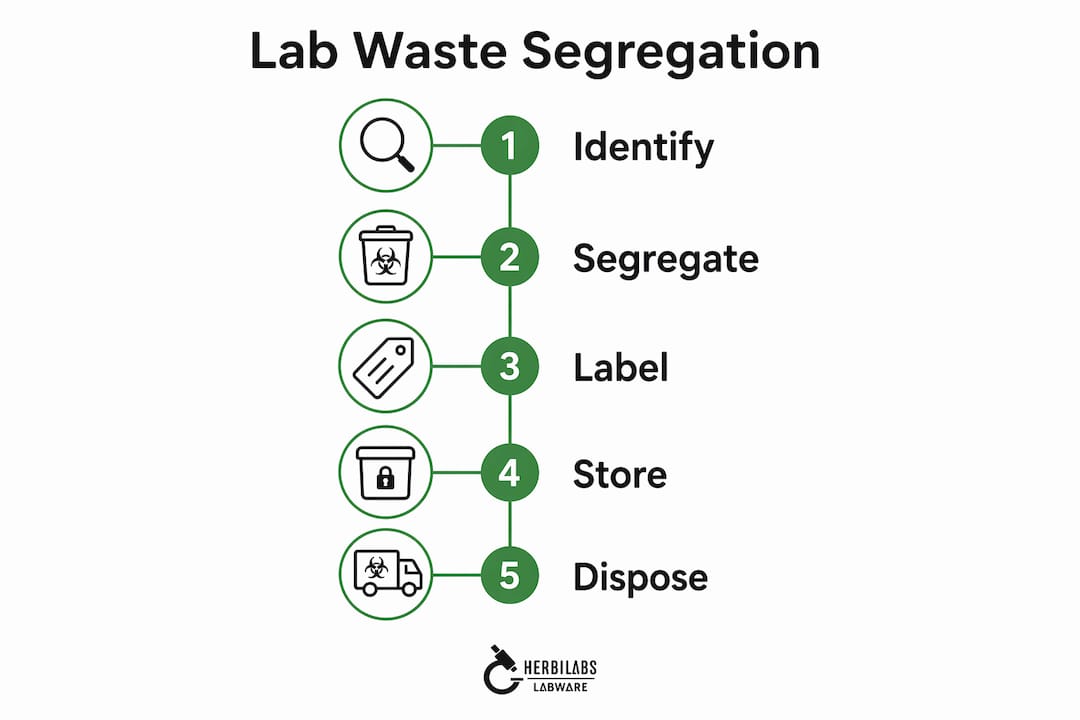
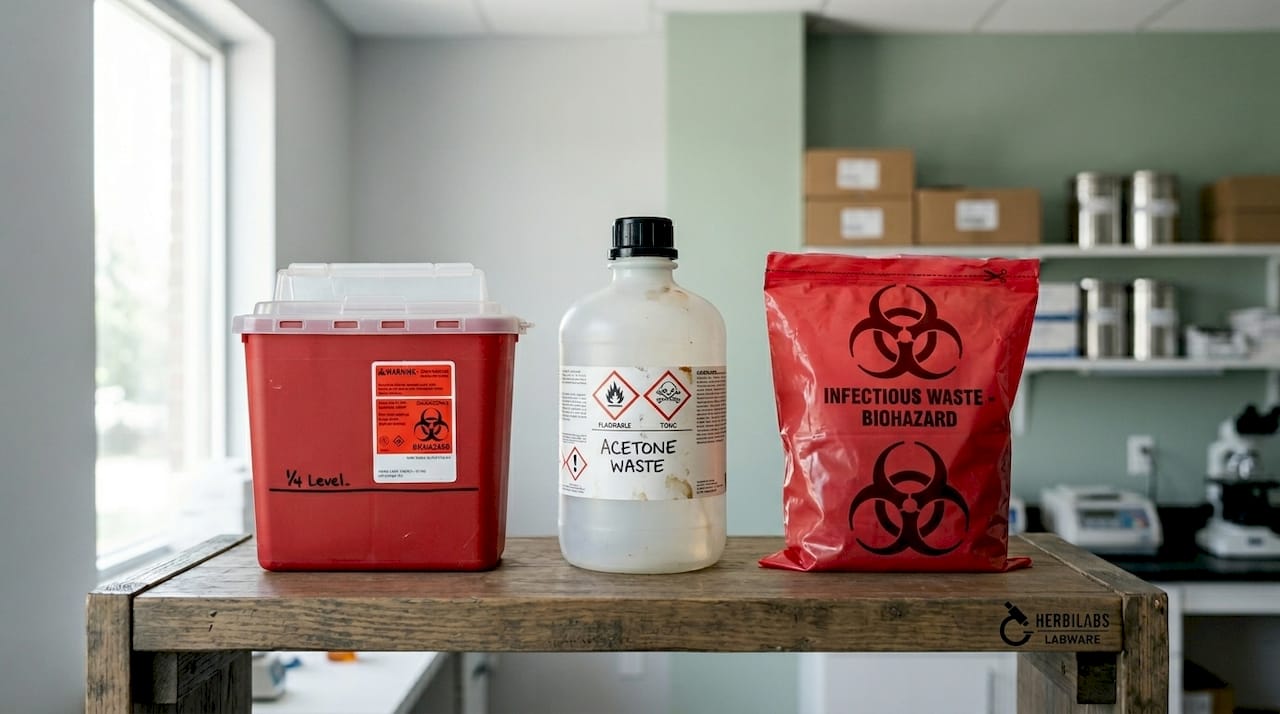
Color-coded containers and standardized symbols make segregation visible and auditable. Biohazardous waste goes into red or orange bags marked with the universal biohazard symbol. Chemical waste containers carry GHS hazard pictograms and chemical identity labels. Sharps go into rigid, puncture-resistant containers that are clearly distinct from soft biohazard bags. Radioactive waste uses yellow containers with the trefoil radiation symbol. Color discipline only works if every person in the lab applies it consistently, every time.
Common segregation failures include:
- Placing broken glass contaminated with biological material into general waste rather than a sharps container
- Mixing aqueous chemical waste with halogenated solvent waste, which creates incompatible mixtures and increases disposal costs
- Disposing of cytotoxic or chemotherapy agents into standard chemical waste streams instead of dedicated cytotoxic containers
- Labeling a container as “mixed waste” without specifying the chemical constituents, which makes downstream treatment impossible
- Discarding empty reagent bottles without decontamination into general recycling
Pro Tip: Attach a laminated segregation reference card at each waste station listing the correct container color, symbol, and SDS location for every waste type generated at that bench. Auditors notice this level of discipline immediately.
Reviewing the lab safety checklist for reagent handling gives you a practical framework for building segregation habits into daily lab routines.
What containers should you use for each waste type?
Container selection is a direct safety control, not an administrative formality. The wrong container for a given waste type creates puncture injuries, chemical leaks, aerosol exposure, and regulatory citations. The table below summarizes the required container specifications for the five main waste streams.
| Waste type | Container requirement | Fill limit |
|---|---|---|
| Sharps | Rigid, puncture-resistant, leak-proof with secure lid | 3/4 full maximum |
| Biohazardous (non-sharps) | Autoclavable biohazard bags, secondary containment | 75% full maximum |
| Chemical waste | Chemical-resistant containers, compatible with contents, secure lid | 75-80% full |
| Nanowaste (liquid) | Ventilated, sealed containers approximately 10L, separate from chemical waste | 90% full maximum |
| Radioactive waste | Shielded containers, radiation symbol, decay-in-storage where applicable | Per radiation safety officer guidance |
Sharps containers must be replaced at three-quarters full. Overfilling is the primary failure mode for sharps disposal programs. When a container is overfilled, personnel attempting to close or move it face direct puncture risk, and the container no longer qualifies as compliant under OSHA’s Bloodborne Pathogens Standard. SOPs must define the fill limit explicitly, and training must reinforce the distinction between sharps containers and biohazard bags. These two container types are never interchangeable.
For chemical waste, container compatibility is non-negotiable. Hydrofluoric acid waste requires polyethylene containers, not glass. Oxidizer waste must never share a container with flammable solvent waste. Consult the SDS for each constituent before selecting a container material. Inspect containers weekly for cracks, leaks, or label degradation, and replace any container showing physical damage immediately.
Pro Tip: Date every container the moment you open it. This single habit prevents the most common satellite accumulation violation: containers that have been accumulating waste for longer than the regulatory limit with no documentation to prove otherwise.
How do storage rules and regulations apply to lab waste?
Storage is where most labs accumulate regulatory risk without realizing it. Under EPA regulations, a satellite accumulation area (SAA) allows labs to store up to 55 gallons of hazardous waste at or near the point of generation, under the control of the operator. Once a container reaches 55 gallons, the lab has three days to move it to a central accumulation area or arrange for licensed hauler pickup. Containers in an SAA must remain closed except when adding or removing waste, and must be labeled with the generator’s name, address, waste description, and the date accumulation began.
The container itself functions as a critical engineering barrier. Keeping it closed and properly labeled is not just good practice. It is the primary evidence auditors use to assess whether a lab has management control over its hazardous waste. An unlabeled or open container in an SAA is an automatic violation regardless of what is inside it.
Biological waste has its own storage time limits, which vary by jurisdiction but typically range from 24 to 72 hours at room temperature before the waste must be treated or refrigerated. Refrigerated biohazardous waste must be stored in a dedicated, locked unit marked with the biohazard symbol. It must never share space with food, reagents, or samples.
For chemical waste storage in research labs, chemical compatibility segregation applies inside the storage area as well. Flammables, corrosives, oxidizers, and toxics must be stored in separate, compatible cabinets. Nanowaste requires ventilated storage areas specifically because of aerosolization risk during handling.
Periodic audits of all accumulation areas, at minimum monthly, catch labeling gaps and container condition issues before they become regulatory findings. Document every audit with date, inspector name, and any corrective actions taken.
Pro Tip: Build your SAA audit into the same calendar event as your weekly reagent inventory check. Labs that treat waste audits as a separate administrative burden tend to let them slip. Labs that integrate them into existing workflows maintain consistent compliance.
What are the main treatment and disposal methods for lab waste?
Treatment and disposal convert hazardous waste into a form that is safe for final disposal or reduces its hazard classification. The method depends entirely on the waste category.
- Biological waste autoclaving: Steam sterilization at 121°C for a minimum of 30 minutes at 15 psi is the standard treatment for most biohazardous waste. Autoclave efficacy must be validated using biological indicators such as Geobacillus stearothermophilus spore strips. Treated waste that passes validation can typically be disposed of as general solid waste, depending on local regulations.
- Incineration: Pathological waste, cytotoxic agents, and certain chemotherapy waste require high-temperature incineration at licensed facilities. Incineration is the only compliant disposal route for prion-contaminated materials and most Category A infectious substances.
- Chemical neutralization: Acid and base waste streams can be neutralized to a pH between 6 and 8 before drain disposal, provided the neutralized solution contains no other hazardous constituents and local sewer authority permits allow it. This is not a universal option. Confirm with your environmental health and safety office before neutralizing any chemical waste stream.
- Licensed waste haulers: Most hazardous chemical waste, halogenated solvents, heavy metal solutions, and mixed waste streams require collection by a licensed hazardous waste hauler operating under EPA or equivalent national authority permits. The hauler provides manifests that document the chain of custody from your lab to the final treatment, storage, and disposal facility.
- Recycling treated plastics: Autoclaved plasticware that passes decontamination validation can enter recycling streams in many jurisdictions, reducing the volume of waste sent to incineration. This is one of the most practical lab waste recycling strategies available to high-volume research labs.
OSHA’s Bloodborne Pathogens Standard requires that biohazard waste handling include engineering controls, appropriate PPE, and a written Exposure Control Plan. This applies to every person who handles, transports, or treats biohazardous waste, not just clinical staff.
How should you handle nanowaste differently from other lab waste?
Nanowaste is not simply a subcategory of chemical waste. Handling emerging waste like nanomaterials requires tailored procedures that go beyond standard chemical waste guidance, reflecting both evolving regulatory requirements and genuine gaps in toxicological data for many engineered nanomaterials.
The key distinctions for nanowaste management are:
- Separate collection: Liquid nanowaste must be stored in its own containers, never combined with general chemical waste streams, because nanoparticles can interact unpredictably with other waste constituents.
- Ventilated storage: Containers must be stored in ventilated areas to prevent aerosol accumulation. Liquid nanowaste containers should not exceed 10 liters and must never be filled above 90% capacity.
- Dual labeling: Storage labels follow GHS/CLP pictogram requirements. Transport labels must comply with ADR (Agreement concerning the International Carriage of Dangerous Goods by Road) requirements. These are different label sets, and applying ADR markings well before scheduled pickup prevents last-minute compliance failures.
- Precautionary principle: Where toxicological data for a specific nanomaterial is incomplete, treat it as hazardous by default. Risk assessment must document this decision.
- EU digital tracking: From May 21, 2026, the EU’s new Waste Shipment Regulation and the DIWASS platform mandate digital tracking and prior informed consent submissions for hazardous waste exports, including nanowaste shipments crossing EU borders.
Labs working with novel nanomaterials should consult the safe reagent handling guide for protocols that address both upstream handling and downstream waste generation from these materials.
Key takeaways
Proper lab waste disposal requires segregation by hazard type, correct container selection, compliant labeling, and documented storage before any treatment or disposal method is applied.
| Point | Details |
|---|---|
| Segregation is the foundation | Sort waste by chemical, biological, sharps, nanomaterial, and radioactive streams before anything else. |
| Container fill limits are regulatory limits | Replace sharps containers at 3/4 full and chemical waste containers at 75-80% to stay compliant. |
| Satellite accumulation has hard deadlines | Label containers from day one and move waste within three days of reaching the 55-gallon limit. |
| Nanowaste needs its own protocols | Store separately in ventilated areas, apply ADR transport labels early, and treat unknown nanomaterials as hazardous by default. |
| Documentation closes the compliance loop | Audit accumulation areas monthly and maintain SDS records, autoclave logs, and waste manifests for every disposal event. |
What I’ve learned from watching labs fail audits they should have passed
I’ve reviewed enough lab waste programs to know where the real failures happen. They almost never occur because a lab chose the wrong disposal method. They happen because someone skipped a label, overfilled a sharps container, or left a satellite accumulation container open for three days without noticing. The compliance infrastructure exists. The knowledge exists. The gap is almost always behavioral and cultural, not technical.
The labs that consistently pass audits without scrambling share one trait: they treat waste management as part of the experiment, not as cleanup afterward. Waste containers are set up before work begins. Labels are completed at the bench, not at the end of the day when memory is unreliable. Segregation decisions are made by the person generating the waste, not delegated to whoever happens to be near the disposal area.
Training matters, but training alone does not create compliance culture. What creates it is making the correct behavior the path of least resistance. That means waste stations stocked with the right containers, SDS binders within arm’s reach, and laminated reference cards that remove any ambiguity about which stream a given material belongs to. When the right choice is also the easy choice, compliance rates climb without enforcement pressure.
The nanowaste and EU digital tracking requirements coming into full effect in 2026 are the next area where I expect labs to struggle. Most labs have not updated their waste procedures to account for the DIWASS platform requirements or the dual labeling distinction between GHS storage labels and ADR transport labels. If your lab exports any hazardous or nanomaterial waste across EU borders, that gap needs to close now, not at the next scheduled procedure review.
— Ragnar
How Herbilabs supports safe lab practices
Reliable lab waste handling starts with knowing exactly what you are working with. Herbilabs supplies research-grade bacteriostatic water, sterile diluents, and reconstitution solutions manufactured to strict purity standards, giving you full confidence in the composition of every reagent you handle and eventually dispose of. When you know your inputs precisely, waste classification becomes straightforward rather than a guessing exercise. Explore the bacteriostatic water FAQs to understand handling, storage, and disposal considerations for one of the most commonly used lab reagents. Herbilabs also offers wholesale pricing and dedicated support for research institutions across the UK and Europe.
FAQ
What is the first step in lab waste disposal?
The first step is identifying and segregating waste by hazard type using Safety Data Sheets and color-coded containers. Segregation at the point of generation determines every subsequent storage, treatment, and disposal decision.
How full should a sharps container be before disposal?
Sharps containers must be sealed and replaced when they reach three-quarters full. Overfilling is the leading cause of sharps injury during disposal and constitutes a direct violation of OSHA’s Bloodborne Pathogens Standard.
What are the satellite accumulation area rules for chemical waste?
Labs may store up to 55 gallons of hazardous chemical waste at the generation point under EPA satellite accumulation rules. Once that limit is reached, the waste must be transferred to a central accumulation area or picked up by a licensed hauler within three days.
How is nanowaste different from regular chemical waste?
Nanowaste requires separate containers, ventilated storage, and dual labeling under both GHS and ADR standards. It cannot be disposed of down sinks due to aerosolization risks, and unknown nanomaterials should be treated as hazardous by default pending toxicological assessment.
What documentation is required for hazardous waste disposal?
Labs must maintain waste manifests for every licensed hauler pickup, autoclave validation logs for biological waste treatment, SDS records for all chemical waste streams, and dated accumulation area audit records. These documents form the compliance record during regulatory inspections.