Private Label, White Label, Wholesale partnerships available - EU, USA and UK - Free shipping from €75

Safe Laboratory Labeling Process: Best Practices Guide
Ensure safety in your lab with our guide on the safe laboratory labeling process. Explore best practices to prevent hazards and meet standards.
TL;DR:
- A safe laboratory labeling process ensures regulatory compliance, traceability, and personnel safety through systematic identification of all containers. Proper label content varies by container type, requiring specific elements under OSHA and EPA standards to prevent errors and violations. Integrating labeling into workflow procedures, using durable materials, and training staff are essential for maintaining accuracy in demanding laboratory environments.
A safe laboratory labeling process is defined as the systematic, regulation-compliant identification of every chemical, sample, and waste container in a laboratory environment to prevent hazards, maintain traceability, and satisfy federal standards. OSHA’s Hazard Communication Standard (HazCom) under 29 CFR 1910.1200 and the EPA’s Resource Conservation and Recovery Act (RCRA) set the legal floor for what labels must communicate and when. Gaps in this process cause mislabeled samples, regulatory violations, and real safety incidents. For researchers and lab professionals working with research-grade reagents, bacteriostatic water, or peptide aliquots, accurate labeling is not administrative overhead. It is the mechanism that keeps data valid and people safe.
What essential information must laboratory labels include?
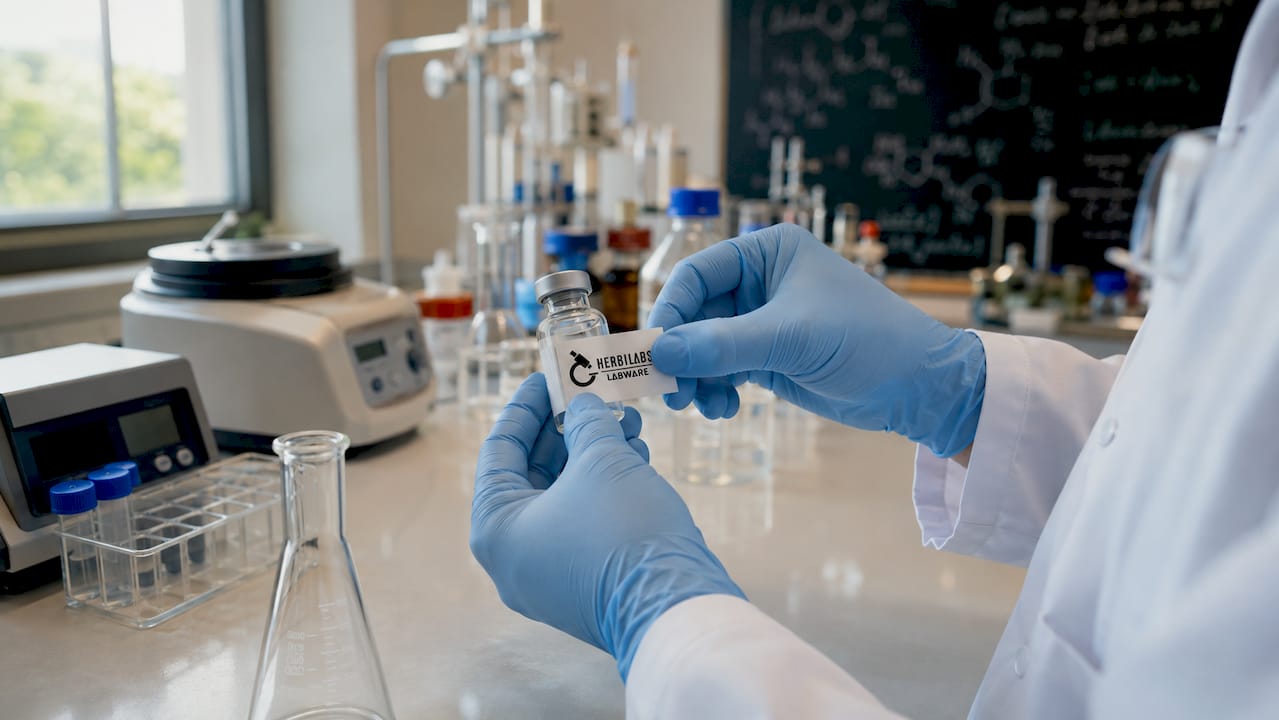
The six required elements under OSHA HazCom for shipped chemical containers are: product identifier, signal word (Danger or Warning), hazard statements, GHS pictograms, precautionary statements, and supplier information. These elements must appear together and be immediately readable. Hazard information buried in fine print or split across label sections fails the standard’s intent.
For secondary containers, the requirement shifts. OSHA 29 CFR 1910.1200(f)(6) mandates that workers have access to hazard information through a label or an equivalent communication system. Oklahoma State University’s laboratory safety program, for example, requires secondary containers to carry the common name, chemical name, and NFPA diamond, with dilutions also noting concentration. Unlabeled chemicals cannot be stored or used under that policy, which reflects the broader regulatory expectation.
Hazardous waste containers follow EPA RCRA rules, which require a distinct set of label elements:
- The words “Hazardous Waste” prominently displayed
- A description of the physical and chemical hazards
- Generator name, address, and contact information
- The accumulation start date, added at the moment waste generation begins
Research and pharmaceutical sample labels carry their own requirements. FDA-aligned sample management standards require that labels include identity, concentration, storage conditions, expiration dates, and traceability back to the originating study and batch. Mislabeled or mismatched samples are a documented cause of regulatory non-compliance in pharmaceutical research settings.
| Container type | Required label elements |
|---|---|
| Shipped chemical container | Product ID, signal word, hazard statements, pictograms, precautionary statements, supplier info |
| Secondary container | Chemical name, common name, hazard info or equivalent communication |
| Hazardous waste container | “Hazardous Waste,” hazard description, generator info, accumulation start date |
| Research/pharma sample | Identity, concentration, storage conditions, expiration date, batch/study traceability |
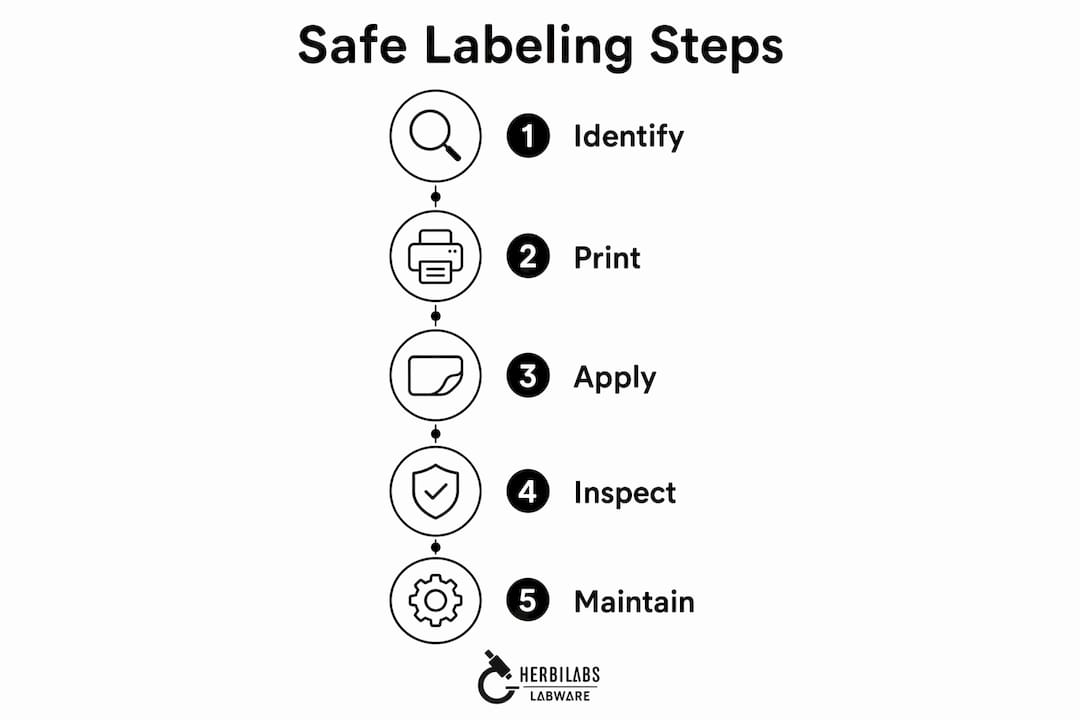
How to implement a safe laboratory labeling process step by step
A structured execution sequence eliminates the most common failure points: transcription errors, missing fields, and labels applied to dirty or wet surfaces. Follow these steps to build a workflow that holds up under inspection and daily use.
-
Audit your SDS data and chemical inventory first. Labels are only as accurate as the source records. Verify that Safety Data Sheets are current and that your chemical inventory reflects what is actually on the bench. Outdated SDS data produces labels with wrong hazard classifications.
-
Generate labels at the point of transfer, not in advance. Automated label generation linked to chemical inventories and SDS records reduces transcription errors and keeps hazard information current. Printing labels hours before use and filling in details by hand is a primary source of mismatch errors.
-
Prepare complete label content before printing. For research samples, this means batch ID, sample ID, preparation date, concentration, storage temperature, expiration or discard date, and any freeze-thaw cycle limits. For hazardous chemicals, include all six GHS elements. Missing a single required field invalidates the label for compliance purposes.
-
Apply labels to clean, dry, and appropriate surfaces. Adhesion fails on contaminated or wet containers. For cryogenic storage, use labels and adhesives rated for temperatures as low as -196°C. Standard label stock loses adhesion during freeze-thaw cycles, which breaks chain-of-custody for stored samples.
-
Verify every label before the container enters storage or use. Two-person checks or barcode scans improve label-to-container matching accuracy. Barcode scanning against a LIMS or inventory record catches transposition errors that visual checks miss.
-
Apply the immediate-use exemption only when all conditions are met. OSHA allows portable containers to go unlabeled if the chemical is used immediately, by a single worker, and within one shift. The immediate-use exemption is narrowly defined and frequently misapplied. If there is any doubt, label the container.
Pro Tip: Set your label printer to pull directly from your chemical management system or LIMS rather than allowing manual text entry. This single change eliminates the majority of transcription-based labeling errors in high-throughput labs.
What are best practices for labeling secondary containers and hazardous waste?
Secondary containers are any vessels other than the original manufacturer’s container into which a chemical has been transferred. They are regulated under OSHA and represent the most common source of labeling violations in routine lab inspections.
The most frequent compliance failure is over-reliance on the immediate-use exemption. Labs routinely transfer solvents or reagents into beakers or spray bottles and leave them unlabeled for hours or days, assuming the exemption applies. It does not. The exemption requires that the chemical be used immediately by the same person who transferred it, with no storage between use and disposal. Any deviation requires a label.
Training employees on secondary container labeling policies and the specific hazards of the chemicals they handle is as critical as the label itself. A label that workers cannot interpret does not communicate hazard information effectively. Training should cover what each GHS pictogram means, how to read signal words, and what to do if a label is missing or damaged.
For hazardous waste, the EPA RCRA framework requires prompt labeling at the point of generation. Failure to label promptly can result in violations and costly fines. Key compliance practices include:
- Label the container the moment waste generation begins, not when it is full or ready for pickup
- Place labels on the side of the container, not the lid, so they remain visible during storage and transport
- Remove or fully cover old labels before applying new ones to prevent misidentification
- Inspect waste container labels weekly and replace any that are damaged, faded, or partially detached
- Labels must remain legible to emergency responders from five feet away and must survive the environmental conditions of the storage area
Pro Tip: Assign a specific person on each shift to perform a five-minute label inspection of all secondary and waste containers. Rotating this responsibility without a named owner is how damaged labels go unnoticed for weeks.
For researchers working with hazardous waste disposal protocols, integrating labeling into the waste generation step rather than treating it as a separate task is the most reliable way to maintain continuous compliance.
How to ensure label durability and accuracy in demanding lab conditions
Label integrity degrades faster than most researchers expect. Cryogenic storage, high humidity, chemical splash, and repeated freeze-thaw cycles all attack standard label stock in ways that become visible only after the damage is done.
| Condition | Risk to standard labels | Recommended solution |
|---|---|---|
| Cryogenic storage (below -80°C) | Adhesive failure, brittleness, ink cracking | Cryogenic-rated labels and adhesives |
| High humidity or wet surfaces | Delamination, smearing | Waterproof polyester or polypropylene substrates |
| Chemical exposure | Ink dissolution, substrate degradation | Chemically resistant overlaminates or direct thermal printing |
| Freeze-thaw cycling | Repeated adhesive stress, label lifting | Cryogenic adhesives with flexible substrates |
Cryogenic sample labeling failures typically result from using standard label stock. Selecting appropriate materials and tracking samples with redundant systems like RFID is the correct approach for any biobank or long-term storage program. RFID tags embedded in cryogenic vials allow retrieval and inventory without requiring the printed label to remain perfectly legible.
For research aliquots, label metadata should extend beyond chemical identity. Operational control information such as freeze-thaw cycle counts, discard rules, and protocol SOP references belongs on the label or in a linked digital record. A peptide aliquot labeled only with its name and concentration gives the next researcher no information about whether the sample is still within acceptable use parameters.
A practical label maintenance program includes three components. First, tie label review to expiration dates. When a chemical or sample approaches its expiration, the label review is triggered automatically rather than reactively. Second, conduct monthly visual inspections of all stored containers, with particular attention to cryogenic freezers and chemical storage cabinets. Third, establish a lab supply best practices protocol that specifies which label materials are approved for each storage environment, so purchasing decisions do not inadvertently introduce incompatible label stock.
Key takeaways
A safe laboratory labeling process requires regulatory compliance, material-appropriate label selection, and workflow integration to prevent errors, protect personnel, and maintain sample traceability.
| Point | Details |
|---|---|
| Know your required elements | OSHA HazCom and EPA RCRA each specify distinct mandatory fields; missing one element constitutes a violation. |
| Generate labels from source data | Automated label printing from SDS records or LIMS eliminates the transcription errors that manual entry creates. |
| Apply the immediate-use exemption correctly | The OSHA exemption is narrow; assume labeling is required unless all three conditions are strictly met. |
| Match label materials to storage conditions | Cryogenic and chemically harsh environments require specialized adhesives and substrates, not standard label stock. |
| Inspect and replace labels proactively | Weekly waste label inspections and expiration-linked reviews catch degradation before it causes compliance failures. |
Why labeling is a system, not a sticker
Most labeling failures I have seen in laboratory settings do not come from ignorance of the regulations. They come from treating labeling as a disconnected manual step that happens after the real work is done. A researcher transfers a reagent, plans to label it “in a minute,” and then gets pulled into something else. That unlabeled container sits on the bench for two hours. That is not a knowledge problem. It is a workflow problem.
The labs that maintain consistent compliance are the ones that have built labeling into the physical sequence of their procedures. The label printer is next to the transfer station. The label template pulls from the chemical record automatically. The person doing the transfer cannot complete the step without also completing the label. When labeling requires a separate decision, it gets deferred.
I also think the durability question is underestimated. Researchers invest significant effort in sample preparation and storage, then use label stock that was never rated for the conditions. A cryogenic vial with a peeling label six months into storage is a traceability failure waiting to happen. For anyone working with peptide aliquots or reconstituted reagents, the label is part of the sample’s integrity. Treat it that way from the start. Connecting your labeling practices to your broader reagent handling protocols is the most direct way to build that discipline into daily lab work.
— Ragnar
Support your labeling workflow with Herbilabs
Herbilabs supplies research-grade bacteriostatic water, sterile diluents, and reconstitution solutions manufactured to strict purity standards, and the team understands that accurate labeling is inseparable from reliable research outcomes. Whether you are labeling reconstituted peptide aliquots for cryogenic storage or managing secondary containers in an active research environment, having the right materials and reference resources matters. Herbilabs provides product guides, detailed bac water FAQs, and a catalog of lab-grade supplies designed for researchers who cannot afford ambiguity in their workflows. Visit Herbilabs to explore supplies built for the standards your research demands.
FAQ
What are the required elements on a chemical label under OSHA?
OSHA HazCom requires six elements on shipped chemical container labels: product identifier, signal word, hazard statements, GHS pictograms, precautionary statements, and supplier information. All six must appear together and be immediately readable on the container.
When does the OSHA immediate-use exemption apply to secondary containers?
The exemption applies only when a chemical is used immediately after transfer, by the same single worker who transferred it, and within one shift. Any storage, shared use, or delay requires a label on the secondary container.
What information must a hazardous waste label include under EPA RCRA?
EPA RCRA requires the words “Hazardous Waste,” a description of the physical and chemical hazards, generator name and contact information, and the accumulation start date. Labels must be applied at the point of generation without delay.
How do you label samples for cryogenic storage safely?
Use cryogenic-rated labels with adhesives designed for temperatures as low as -196°C. Standard label stock loses adhesion during freeze-thaw cycles, which breaks chain-of-custody. RFID tagging provides a redundant identification layer when printed labels are at risk of degradation.
What metadata should research aliquot labels include beyond chemical identity?
Research aliquot labels should include preparation date, concentration, storage temperature, expiration or discard date, and freeze-thaw cycle count. Linking labels to protocol SOPs and batch records maintains full traceability throughout the sample lifecycle.