Private Label, White Label, Wholesale partnerships available - EU, USA and UK - Free shipping from €75

Essential quality control checkpoints for reliable lab research
Discover essential quality control checkpoints to enhance lab research. Prevent costly errors and ensure reliable results with effective strategies.
TL;DR:
- Inconsistent quality standards in laboratory solutions can compromise research and invalidate data through undetected contamination events. Implementing structured quality control checkpoints at receipt, preparation, and use is essential for maintaining safety and integrity in experiments with bacteriostatic water and peptides. Focusing on core, consistently enforced checks—such as visual inspections, proper documentation, and timing—ensures reliable results while avoiding overcomplicated procedures that may reduce compliance.
Inconsistent quality standards in laboratory solutions are one of the fastest ways to compromise otherwise solid research. Whether you’re reconstituting peptides or working with bacteriostatic water, a single undetected contamination event can invalidate weeks of data and waste materials that aren’t cheap to replace. Quality control checkpoints give you structured, repeatable moments in your workflow to catch problems before they cascade. This guide covers the most critical checkpoints for bacteriostatic water and research reagents, with specific guidance aligned to European lab practice and EMA oversight.
Table of Contents
- What is a quality control checkpoint?
- Top quality control checkpoints for bacteriostatic water
- Essential checkpoints in peptide synthesis and reagents
- Comparison table: Water vs peptide QC checkpoints
- Common mistakes and how to avoid them
- A practical mindset: Why overcomplicating QC can backfire in the lab
- Lab-ready solutions for practical quality control
- Frequently asked questions
Key Takeaways
| Point | Details |
|---|---|
| Checkpoints prevent errors | Smart quality control steps catch issues before they affect experiments. |
| Time limits matter | Bacteriostatic water must be used within 28 days of opening to ensure sterility. |
| Analytical tests are key | Synthetic peptides require specific tests at critical synthesis points to ensure purity. |
| Simplicity wins | A few well-enforced checkpoints often outperform complicated, lengthy lists. |
What is a quality control checkpoint?
A quality control checkpoint is a planned verification step built into a process to confirm that a product or procedure meets defined safety and purity standards before moving forward. Think of it less like a bureaucratic hurdle and more like a logical pause where you confirm everything is as it should be before proceeding. In lab environments, these checkpoints are what stand between you and a contaminated batch, a degraded reagent, or a ruined experiment.
For bacteriostatic water and research reagents, checkpoints typically fall at three stages:
- Receiving: Confirming that incoming products match specifications, are undamaged, and show correct labeling and expiration dates.
- Preparation: Verifying aseptic technique, correct reconstitution volumes, and the absence of visible contamination before mixing.
- In-use: Monitoring appearance at each use, recording first puncture dates, and enforcing discard timelines.
The distinction between checkpoints and general “good practice” is formalization. A checkpoint is documented, assigned, and consistently applied. It’s what transforms individual diligence into a reproducible lab standard.
“Quality-control checkpoints for bacteriostatic water include strict aseptic handling and a defined in-use discard timeframe.” — What is Bacteriostatic Water and How is it Used
If you’re still getting oriented with the basics, our full resource on what is bacteriostatic water covers the fundamentals in depth. Understanding what the product is designed to do makes it much easier to understand why each checkpoint exists in the first place.
Top quality control checkpoints for bacteriostatic water
With an understanding of what checkpoints are and where they sit in your workflow, let’s look at how they apply specifically to bacteriostatic water. Each step below has a real consequence if skipped.
-
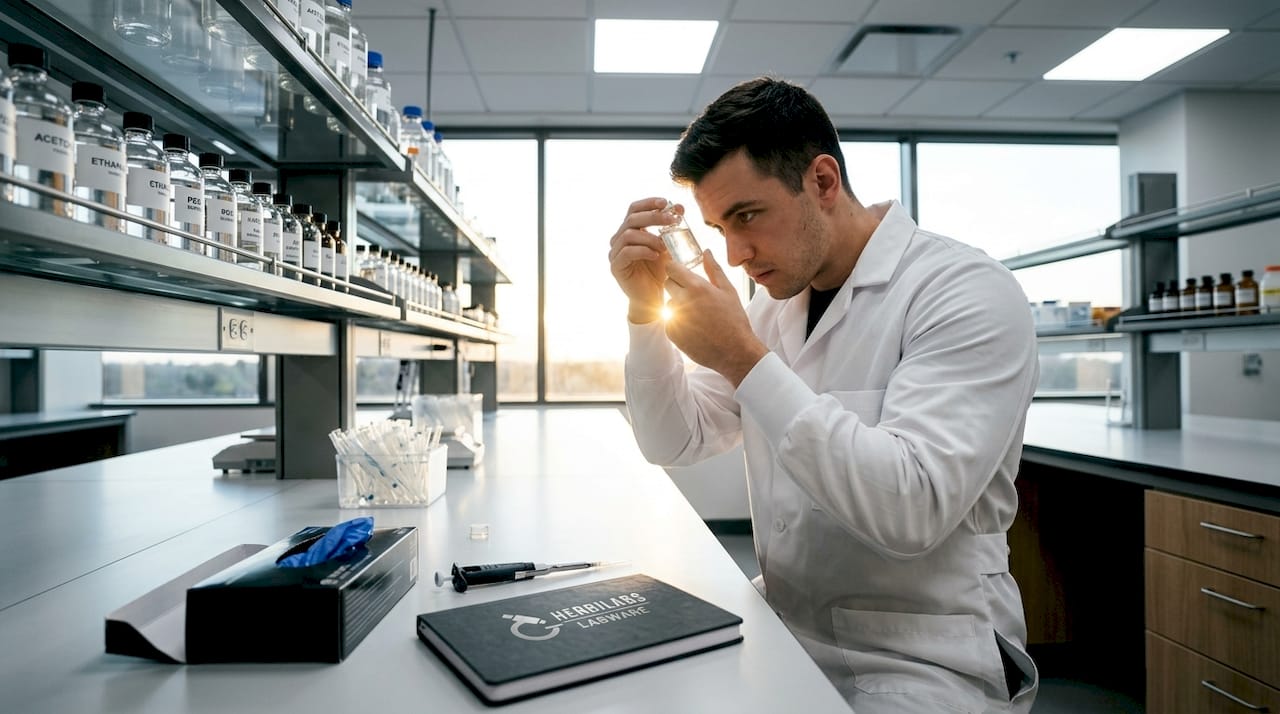
Visual inspection on receipt. Before you even store a vial, hold it up to light and check for cloudiness, floating particles, or unusual color. Bacteriostatic water should be clear and colorless. Any deviation is grounds for rejection before the product ever enters your workflow.
-
Expiration date verification. Check the printed expiration date on every vial before use. This sounds obvious, but labs that order in bulk often rotate stock poorly. A vial sitting at the back of a refrigerator can easily age past its shelf date without anyone noticing. Make this check mandatory at receiving and again at point of use.
-
Confirming packaging integrity. Inspect the rubber stopper and cap seal before first puncture. Any signs of damage, tampering, or previous needle entry means the vial is compromised and should not be used.
-
Recording first puncture date. The moment you first pierce a vial, write the date on the label. This is the starting clock for your in-use shelf life. According to in-use shelf life data, bacteriostatic water must be discarded within 28 days of first puncture even when refrigerated. Without a recorded date, there is no way to enforce this rule.
-
Aseptic technique at every access point. Swab the stopper with 70% isopropyl alcohol before each needle insertion. Use a sterile syringe every time. Never return solution drawn into a syringe back into the vial. These habits prevent contamination from accumulating across multiple uses.
-
Visual inspection at each use. Don’t just inspect at first use. Every time you draw from a vial, check appearance again. Contamination can develop gradually, and a vial that looked perfect last week may show early signs of cloudiness today. Discard immediately at the first sign of any change.
-
Enforcing the 28-day discard rule. This is where labs most often lapse. The 28-day rule is not a guideline that bends based on how much solution remains. Even a nearly full vial must be discarded on day 28. The benzyl alcohol preservative that gives bacteriostatic water its antimicrobial properties does not offer indefinite protection. Our guide on bacteriostatic water shelf life explains the chemistry behind why this limit exists.
Pro Tip: Label your vials with both the date of first puncture and the calculated discard date in permanent marker. This removes any ambiguity and makes compliance easier to audit at a glance.
If you notice cloudiness or visible particles mid-use, do not attempt to filter and continue. Contamination at that stage means the entire vial should be discarded. For guidance on safe vial practices, our resource on reusing bacteriostatic water vials clarifies what is and isn’t acceptable. And if storage conditions in your lab are variable, storing bacteriostatic water covers best practices for maintaining stability between uses.
Essential checkpoints in peptide synthesis and reagents
Moving beyond water, many labs work with complex peptides and broader research reagents. Here, quality control checkpoints take on a more analytical character, and European labs operate under EMA guidelines that define what monitoring is required at critical process steps.
For synthetic peptide work, the key in-process analytical tests include:
- Kaiser test: Detects free amines on solid-phase resin, confirming that coupling reactions have gone to completion. A positive Kaiser test (blue color) mid-synthesis signals an incomplete coupling that needs to be addressed before continuing.
- Chloranil test: Used specifically for secondary amines, where the Kaiser test gives unreliable results. This is critical for sequences containing proline or other N-alkyl amino acids.
- TNBS test (trinitrobenzenesulfonic acid): Another colorimetric method for detecting free amines, offering an alternative read when Kaiser results are ambiguous.
- Mass spectrometry: The gold standard for confirming peptide identity and detecting truncated sequences, deletion products, or oxidation at any stage of synthesis.
According to EMA guidance, monitoring of critical synthesis steps via analytical tests (Kaiser, chloranil, TNBS) and complementary procedures is required for quality assurance of synthetic peptides. This applies not just to manufacturers but should inform the QC expectations researchers bring to their reagent sourcing.
For reference, here is a summary table of key reagent checkpoints:
| Checkpoint | Method | Purpose |
|---|---|---|
| Coupling completion | Kaiser / Chloranil / TNBS | Confirm reaction at each step |
| Identity confirmation | Mass spectrometry | Verify correct peptide sequence |
| Purity assessment | HPLC analysis | Detect impurities and truncations |
| Appearance check | Visual / UV absorbance | Flag gross contamination or degradation |
| Solubility verification | Reconstitution test | Confirm correct behavior in diluent |
Practical reconstitution from synthesis to solution also carries its own checkpoint logic. Reviewing established peptide reconstitution protocols is useful for labs that handle lyophilized peptides and need to verify concentration accuracy at the point of reconstitution.
Comparison table: Water vs peptide QC checkpoints
After reviewing the specifics for both types, a side-by-side comparison brings the key differences into focus.
| Checkpoint category | Bacteriostatic water | Peptide reagents |
|---|---|---|
| Primary focus | Sterility and preservative efficacy | Purity, identity, and synthesis completion |
| Key inspection method | Visual clarity check | Analytical tests (Kaiser, MS, HPLC) |
| Discard criteria | 28 days post first puncture or contamination | Impurity threshold exceeded or identity mismatch |
| Regulatory reference | In-use shelf life standards | EMA guidelines on synthetic peptide manufacture |
| Documentation requirement | Puncture date log | Batch records with analytical results |
| Temperature sensitivity | Refrigeration required | Lyophilized: room temp stable; in solution: refrigerate |
The key takeaway from this comparison is that bacteriostatic vs sterile water distinctions matter for how checkpoints are structured. Bacteriostatic water carries an active preservative, which drives specific in-use discard timelines. Peptide reagents require identity-level verification that visual inspection alone can never provide. Per EMA guidelines, bacteriostatic water and peptide reagents require distinct types of quality control checkpoints based on their specific use case and applicable regulatory standards.
For European labs specifically, the EMA framework is the baseline. Independent researchers sourcing peptides and reagents from third parties should expect and request batch-level documentation that reflects this standard of oversight.
Common mistakes and how to avoid them
Despite good intentions, lapses in quality control practice are common, especially in smaller labs or independent research settings where formal oversight is limited. Here are the most frequent errors and how to address them.
-
Skipping visual inspection. This is the simplest checkpoint and the one most often treated as optional. Researchers who have used a product from the same supplier for months often stop looking. But contamination events are not predictable. Every use demands a fresh check.
-
Misreading the expiration date as the discard rule. A vial with an expiration date six months out is not good for six months once opened. The expiration date applies to unopened product stored correctly. Once opened, the 28-day in-use rule applies regardless. According to clear guidance on discard timelines, bacteriostatic water must be discarded after 28 days due to sterility risk.
-
Not recording the opening date. Without a documented first-use date on the vial, the 28-day clock cannot be enforced consistently. This is especially risky in labs where multiple researchers access shared reagents.
-
Using non-sterile technique on multi-use vials. Every stopper puncture is a potential contamination event. Skipping the alcohol swab step “just this once” or reusing a syringe to save time creates risk that compounds with each access.
-
Assuming all reagents follow the same QC rules. Peptide reagents, sterile diluents, and bacteriostatic water each have different stability profiles, inspection criteria, and discard guidelines. Treating them identically is a recipe for avoidable failures.
Pro Tip: Create a simple laminated reference card for each reagent type used in your lab. It should list inspection criteria, storage requirements, and discard rules. Post it where the reagents are accessed. This eliminates reliance on memory, especially in high-throughput periods.
Regular team training matters more than most labs acknowledge. A quality control system is only as strong as the least-informed person using the reagents on any given day. Our resource on bacteriostatic water FAQs is a good starting point for onboarding new team members quickly on essential safe-use principles.
A practical mindset: Why overcomplicating QC can backfire in the lab
Here is something most QC literature won’t say directly: too many checkpoints, poorly enforced, are worse than fewer checkpoints applied consistently. Labs that build exhaustive QC frameworks often find that compliance drops as the list grows. When every step feels equally critical, nothing feels truly critical.
In our experience working with independent researchers and research institutions across Europe, the labs with the cleanest track records are not the ones with 40-point inspection checklists. They’re the ones that ruthlessly enforce four or five core checkpoints and make those habits automatic. Appearance check, first-use date, aseptic technique, 28-day discard, batch documentation. That’s the core. Everything else builds on whether those fundamentals are solid.
The instinct to add more checkpoints after a quality event is understandable. Something went wrong, so you want more safeguards. But often the failure wasn’t a missing checkpoint. It was an existing checkpoint that got skipped because the process felt like too much. The solution isn’t more process. It’s less, better.
This mindset applies equally to peptide QC. The analytical tests exist for good reason, but a lab that runs Kaiser and chloranil tests sporadically because the protocol feels cumbersome will get worse results than one that runs only Kaiser consistently on every coupling cycle. Consistency is the variable that matters most.
Browse the labware blog for more operational insights from researchers working across different lab environments. The goal is always the same: reliable results, without wasted resources.
Lab-ready solutions for practical quality control
If you’re ready to streamline your quality control with reliable products and resources, Herbilabs supports researchers at every stage of their QC workflow. From research-grade bacteriostatic water manufactured to strict purity standards through to detailed guidance on reconstitution and reagent handling, everything is designed with the working researcher in mind.
Browse the full range of answers to common handling questions in our bacteriostatic water FAQs, or go deeper into reagent-specific protocols with our dedicated resource on quality control for reagents. For anyone refining their storage procedures, store bacteriostatic water safely walks through exactly what your fridge setup should look like. Herbilabs products ship across the UK and Europe with full batch transparency so you can apply your QC checkpoints with confidence from the moment the order arrives.
Frequently asked questions
How long can I safely use bacteriostatic water after opening?
Bacteriostatic water should be discarded 28 days after first puncture, even if refrigerated. This 28-day in-use limit applies regardless of how much solution remains in the vial.
Which visual signs indicate bacteriostatic water should be discarded?
Discard immediately if cloudiness, floating particles, or discoloration appear. Per established discard criteria, any visible change in appearance is sufficient grounds to reject a vial without further testing.
What main checkpoints does EMA recommend for synthetic peptides?
EMA emphasizes in-process analytical tests and impurity monitoring at critical synthesis steps. Specifically, EMA requires monitoring using Kaiser, chloranil, TNBS, and complementary analytical procedures throughout the synthesis process.
Can peptide users apply the same checkpoints to all reagents?
Many QC checkpoints overlap, but specific reagents often require unique tests and documentation. Bacteriostatic water requires in-use timeline enforcement, while peptide reagents require identity and purity verification that visual inspection alone cannot provide.
What is the risk of skipping quality control checkpoints?
Skipping checkpoints increases contamination risk and may compromise research validity. In practical terms, it also means any data generated from those reagents cannot be trusted, which can invalidate entire experimental runs.