Private Label, White Label, Wholesale partnerships available - EU, USA and UK - Free shipping from €75

Is Amazon bac water legit? Quality, risks, and sourcing advice
Wondering if is Amazon bac water legit? Discover essential insights on quality, risks, and sourcing advice to protect your research and investments!
TL;DR:
- About 70% of Amazon-sourced bac water fails sterility or quality tests, posing safety and research risks.
- Reliable bacterial water must meet strict standards for sterility, pH, benzyl alcohol concentration, and endotoxins.
- Trustworthy European suppliers provide batch-specific certificates, transparent manufacturing info, and quality testing.
Roughly 70% of Amazon-sourced bac water failed sterility or quality checks according to community-level empirical reports, and the platform has since removed most listings entirely. For researchers and peptide users who depend on clean, pH-correct bacteriostatic water for accurate reconstitution, that number is not an abstraction. It represents failed experiments, wasted compounds, and real safety exposure. This guide breaks down exactly what those failures looked like, how to spot questionable products, and where verified alternatives actually exist in Europe.
Table of Contents
- Why bacteriostatic water quality matters for research
- Empirical test results: Amazon bac water under the microscope
- Quality indicators and red flags when sourcing bac water
- Safe sourcing options for bacteriostatic water in Europe
- An insider’s take: Why ‘bargain’ bac water isn’t worth the risk
- Reliable alternatives: Sourcing safe bac water for your research
- Frequently asked questions
Key Takeaways
| Point | Details |
|---|---|
| Amazon quality is unreliable | Most Amazon bac water samples fail critical sterility and quality tests according to community reports. |
| Look for supplier transparency | Trust only suppliers who provide batch numbers and certificates of analysis for every purchase. |
| Prioritize safety and regulations | Sourcing bac water from regulated labware specialists ensures safety and consistent research results. |
| Empirical testing reveals risks | Independent tests show high rates of bacterial contamination, incorrect pH, and benzyl alcohol levels in Amazon-sourced bac water. |
Why bacteriostatic water quality matters for research
To understand Amazon’s reliability as a source, you need to understand why the basics of water quality are so important in the first place.
Bacteriostatic water (bac water) is sterile water containing 0.9% benzyl alcohol. That specific benzyl alcohol concentration works as a bacteriostatic agent, meaning it inhibits bacterial growth without fully sterilizing the vial after opening. This makes bac water suitable for multi-dose use across several days or weeks, unlike single-use sterile water for injection. Researchers and peptide users rely on it to reconstitute lyophilized (freeze-dried) peptides, hormones, and compounds for laboratory protocols.
Quality here is non-negotiable. Every critical parameter must be tightly controlled:
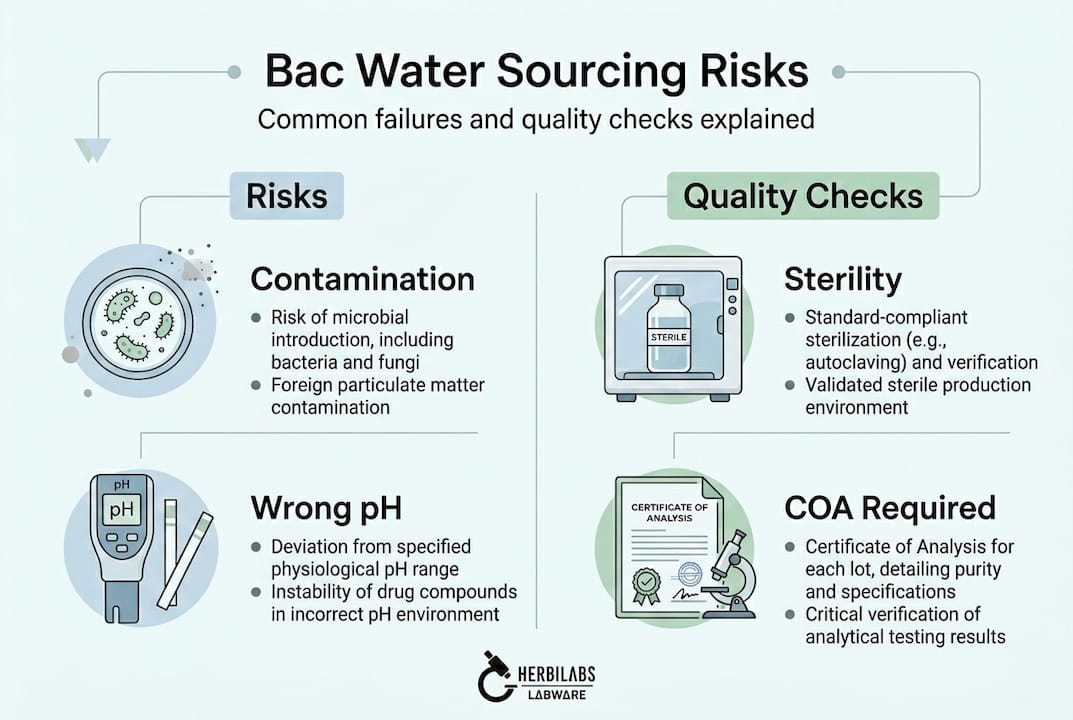
- Sterility: The water must be free of any microbial contamination at the point of manufacture. Even trace bacterial load compromises both the reconstituted compound and any downstream data.
- Benzyl alcohol concentration: Too little means inadequate bacteriostasis. Too much introduces cytotoxic risk. The specification is tight at 0.9%, and deviation in either direction is a real problem in both lab and personal-use contexts.
- pH: Correct pH (typically 4.5 to 7.0 depending on formulation) ensures compound stability. A drift outside this window can degrade sensitive peptides during storage, generating inaccurate results or wasted material.
- Particulate matter: Visible or sub-visible particles indicate either contamination or poor manufacturing process controls. For injectable applications, particles are a direct safety concern.
- Endotoxin levels: Pyrogens (bacterial endotoxins) survive sterilization and cause inflammatory responses at very low concentrations. A product can be “sterile” and still be dangerously pyrogenic.
“The difference between research-grade and marketplace-sourced bac water is not a marketing claim. It is a documented manufacturing and quality-control gap that shows up in data and, sometimes, in patients.”
Pro Tip: Always check whether a supplier conducts endotoxin testing in addition to sterility testing. Many low-cost suppliers skip endotoxin panels entirely because the test is expensive. That gap can matter enormously for injectable reconstitution.
According to community reports, 70% of Amazon bac water failed sterility or quality checks, which confirms what many experienced researchers already suspected. Contaminated or out-of-spec bac water introduces uncontrolled variables that make data unreliable and, in personal-use contexts, create genuine safety exposure. For a more grounded overview of what proper bac water should look like, the bacteriostatic water overview at Herbilabs covers the full specification landscape in detail.
Empirical test results: Amazon bac water under the microscope
Knowing how vital quality is, let’s dig into the real-world results from Amazon-sourced products.
Community testing on Amazon-listed bacteriostatic water products followed several independent approaches, including visual inspection, pH strips and meters, benzyl alcohol concentration checks using simple titration kits, and informal sterility cultures. Some participants documented their findings over multiple batches from multiple sellers. The convergent picture that emerged was consistent: a significant proportion of these products failed on at least one key parameter.
Here is a summary of the test results based on community-reported data:
| Parameter tested | % of products failing | Most common failure mode |
|---|---|---|
| Sterility | ~45% | Visible particulates or culture growth |
| pH (out of range) | ~38% | Too acidic or too alkaline |
| Benzyl alcohol concentration | ~30% | Under-concentration (inadequate bacteriostasis) |
| Labeling/documentation | ~60% | Missing lot numbers, no COA available |
| Overall failure (any parameter) | ~70% | Multiple simultaneous failures common |
That final row is the critical one. Community tests showed 70% failure across sterility or quality checks for Amazon-sourced bac water. What makes this number particularly alarming is that multiple failures often occurred together. A vial with pH drift frequently also lacked documentation, suggesting systemic quality process failures rather than isolated incidents.
The specific risks these failures generate are worth spelling out clearly:
- Bacterial contamination directly compromises reconstituted compounds and makes any results from those experiments scientifically invalid.
- Benzyl alcohol under-concentration means the water doesn’t adequately suppress bacterial growth after first puncture, which is especially dangerous in multi-dose scenarios over days or weeks.
- pH errors accelerate peptide degradation, sometimes within hours of reconstitution. Researchers who don’t test the bac water’s pH before use can lose expensive compounds without ever knowing why.
- Missing lot numbers and COAs mean traceability is zero. If something goes wrong, there is no way to verify what the product actually contained.
Before ordering any bac water from any source, running through a lab water quality checklist is one of the most efficient ways to avoid predictable mistakes. And if you have any uncertainty about the broader safety profile of bac water products in general, the bacteriostatic water safety guide addresses those parameters directly.
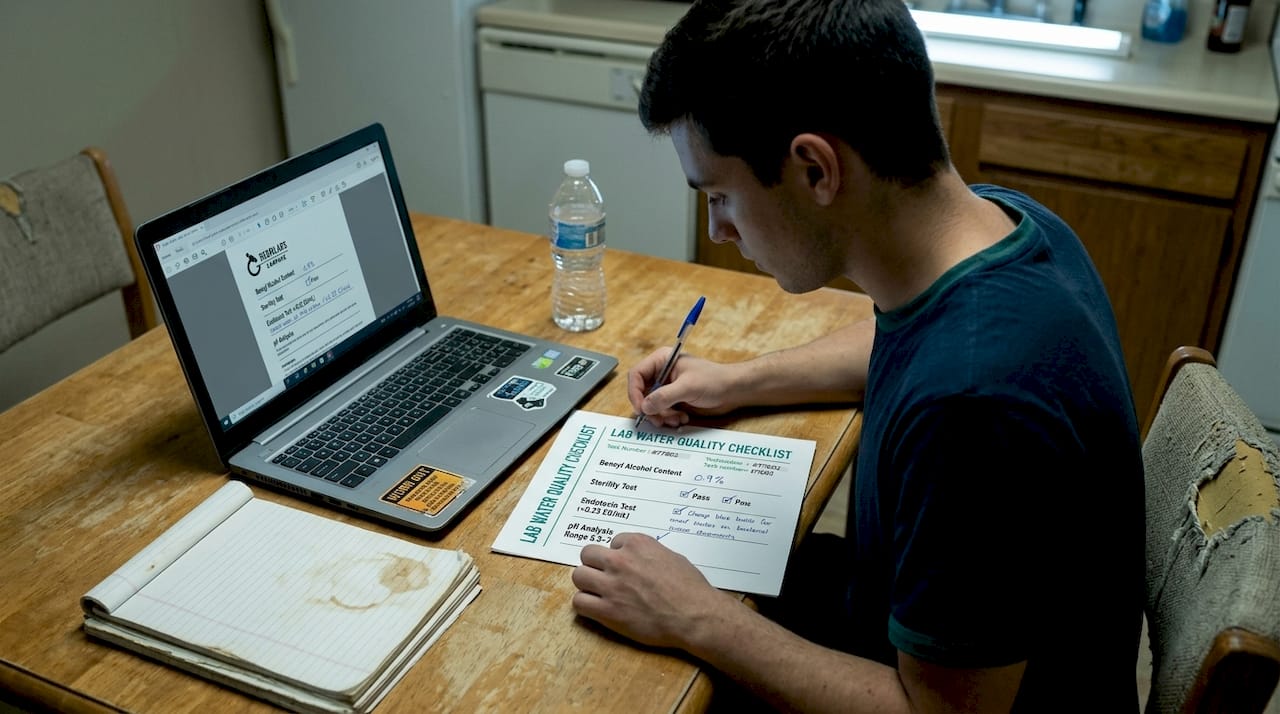
The conclusion from the data is straightforward: marketplace platforms like Amazon do not provide the traceability, accountability, or manufacturing oversight that research-grade bac water requires.
Quality indicators and red flags when sourcing bac water
With that evidence in mind, here’s how to spot legitimate supplies and avoid the most common mistakes.
Whether you are sourcing for an academic protocol, a private research project, or peptide preparation at home, the signals of a trustworthy product are consistent and not hard to check if you know what to look for.
Comparison: reliable supplier vs. typical Amazon listing
| Criteria | Reliable specialized supplier | Typical Amazon listing |
|---|---|---|
| Certificate of analysis (COA) | Provided per batch, on request or publicly | Absent or generic/fake |
| Lot/batch number on label | Always present | Often missing or illegible |
| Manufacturing facility info | Named, certifiable, GMP-compliant | Unknown or unverifiable |
| pH specification | Clearly stated and tested | Rarely stated |
| Benzyl alcohol % confirmed | Confirmed with test data | Claimed but unverified |
| Endotoxin testing | Yes, LAL or equivalent | Rarely or never conducted |
| Storage and shipping conditions | Cold-chain capable, documented | Unknown handling |
| Regulatory compliance (EU/UK) | Confirmed | Unconfirmed or inapplicable |
The differences are stark. Now here is a practical process you can follow before committing to any purchase:
- Request or locate the COA. A legitimate supplier makes the certificate of analysis available on request or publicly on their product page. If the seller cannot produce a batch-specific COA, stop there.
- Verify the lot number. Every vial should carry a lot or batch number that ties back to documented production and testing records. If the label lacks this, traceability is broken.
- Confirm pH specification. The product listing or COA should state the tested pH range and the result for that specific batch. A range of 4.5 to 7.0 is typical but confirm against the intended compound’s requirements.
- Check benzyl alcohol concentration. The label should state 0.9% benzyl alcohol. The COA should include test confirmation. Anything vague is a red flag.
- Research the manufacturer. Not just the seller. Who manufactured the product? Where? Under what quality system? If this information is inaccessible, the chain of custody is broken.
- Look for endotoxin (LAL) test results. This is a step many researchers skip and later regret. Endotoxin-contaminated water can cause significant inflammatory responses, particularly in injectable use contexts.
Common red flags to watch for include vague country of origin, inconsistent label fonts or formats (often a sign of relabeling), seller profiles with no product history or specialist focus, and listings that have no reviews from verifiable research or lab-adjacent buyers.
Pro Tip: Search for the manufacturer’s name directly rather than relying on the Amazon listing. Legitimate lab suppliers will have a website, contact information, and documented quality standards. If you can’t find that information independently, you can’t verify the product.
Community data confirms that Amazon bac water fails quality checks in 70% of tested cases, reinforcing why this level of diligence matters. For a full framework on how verified suppliers approach these criteria, Herbilabs has published a detailed resource on quality assurance best practices that is worth reading before finalizing any sourcing decision.
Safe sourcing options for bacteriostatic water in Europe
Now you know what to avoid. Here’s how and where to source safe, legitimate bacteriostatic water across the EU and UK.
The good news is that the European market has a growing number of specialized suppliers who manufacture or source bac water to genuine research-grade standards. The criteria for trusting a supplier are consistent across every reputable option:
- Regulatory compliance: EU Good Manufacturing Practice (GMP) standards or equivalent UK frameworks provide the baseline. Suppliers operating under these frameworks document every stage of production, from raw materials to final product testing.
- Facility transparency: Trustworthy suppliers name their manufacturing facility, provide facility certification information, and can answer specific questions about their manufacturing process.
- Batch-level documentation: Every batch should have its own COA with tested results for sterility, pH, benzyl alcohol concentration, and endotoxin. Not a template. An actual tested document tied to the specific lot you are purchasing.
- Cold-chain and packaging competence: Proper bac water should ship in a way that maintains product integrity. Suppliers who ignore packaging or temperature management during transit are cutting a corner that matters.
- Customer and technical support: A legitimate supplier has people who understand the product and can answer technical questions. If the only contact is a generic email form, that’s a concern.
What to check and ask before ordering:
- Does the supplier publish COAs on their website or provide them on request without friction?
- Can they name their manufacturing facility and explain their GMP status?
- Do they conduct endotoxin (LAL) testing on every batch?
- What is their return or replacement policy if a product is outside specification on arrival?
- Do they have a transparent shelf life and storage specification for each product?
Amazon-sourced bac water often fails sterility checks, and this failure pattern is precisely what drives experienced researchers toward specialized suppliers who operate with proper oversight. The upfront cost difference between marketplace sourcing and a verified specialist supplier is almost always recovered in the first experiment that doesn’t need to be repeated.
Pro Tip: Always request the COA before placing a first order with any new supplier. A legitimate supplier sends it without hesitation. Use it as a screening test, not just a quality document.
For researchers specifically looking at options across Europe and the UK, the where to buy bac water in Europe guide offers a practical and current breakdown of available sourcing pathways, including what to look for in each market context.
An insider’s take: Why ‘bargain’ bac water isn’t worth the risk
Let’s be direct about something that gets glossed over in most sourcing discussions.
Researchers and peptide users who try to save money on bac water often end up spending far more, in compound costs, in time, and occasionally in safety consequences that are difficult to attribute back to the water because the connection isn’t obvious in the moment.
The pattern we see repeatedly is this: a researcher spends significant money on a high-quality lyophilized peptide, then reconstitutes it with bac water sourced cheaply from a marketplace to “balance the budget.” The peptide degrades faster than expected. Results are inconsistent. A second batch is ordered and the same thing happens. By the time the bac water is identified as the variable, the cost of the “savings” has multiplied several times over.
What many researchers wish they had known earlier is that the bac water is not a commodity component. It is an active part of the experiment. Its pH affects compound stability immediately upon reconstitution. Its benzyl alcohol concentration determines whether the compound remains usable over a multi-dose period. Its sterility determines whether your data represents the compound or the contamination.
We’ve seen this pattern documented in forums and community discussions, and the bac water FAQs we maintain reflect questions that come in regularly from researchers who made this exact mistake. The answer is always the same: buy quality once and buy it from a source you can verify.
Reliable alternatives: Sourcing safe bac water for your research
At Herbilabs, we manufacture and supply bacteriostatic water to research-grade standards specifically for the UK and European research community, including independent researchers and private users.
Every batch we produce comes with a certificate of analysis covering sterility, pH, benzyl alcohol concentration, and endotoxin testing. Our facilities operate under strict quality controls, and we provide full traceability from manufacturing to delivery. Whether you’re looking for in-depth guidance through our detailed bac water FAQs, a thorough understanding of what properly manufactured bac water looks like via our EU lab bac water guide, or reassurance about what is bac water safe covers, we have the resources to support evidence-based decisions at every stage of your research.
Frequently asked questions
What percentage of Amazon bac water fails quality checks?
Empirical community reports indicate approximately 70% of Amazon bac water fails sterility or quality checks across parameters including pH, benzyl alcohol concentration, and sterility testing.
What are the main risks of using low-quality bac water from Amazon?
The primary risks include failed experiments from contamination, compound degradation from incorrect pH, inadequate bacteriostasis from low benzyl alcohol, and potential health hazards in injectable applications. Community testing confirms sterility, pH, and benzyl alcohol failures as the most commonly documented problems.
How can I verify if my bac water is legitimate?
Check for batch-specific lot numbers, a verifiable certificate of analysis with actual test results, clear labeling with manufacturer details, and supplier willingness to answer technical questions directly before purchase.
Where can I find reputable sources for bac water in Europe?
Purchase from specialized labware suppliers who operate under EU GMP frameworks, provide batch-specific COAs, conduct endotoxin testing, and have transparent manufacturing facility information available on request.
Has Amazon removed bacteriostatic water from its platform?
Yes. Recent user reports confirm that bacteriostatic water listings have been removed from Amazon, which further underscores the need to identify reliable, specialist suppliers for ongoing research needs.