Private Label, White Label, Wholesale partnerships available - EU, USA and UK - Free shipping from €75

The Role of Storage Conditions in Reagent Stability
Discover the crucial role of storage conditions in reagent stability. Learn how your storage practices can impact peptide synthesis yields.
TL;DR:
- Proper storage conditions are critical for maintaining reagent stability in peptide research, as temperature, humidity, and light exposure actively influence degradation rates. Implementing strict handling protocols, aliquoting, and continuous monitoring extends reagent lifespan and ensures experimental reliability. Regulatory frameworks reinforce the importance of validated storage practices, emphasizing that deviations can irreparably compromise reagent integrity and data quality.
If you’ve ever run a peptide synthesis assay and gotten unexpectedly poor yields, your reagents may have been compromised long before you opened the vial. The role of storage conditions in reagent stability is one of the most underestimated variables in peptide research. Most researchers treat storage as a one-time setup task, but stability is an active, ongoing process shaped by temperature, humidity, light exposure, and handling practices. Get any one of those wrong, and your reagents can degrade far faster than the expiration date suggests.
Table of Contents
- Key Takeaways
- Role of storage conditions in reagent stability: the science
- Practical storage guidelines for peptide research reagents
- Regulatory and quality control frameworks
- Effects of storage deviations and excursions
- Best practices for maximizing reagent lifespan
- My perspective on reagent storage in peptide research
- Reliable reagent storage starts with quality products
- FAQ
Key Takeaways
| Point | Details |
|---|---|
| Temperature drives degradation rate | Even 4°C storage only slows degradation; reagents continue to lose potency and require validated use windows. |
| Humidity and oxygen accelerate breakdown | Moisture triggers hydrolysis, oxygen promotes oxidation, and both destroy reagent integrity faster than expected. |
| Aliquoting extends reagent lifespan | Single-use aliquots eliminate repeated freeze-thaw cycles that degrade enzymatic and peptide reagents. |
| Regulatory frameworks define storage thresholds | ICH Q1A(R2) and FDA 21 CFR 58.83 set specific conditions that directly translate to operational lab requirements. |
| Excursions require documented responses | Even a 2°C deviation for 72 hours can compromise shelf-life data and render samples unusable. |
Role of storage conditions in reagent stability: the science
Reagent degradation is not a sudden event. It follows predictable chemical kinetics, and storage conditions directly control how fast those kinetics operate. Understanding the underlying mechanisms gives you the tools to anticipate failures rather than just react to them.
How temperature governs reaction rates
The Arrhenius equation describes how reaction rates increase exponentially with temperature. Every 10°C rise roughly doubles or triples the rate of most chemical degradation reactions. This is why cold storage matters so much, but it also explains why cold storage alone does not stop degradation. It only slows the inevitable.
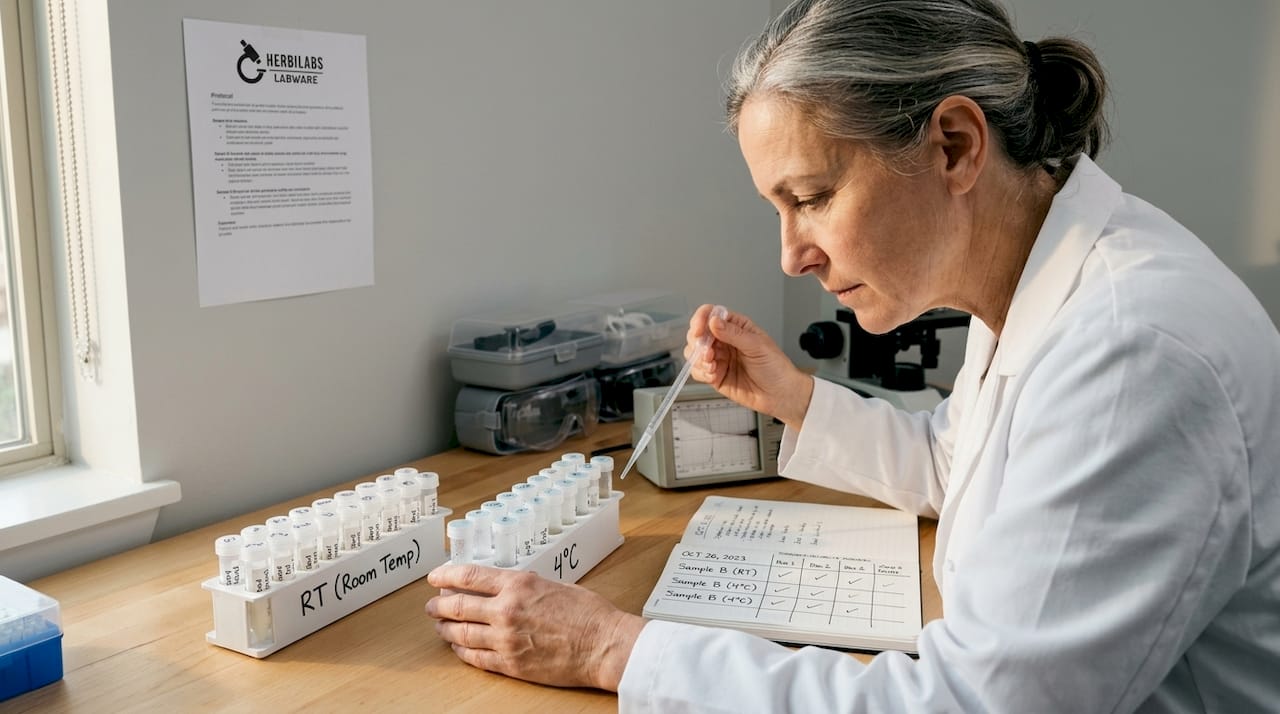
Azacitidine is a striking example. At room temperature, only ~15% of the drug remains intact after 24 hours. At 4°C, that figure rises to ~74%, a 4.6-fold difference in degradation kinetics. For peptide reagents in your lab, this means that even brief excursions from cold storage carry measurable consequences.
Moisture, oxygen, and light as degradation accelerators
Beyond temperature, three other environmental factors influence reagent integrity:
- Humidity and hydrolysis. Water molecules cleave peptide bonds, ester linkages, and other reactive sites. Hygroscopic reagents absorb atmospheric moisture and begin degrading before you even use them. The effects of humidity on reagents are especially pronounced with lyophilized peptide stocks and enzyme preparations.
- Oxygen and oxidation. Methionine, cysteine, and tryptophan residues in peptide reagents are particularly vulnerable to oxidation. Exposure to air during storage or handling triggers cascading degradation that no downstream step can reverse.
- Light-driven photodegradation. UV and visible light catalyze free-radical reactions in sensitive reagents. Even fluorescent laboratory lighting is enough to compromise some chromogenic substrates and labeled peptides over time.
Pro Tip: Store light-sensitive reagents in amber vials or wrapped containers, and never leave stock solutions uncapped on the benchtop during prolonged procedures.
mRNA-LNP formulations illustrate how formulation and temperature interact. Ultra-cold storage below -20°C with sucrose stabilizers preserves integrity, while 5°C storage leads to more than a 10-fold potency loss over 12 months. The lesson applies broadly: buffer composition, container material, and temperature-time profiles are not independent variables.
Practical storage guidelines for peptide research reagents
Knowing the science matters, but what you actually do in the lab determines outcomes. Reagent storage guidelines are most useful when they are specific, testable, and tied to the reagent class you are working with.
Temperature ranges by reagent type
Different reagent formats require different temperature targets:
- Lyophilized peptides. Store desiccated at -20°C or colder in sealed, inert containers. Once reconstituted, use within the manufacturer-specified window or aliquot immediately and refreeze.
- Enzyme-containing reagents. Illumina sequencing kits, for example, require -20°C to -25°C before thawing. After thawing, store at 2°C to 8°C with kit-specific stability windows, such as one week for iSeq 100 kits.
- Buffer solutions. Most aqueous buffers tolerate 4°C storage for weeks. However, buffers containing reducing agents like DTT or TCEP degrade rapidly and should be prepared fresh or aliquoted under inert gas.
- Labeled and fluorescent reagents. Keep frozen in light-tight containers. Room temperature exposure accelerates both photodegradation and fluorophore quenching.
Thawing and handling protocols
Thawing is where many labs lose reagent quality without realizing it. Repeated freeze-thaw cycles and prolonged thaw times degrade enzymatic reagents and directly affect experimental outcomes. The fix is straightforward but requires discipline.
| Practice | Recommended approach | Common mistake |
|---|---|---|
| Thawing method | Thaw on ice or at 4°C overnight | Thawing at room temperature |
| Aliquot strategy | Single-use aliquots from master stock | Repeated freeze-thaw of bulk stock |
| Post-thaw storage | 2°C to 8°C with defined use window | Refreezing partially used aliquots |
| Container choice | Inert polypropylene, low-bind tubes | Standard microcentrifuge tubes with high surface binding |
Aliquoting is the single most effective intervention for how storage affects reagent lifespan. When you divide a master stock into single-use portions on the day you receive it, you eliminate the biggest source of incremental degradation in most labs.
Pro Tip: Label every aliquot with the date of preparation and the number of freeze-thaw cycles it has been through. A simple log takes 30 seconds and saves hours of troubleshooting later. For detailed protocols, Herbilabs publishes a peptide storage guide covering 28-day stability windows for common research formats.
For reconstitution solutions specifically, the choice of diluent and the storage vessel matter as much as the temperature. Bacteriostatic water, for instance, carries inherent antimicrobial protection that extends usable shelf life in ways sterile water cannot match.
Regulatory and quality control frameworks
Regulatory guidance on reagent storage is not just bureaucratic overhead. It encodes decades of stability science into operational requirements that directly protect your data integrity.
FDA and ICH requirements
Under US CFR 21 §58.83, all reagents must be properly labeled with storage conditions and expiration dates. Deteriorated or outdated reagents must not be used. This is a compliance baseline, but it also reflects a scientific reality: using a reagent outside its validated storage conditions is equivalent to using an unknown reagent.
ICH Q1A(R2) defines the stability testing conditions that generate the shelf-life data printed on your reagent labels:
- Long-term: 25°C ± 2°C at 60% RH ± 5% RH
- Intermediate: 30°C ± 2°C at 65% RH ± 5% RH
- Accelerated: 40°C ± 2°C at 75% RH ± 5% RH
These stability testing conditions translate directly to lab operations. If your storage chamber drifts outside the long-term band, the shelf-life data from the manufacturer no longer applies to your sample.
Treating a manufacturer’s expiration date as an absolute guarantee only holds if your storage conditions match the conditions under which the shelf-life study was conducted. Deviation breaks that guarantee entirely.
Chain of custody documentation and temperature logs are not optional niceties. They are the only way to demonstrate, under inspection or troubleshooting, that a reagent failure was a product issue and not a storage failure. A quality control framework built around continuous monitoring is the foundation of defensible research.
Effects of storage deviations and excursions
Even well-designed storage systems fail. Equipment drifts, power goes out, and someone leaves the freezer door ajar. What matters is how quickly you detect excursions and how rigorously you respond.
How small deviations compound over time
The numbers are sobering. A 2°C above-setpoint excursion sustained for just 72 hours can produce shelf-life estimation data that is effectively unusable. For moisture-sensitive samples, the same excursion accelerates hydrolysis in ways that are invisible until your assay fails.
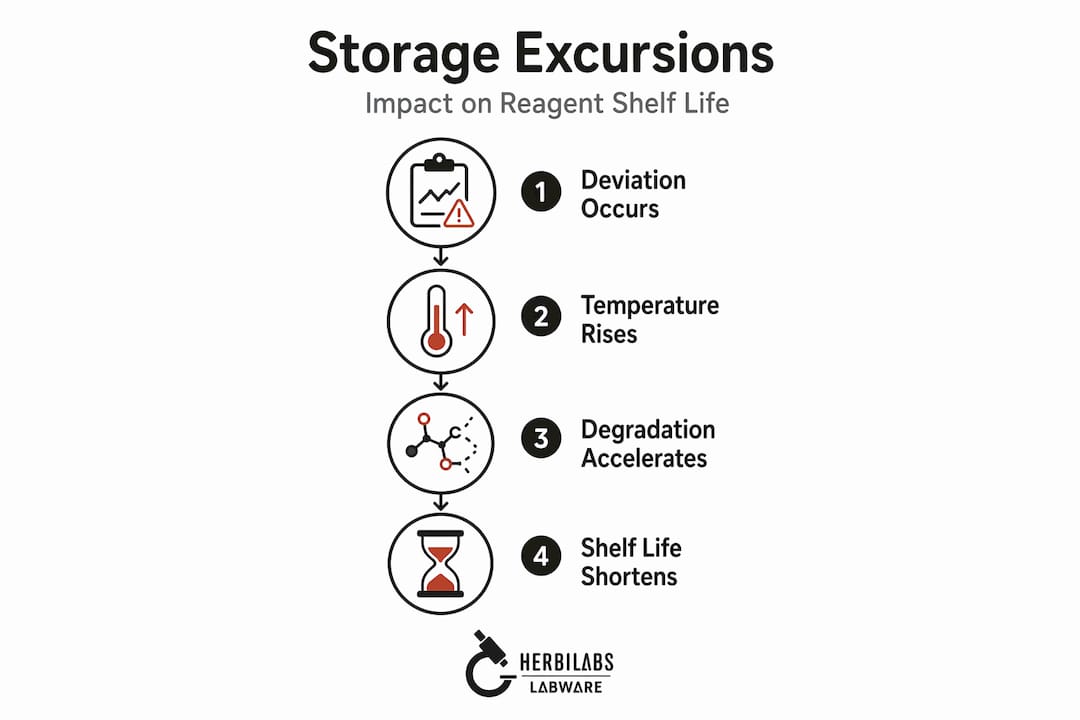
Single thermostat readings are insufficient to characterize storage chamber uniformity. Full chambers create thermal gradients. Samples near the door or in corners of a freezer can experience temperatures meaningfully different from the setpoint, especially when load configuration changes.
Best practices for managing deviations include:
- Temperature mapping at qualification. Map your storage chambers when empty, at partial load, and at full load. Hotspots and cold zones shift with fill level.
- Continuous data logging with alert thresholds. Set alerts at 1°C outside your target range, not at the regulatory limit. Early warning gives you time to act before the excursion becomes a write-off.
- Documented excursion responses. Every excursion should trigger a written investigation: what happened, how long it lasted, what samples were affected, and what corrective action was taken.
- Segregation of potentially compromised stock. Move flagged reagents to a quarantine location immediately and requalify before use.
Pro Tip: Do not rely solely on the chamber’s built-in temperature display. Use an independent calibrated data logger placed at the center of the sample load. Discrepancies between the two readings are more common than most labs expect.
Best practices for maximizing reagent lifespan
Optimal storage conditions for reagents are the sum of many small, consistent decisions made across the entire lifecycle of a reagent, from receipt through final use. No single intervention is enough on its own.
- Inspect on arrival. Check packaging integrity, temperature indicators, and expiration dates before signing off on receipt. A compromised cold-chain at delivery is the supplier’s problem, but only if you catch it before accepting the shipment.
- Store immediately at validated conditions. Do not let reagents sit at ambient temperature while you process paperwork. Every minute at room temperature counts, especially for enzymatic and peptide reagents.
- Aliquot at first use. Divide master stocks into single-use portions sized for one experiment. Label with date, lot number, and freeze-thaw cycle count.
- Implement a first-in, first-out inventory system. Older stock should always be consumed before newer arrivals. Reagent rotation is basic but frequently neglected in busy labs.
- Review storage records regularly. Monthly audits of temperature logs catch drift before it becomes a systemic problem. Pair this with scheduled preventive maintenance on refrigeration equipment.
- Match your storage solution to the reagent format. Peptide solutions, lyophilized powders, enzyme mixes, and labeled conjugates each have distinct needs. A research reagent storage guide built around your specific reagent portfolio will save time and prevent losses.
My perspective on reagent storage in peptide research
I’ve spent enough time in and around peptide research labs to recognize the pattern: storage gets treated as a solved problem. The freezer is set to -20°C, the humidity alarm is somewhere in the settings, and everyone moves on to the science. The assumption is that if the equipment is running, the reagents are fine.
What I’ve learned is that this assumption is the most expensive one in the lab. I’ve seen entire batches of reconstituted peptide lose potency between day one and day three of an experiment, not because of a dramatic failure, but because of a 20-minute room-temperature thaw, a high-bind tube, and a buffer that had been sitting unsealed in the fridge for two weeks.
The subtlety that most practitioners miss is the interaction between thaw timing and buffer composition. A reducing agent that degrades in the buffer during refrigerator storage can actually oxidize your peptide faster than if you’d used plain water. The storage condition of your diluent is just as consequential as the storage condition of your stock.
My take: treat reagent storage as an ongoing quality management task. That means auditing your cold chain quarterly, validating your storage chambers annually, and documenting every excursion regardless of how minor it looks. Regulatory inspectors are not the only audience for those records. You are. When an experiment fails six months from now, those logs are what let you distinguish a storage problem from a protocol problem.
— Ragnar
Reliable reagent storage starts with quality products
Your storage protocols are only as good as the reagents and diluents you start with. At Herbilabs, every bacteriostatic water product and sterile reconstitution solution is manufactured under rigorous quality control standards specifically designed to support the demands of peptide research. Consistent purity means your starting material is not a variable you need to account for.
If you are working with reconstituted peptides or enzyme-based assay reagents, the stability of your bacteriostatic water diluent directly affects how long your prepared solutions remain viable. Herbilabs products are produced to strict purity standards and are supported by full documentation, so you can build them into your validated protocols with confidence. Explore the Herbilabs catalog to find research-grade solutions matched to your specific peptide research requirements.
FAQ
How does temperature affect reagent stability?
Temperature directly controls degradation reaction rates. At room temperature, some reagents like azacitidine lose over 85% of their potency within 24 hours, while storage at 4°C preserves roughly 74% over the same period.
What is the recommended storage temperature for most peptide reagents?
Lyophilized peptides should be stored at -20°C or below in sealed, desiccated containers. Reconstituted peptide solutions are typically stable at 4°C for short-term use but should be aliquoted and frozen for anything beyond a few days.
How do humidity and oxygen affect reagents in storage?
Humidity drives hydrolysis of peptide bonds and other sensitive linkages, while oxygen oxidizes reactive residues like methionine and cysteine. Both processes permanently reduce reagent potency and cannot be reversed after exposure.
What counts as a storage excursion, and why does it matter?
A storage excursion occurs any time a reagent is held outside its validated temperature or humidity range. Even a 2°C deviation sustained for 72 hours can compromise shelf-life data and make accelerated stability estimates unreliable.
Why is aliquoting important for reagent stability?
Aliquoting eliminates repeated freeze-thaw cycles, which degrade enzymatic activity and peptide integrity with each cycle. Single-use portions prepared from a master stock at first receipt represent one of the most cost-effective stability interventions available to any lab.