Private Label, White Label, Wholesale partnerships available - EU, USA and UK - Free shipping from €75

The Role of Water Quality in Experimentation
Discover the critical role of water quality in experimentation and how it impacts reproducibility. Make informed choices for better results!
TL;DR:
- Water is the most frequently used reagent in laboratories but often remains uncontrolled, introducing variability that hampers reproducibility. Ensuring water quality through proper grading, point-of-use verification, lifecycle management, and storage controls is essential to prevent contamination-driven assay errors and maintain experimental integrity. Adopting continuous monitoring and systematic audits of water systems helps researchers treat water quality as a critical, controllable variable in scientific experiments.
Water is the most used reagent in any laboratory, yet it’s also the most frequently uncontrolled one. The role of water quality in experimentation goes far beyond choosing between distilled and deionized. Trace ionic contaminants, dissolved organics, microbial load, and even the container you store it in can introduce variability that breaks reproducibility and generates analytical artifacts. As ASTM D1193-24 standards and evolving regulatory frameworks continue to tighten specifications in 2026, researchers who treat water as a passive solvent are working with a critical blind spot in their experimental design.
Table of Contents
- Key takeaways
- The role of water quality in experimentation: parameters and standards
- How impurities disrupt analytical methods
- Lifecycle management of lab water systems
- Selecting and verifying water quality for your workflow
- Emerging challenges in water quality control
- My take on water as a research variable
- Why Herbilabs researchers trust their reagent water
- FAQ
Key takeaways
| Point | Details |
|---|---|
| Water grade must match your method | Using the wrong ASTM water type introduces background interference that invalidates sensitive assays. |
| Point-of-use verification is non-negotiable | Purification systems can’t guarantee purity at the bench; you must verify quality where water enters the assay. |
| Biofilm is a hidden reproducibility threat | Distribution piping sheds organic and microbial material even when bulk metrics look acceptable. |
| Storage and handling cause quality drift | Unsuitable containers and extended storage times reintroduce contaminants into purified water. |
| Treat water as a controlled reagent | Apply the same documentation, lot tracking, and specification controls you use for any other reagent. |
The role of water quality in experimentation: parameters and standards
Before you can manage water quality, you need to know what you’re measuring. Three parameters define the majority of water purity specifications used across laboratory settings: resistivity, total organic carbon (TOC), and microbial content.
Resistivity measures how strongly water resists electrical conduction. Pure water at 25°C has a theoretical maximum resistivity of 18.2 MΩ·cm. Any dissolved ions reduce that number. TOC measures the total carbon content from organic compounds, whether from environmental contamination, plastic leaching, or biological activity. Microbial content, expressed as colony-forming units per milliliter (CFU/mL), captures bacterial load that can metabolize, shed endotoxins, or directly interfere with biological assays.
ASTM D1193-24 defines four grades of reagent water, each with distinct purity thresholds:
| Water Type | Resistivity (MΩ·cm) | TOC (ppb) | Microbial Limit (CFU/mL) | Typical Application |
|---|---|---|---|---|
| Type I | 18.2 | <10 | <1 | HPLC, ICP-MS, cell culture |
| Type II | ≥1 | <50 | <10 | General analytical chemistry |
| Type III | ≥0.05 | <200 | <1000 | Glassware rinsing, feed water |
| Type IV | Not specified | Not specified | Not specified | Preliminary rinses |
Matching water grade to your experimental technique is one of the most direct ways to reduce unexplained variability. Feeding a TOC-sensitive LC-MS workflow with Type III water is not a cost-saving measure. It’s a guarantee of background artifacts that will consume hours of troubleshooting time. ASTM D1193-24 also provides guidance in Appendix X1 on use, storage, and validation, all of which are now required reading for any lab pursuing method compliance in 2026.
How impurities disrupt analytical methods
The significance of water conditions becomes clearest when you examine exactly how contaminants interfere at the method level. Trace contamination in lab water is not an abstract concern. It produces specific, reproducible failure modes.
Here are the four most common contamination-driven errors researchers encounter:
-
Signal suppression in LC-MS and ICP-MS. Ionic species in water compete with analyte ions during ionization, compressing the signal and causing underestimation of true concentrations. Even low-ppb sodium contamination can shift calibration curves.
-
False positives in microbiological assays. Water carrying viable microbial load or endotoxins triggers responses in biological assays independent of your sample, particularly in cell-based and limulus amebocyte lysate (LAL) assays.
-
Elevated baseline in UV spectrophotometry. Dissolved organics absorb in the UV range. If your water TOC is uncontrolled, your blank subtraction is unreliable, and low-concentration analytes become statistically indistinguishable from background.
-
Precipitation and matrix effects in protein assays. Divalent cations like calcium and magnesium in water interfere with buffer preparation and can cause protein aggregation or altered enzyme activity, masking real biological effects.
Water grade must match the method, and quality should be verified at the point of use, not just at the purification unit output. That last part is where most labs fail. Your ultrapure system may be performing perfectly, but the 2-meter tubing run to the bench, the storage vessel, or the pipette reservoir could be reintroducing contaminants.
Type I ultrapure water at 18.2 MΩ·cm and TOC below 50 ppb is the minimum standard for ultra-trace analytical techniques. For HPLC mobile phase preparation or ICP-MS standard dilution, anything less introduces method-level uncertainty that cannot be corrected during data analysis.
Pro Tip: Run a paired comparison of your analytical blanks prepared with in-house Type I water versus certified reference water quarterly. Divergence between the two signals at your detection threshold is a reliable early indicator of system degradation before it becomes visible in your calibration data.
Lifecycle management of lab water systems
Getting water purity right at the purification unit is only the beginning. Microbial contamination risk is system-wide and requires lifecycle design and operational controls, not just filtration technology.
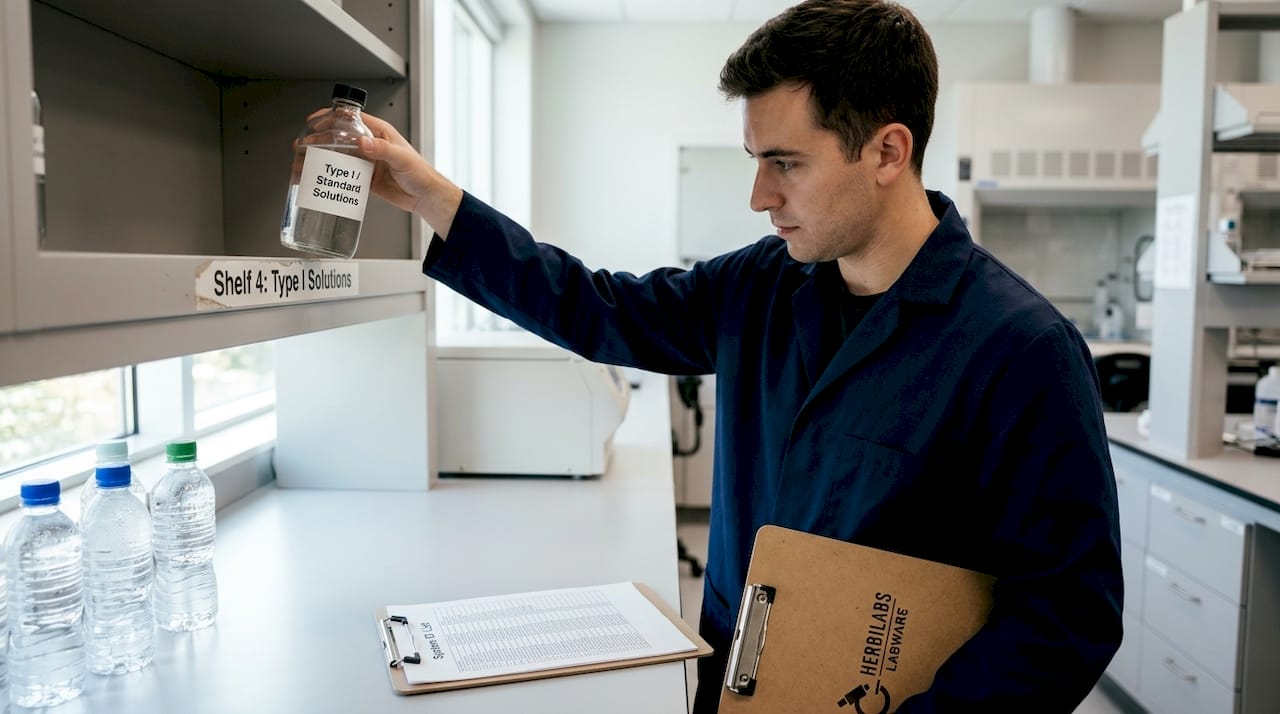
Think of lab water quality as a chain. Each link represents a stage where contamination can enter or amplify. The chain runs from raw feed water through pretreatment, primary purification (typically reverse osmosis), polishing (electrodeionization or mixed-bed ion exchange), distribution piping, point-of-use dispensing, and finally storage. Breaking the chain at any stage compromises everything downstream.
Biofilm is the most underestimated threat in this chain. Biofilms in distribution systems shed organic and microbial by-products that alter sample reproducibility even when bulk water resistivity or TOC readings appear acceptable. A water system that passes its morning quality check can still be shedding Pseudomonas biofilm fragments into your afternoon samples.
The operational controls that actually protect quality across the lifecycle include:
- Inline monitoring of resistivity and TOC at both the purification unit output and point of use. If the two readings diverge, the distribution system is contributing contamination.
- Scheduled cartridge and filter replacement based on validated usage volume or time limits, not just instrument alarms. Waiting for a fault signal means you’ve already been running with degraded purity.
- Periodic microbial testing using membrane filtration or heterotrophic plate count methods, at frequencies matched to your system size and microbial risk profile.
- UV sanitization or recirculation loops to prevent stagnant water in distribution lines. Stagnant segments are biofilm nurseries.
- Low-extractable storage containers, typically made from borosilicate glass or certified low-extractable fluoropolymer, for any water held before use. Polycarbonate and standard polyethylene containers leach plasticizers and metal ions into purified water within hours.
Poor handling and extended storage accumulate impurities that directly affect analytical accuracy. The practical rule: purified water that sits in a container for more than 24 hours should be treated as suspect for trace-level applications.
Pro Tip: Label every stored water aliquot with production time and system ID, exactly as you would a reagent lot. This creates an audit trail when anomalous results need investigation and encourages the habit of treating water as a controlled material.
Selecting and verifying water quality for your workflow
With parameters and lifecycle risks understood, the next step is building a selection and verification process that fits your actual experimental workflow. For guidance on ASTM Type I water criteria in biomedical and trace analytical applications, a structured checklist approach is the most practical starting point.
Start by characterizing the sensitivity of your technique. Ultra-trace methods like ICP-MS, LC-MS/MS, and single-cell assays require Type I water with continuous inline monitoring. General photometric or gravimetric methods can often operate with Type II, provided storage and handling controls are in place. Cell culture and biological assays require Type I water with additional endotoxin testing, since resistivity and TOC alone don’t capture endotoxin load.
| Verification Method | What It Measures | Recommended Frequency |
|---|---|---|
| Inline resistivity monitor | Ionic contamination | Continuous |
| Inline TOC analyzer | Organic contamination | Continuous or daily |
| Membrane filtration count | Viable microbial load | Weekly to monthly |
| Endotoxin (LAL) test | Endotoxin units | Per batch for biologics |
| ICP-MS of water blank | Trace metal profile | Quarterly |
Point-of-use verification is the most defensible approach for protecting assay integrity. Multiple contamination pathways exist between the purification unit and your experiment, and upstream monitoring cannot account for all of them. Verify at the bench, not just at the machine.
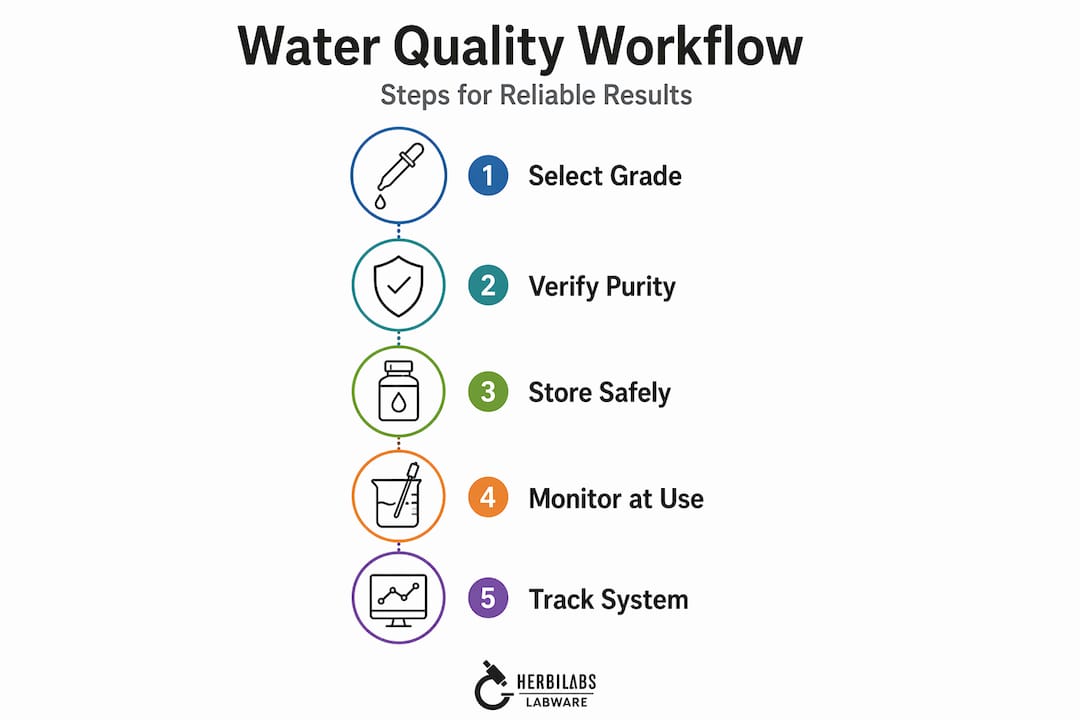
Container choice matters more than most researchers expect. For safe storage practices that prevent quality drift, borosilicate glass or certified fluoropolymer vessels should be your default. Never store Type I water in open containers or reuse vessels that previously held biological samples without validated decontamination.
Emerging challenges in water quality control
The role of water quality in research is getting more complicated as both the science and the regulatory environment evolve. Three trends are shaping how labs will need to approach water management through 2026 and beyond.
-
Distribution system biofilms are receiving dedicated regulatory attention. Biofilm formation in piping is now recognized as a primary driver of intra-lab reproducibility failures, and replicate sampling design that accounts for biofilm shedding variability is increasingly expected in method validation documentation.
-
USP and FDA alignment with ASTM standards is tightening. Pharmaceutical water system validation already requires documented TOC and microbial action thresholds under USP chapters including <61>, <62>, and <643>. Life science research labs operating under GLP or GMP conditions are increasingly held to equivalent standards.
-
Predictive maintenance and real-time monitoring are replacing scheduled checks. IoT-connected water quality systems now generate continuous data streams that can flag anomalies within minutes. For high-throughput research environments, this shift from periodic to continuous monitoring substantially reduces the window of contaminated water use.
The labs that will achieve the most consistent reproducibility in the next five years are the ones treating water quality monitoring as a data stream, not a maintenance task.
Sustainability is also entering the conversation. Energy-efficient purification technologies like electrodeionization generate less wastewater than traditional mixed-bed systems, making them increasingly attractive for labs with sustainability mandates alongside performance requirements.
My take on water as a research variable
I’ve reviewed results from labs where everything looked correct on paper. Columns freshly conditioned, calibration standards freshly prepared, instruments within specification. And the data was still wrong, subtly but consistently wrong in ways that took weeks to trace back to water quality.
In my experience, the fundamental mistake researchers make is treating water quality as a procurement decision rather than an experimental variable. You specify your antibodies, your buffers, your reference standards with care. Then you draw water from a system that hasn’t been microbially tested in three months and call it Type I because the resistivity display says 18.2.
What I’ve learned is that the quality of your water is only as good as the weakest point in its handling chain. Purified water does not remain pure post-treatment without continuous handling and storage controls. A well-designed purification system paired with poor dispensing practices produces the same contaminated endpoint as a poorly maintained system.
My strongest recommendation is to conduct a full audit of your water system at least once per year, from pretreatment to point of use. Document every component, every holding volume, every potential dead-leg in your distribution piping. Treat that audit report the way you’d treat an equipment qualification record. That mindset shift, from infrastructure to controlled reagent system, is where reproducibility actually begins.
— Ragnar
Why Herbilabs researchers trust their reagent water
For researchers who need confidence in their reconstitution solutions and sterile diluents, Herbilabs supplies bacteriostatic water and research reagents manufactured to strict purity standards in a dedicated facility. Every product is designed to address the contamination and handling challenges covered in this article, from controlled microbial content to certified container integrity.
If you’re building or auditing your lab’s water quality protocols, start with the bacteriostatic water guide to understand which water type fits your specific application. For application-specific decisions, including microbial risk control in reconstitution workflows, explore the bac vs. sterile water comparison or browse the researcher FAQ resource for direct answers to the questions labs ask most.
FAQ
What is the role of water quality in experimentation?
Water quality directly affects analytical signal integrity, assay specificity, and result reproducibility. Ionic, organic, and microbial contaminants in reagent water introduce artifacts, suppress signals, and create false positives that cannot be corrected after data collection.
Which ASTM water type should I use for HPLC or ICP-MS?
Type I ultrapure water with resistivity at 18.2 MΩ·cm and TOC below 50 ppb is required for ultra-trace methods including HPLC and ICP-MS. Lower grades introduce background contamination that compromises calibration and detection limits.
Can water quality affect biological assay results?
Yes. Viable microbial load, endotoxins, and dissolved organics in water all trigger biological responses independent of your actual sample, particularly in cell-based assays and protein quantification methods.
How often should I verify water quality at the point of use?
Resistivity and TOC should be monitored continuously or daily with inline analyzers. Microbial counts require periodic testing at frequencies matched to your system’s risk profile, typically weekly to monthly for active research labs.
Does storage container type affect purified water quality?
Significantly. Low-extractable borosilicate glass or certified fluoropolymer containers are required for Type I water. Standard plastic containers leach plasticizers and metal ions that degrade purity within hours of contact.