Private Label, White Label, Wholesale partnerships available - EU, USA and UK - Free shipping from €75

The Purpose of Research-Grade Solvents Explained
Discover the purpose of research-grade solvents and how their purity impacts your experimental results. Get the insights you need!
TL;DR:
- Research-grade solvents are manufactured with specified high purity and lot-specific documentation to ensure experimental accuracy. Using the correct grade is vital for reliable chromatography, spectroscopy, and synthesis results, as impurities can cause data inconsistencies and instrument issues. Proper storage, handling, and verifying COA details before use are essential practices to maintain solvent integrity and reproducibility in research.
Solvent grade is one of those decisions that looks minor on a purchase order but can silently undermine months of work. The purpose of research-grade solvents goes beyond simple chemical dissolution. These solvents are manufactured to defined purity thresholds, documented with lot-specific data, and selected specifically because unknown impurities at trace levels can shift spectroscopic baselines, corrupt chromatographic peaks, and invalidate synthesis yields. If you have ever chased an anomalous result back to the reagent shelf, you already know the stakes. This article breaks down what makes a solvent “research-grade,” which types matter most, and how to keep them performing the way your experiments require.
Table of Contents
- Key Takeaways
- Purpose of research-grade solvents and how they are defined
- Why the purpose of research-grade solvents matters in practice
- Top research-grade solvents and their applications
- Handling and storage to maintain solvent integrity
- My perspective on solvent grade as a practical discipline
- Why Herbilabs supports your solvent quality work
- FAQ
Key Takeaways
| Point | Details |
|---|---|
| Purity defines the grade | Research-grade solvents carry defined impurity profiles and lot-specific COAs that make experimental results traceable and reproducible. |
| Grade selection affects instruments | Using the wrong solvent grade in LC-MS or HPLC introduces interferences that skew data and shorten column life. |
| Not all grades are interchangeable | Pharmaceutical-grade solvents meet stricter compendial standards; technical-grade solvents are unsuitable for analytical work. |
| Storage protects your investment | Proper container choice, temperature control, and minimal headspace are as important as the grade you purchase. |
| COAs are working documents | Read them before every experiment, not just when opening a new lot for the first time. |
Purpose of research-grade solvents and how they are defined
A research-grade solvent is not simply a chemical that is “pretty pure.” It is a solvent produced to a specified purity range, typically 99% or higher, with a known impurity profile and documentation that lets you confirm every batch meets that standard. R&D labs account for about 12% of pharmaceutical-grade solvent demand, which reflects how central high-purity solvents are to analytical testing and synthesis work.
The key document is the Certificate of Analysis, or COA. Lot-specific COAs specify purity, water content, and common impurities so you can validate solvent suitability before a single experiment begins. This is not bureaucracy. It is the only way to confirm that what is in the bottle matches what the label claims for that specific production run.
How research-grade compares to other solvent grades
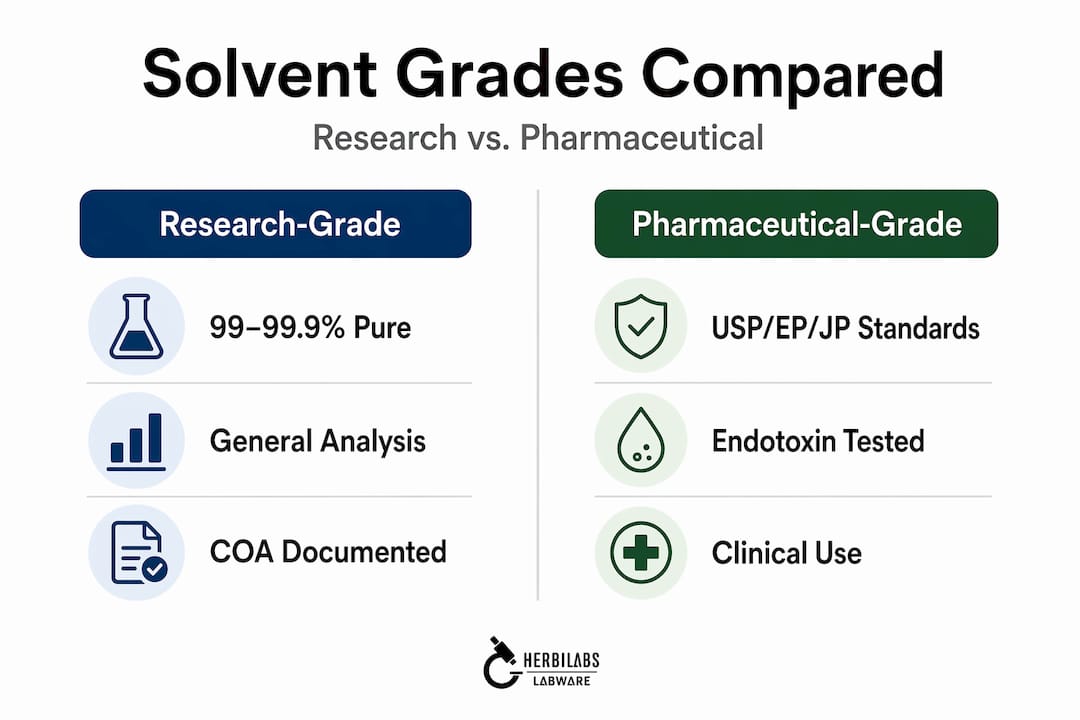
The three grades you will encounter most often are research-grade, pharmaceutical-grade, and technical-grade. Each exists for a different purpose, and substituting one for another has real consequences.
| Grade | Typical purity | Regulatory standard | Intended use |
|---|---|---|---|
| Research-grade | 99% to 99.9%+ | Manufacturer specification, COA | Analytical work, synthesis, spectroscopy |
| Pharmaceutical-grade | 99% to 99.9%+ | USP, EP, or JP compendial | Drug manufacturing, clinical formulation |
| Technical-grade | Variable (85-99%) | None formal | Industrial cleaning, bulk processing |
Pharmaceutical-grade solvents comply with USP, EP, or JP compendial standards and additionally require endotoxin and bioburden testing that research-grade solvents do not. That extra layer of testing makes pharma-grade appropriate for drug manufacturing but also significantly more expensive. Research-grade solvents hit the sweet spot for most analytical and experimental work: tight purity control, full documentation, and a price point that does not consume your entire reagent budget.
Technical-grade solvents are a different story entirely. The purity can be highly variable, impurities are rarely characterized, and no COA exists. Using technical-grade acetone to clean an HPLC injector will deposit residues that haunt you for weeks.
Pro Tip: Always cross-reference the COA lot number printed on the bottle against the documentation from your supplier before opening a new container. Mislabeled or swapped lots happen, and catching them before use costs minutes. Catching them after use costs experiments.
Why the purpose of research-grade solvents matters in practice
The importance of high-purity solvents becomes most apparent when you consider how they function across different analytical platforms. A solvent is rarely just a carrier. It defines the chemical environment in which your measurement takes place.
Here are the primary applications where solvent grade directly determines data quality:
- Chromatography (HPLC, LC-MS, GC-MS): Mobile phase purity dictates baseline noise, peak resolution, and detector sensitivity. Vendors offer LC-MS and HPLC grade solvents specifically treated to reduce UV-absorbing impurities and non-volatile residues that would otherwise produce ghost peaks and elevated baselines.
- Spectroscopy (UV-Vis, NMR, IR): Trace chromophores in a substandard solvent absorb at wavelengths of interest and shift your sample’s apparent absorbance. Spectroscopic-grade solvents are tested specifically for transmission cutoffs in the relevant wavelength range.
- Organic synthesis: Solvent impurities can act as catalysts, chain-transfer agents, or competing nucleophiles. In sensitive reactions such as organolithium chemistry or palladium-catalyzed coupling, water content measured in parts per million changes reaction outcomes.
- Sample preparation: Extraction, dilution, and reconstitution all require solvents that introduce zero background. Any unknown extractables in your solvent become part of your sample matrix.
- Biological assays and peptide work: Solvents used to reconstitute peptides or prepare assay standards must be free from metal ions, peroxides, and stabilizers that alter biological activity.
The reproducibility argument is particularly strong. Two labs running the same protocol with different solvent grades will often generate results that appear incompatible. Knowing that both used documented research-grade material is one of the fastest ways to rule out a systemic source of variation during inter-lab comparisons.
Top research-grade solvents and their applications
Selecting the right solvent from the available types of research solvents requires matching the solvent’s chemical properties to your specific application. Below are the most widely used options and why each earns its place on the lab shelf.
-
Acetonitrile (MeCN): The default choice for reversed-phase HPLC and LC-MS work. Low UV cutoff (190 nm), low viscosity, and excellent miscibility with water make it ideal as a mobile phase component. LC-MS grade acetonitrile is additionally treated to minimize ammonium and metal ion content.
-
Methanol: A cost-effective alternative to acetonitrile for HPLC, though its higher viscosity increases back-pressure at high flow rates. Research-grade methanol is also used extensively in transesterification reactions and as a reconstitution solvent for polar compounds.
-
Dichloromethane (DCM): Methylene chloride consumption remains high in pharmaceutical extraction and chromatography, particularly in column chromatography for natural product isolation. Its high density and low boiling point make workup straightforward, but purity is critical because residual stabilizers (typically amylene) interfere with certain reactions.
-
Ethanol: Widely used in cell-based assays, protein precipitation, and as a cleaning solvent. Absolute (anhydrous) ethanol at research grade is specified for water content below 0.1%, which matters in moisture-sensitive reactions.
-
Isopropanol (IPA): The go-to solvent for optics cleaning, HPLC normal-phase systems, and lipid extractions. Research-grade IPA carries very low peroxide content, which is critical because peroxides degrade biological analytes.
-
Tetrahydrofuran (THF): Used in polymer analysis, GPC/SEC work, and as a reaction solvent. Peroxide formation on storage is the primary concern. Inhibitor-free and stabilized versions exist for different applications, and the COA will specify which you have.
| Solvent | Key application | Critical purity parameter |
|---|---|---|
| Acetonitrile | HPLC, LC-MS mobile phase | UV cutoff, non-volatile residue |
| Methanol | HPLC, reconstitution | Residue on evaporation |
| DCM | Extraction, column chromatography | Stabilizer content, water |
| Ethanol | Assays, protein work | Water content |
| IPA | Cleaning, lipid extraction | Peroxide content |
| THF | GPC, polymer work | Peroxide level, inhibitor type |
Common solvents like ethanol, isopropanol, and DCM serve synthesis, cleaning, and analytical separations equally well when procured at the correct grade. The failure mode is almost always using a lower grade to save cost and then spending three times as long troubleshooting the resulting data.
Handling and storage to maintain solvent integrity
Purchasing research-grade solvents is only the first step. How you store and handle them determines whether they stay at grade throughout their useful life.
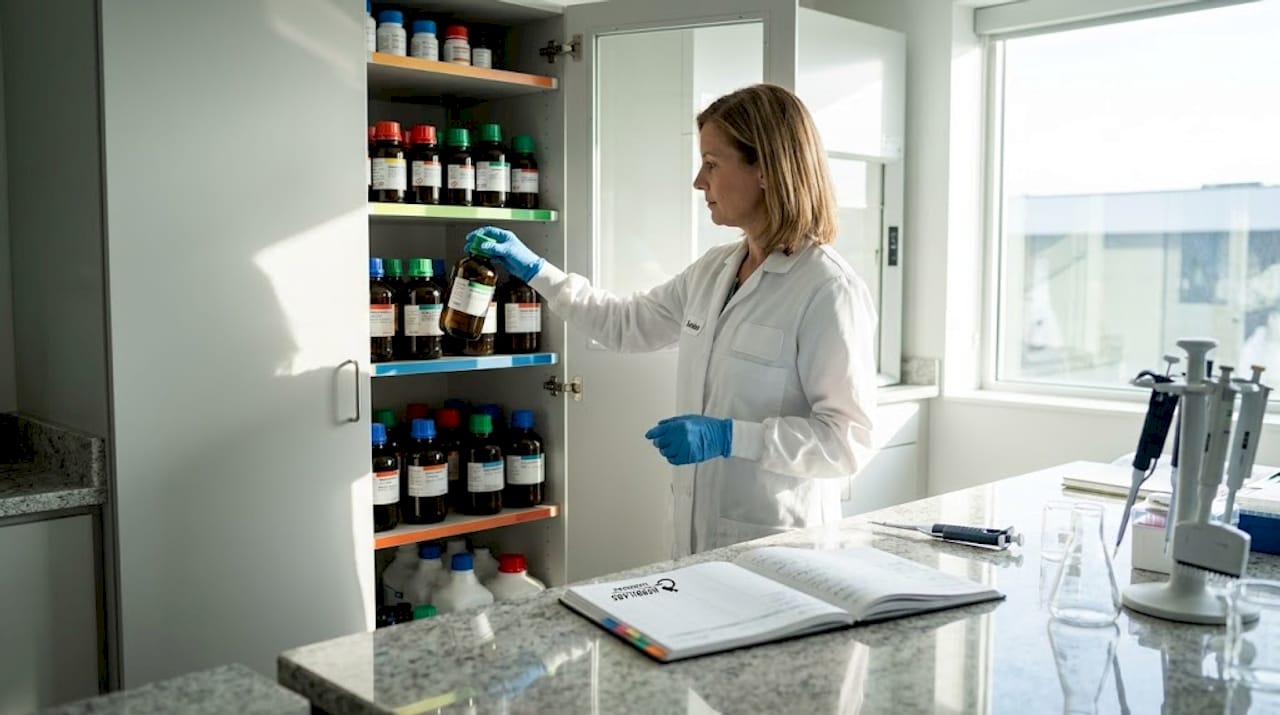
- Container integrity: Amber glass is standard for light-sensitive solvents like THF and DCM. Never transfer research-grade solvents to unlabeled containers or vessels that previously held a different chemical, regardless of how clean they appear.
- Temperature and atmosphere: Store volatile solvents in a ventilated, flammable-materials cabinet at or below room temperature. Oxygen and moisture from ambient air degrade solvents that absorb water (acetonitrile, THF) or form peroxides (diethyl ether, THF, dioxane). Always replace caps immediately after use.
- Peroxide testing: THF and diethyl ether should be tested for peroxides with peroxide test strips before each use, especially if the bottle has been open longer than three months. Peroxide levels above 25 ppm are a safety concern, not just a purity issue.
- Lot segregation: Keep new lots separate from partially used bottles of the same solvent. Do not mix lots in the same working container. If reproducibility suddenly drops, lot-to-lot variation is easy to identify only if you track which lot was in use.
COA documentation allows you to confirm lot-specific identity and purity before use, making it the practical backbone of any quality control program for solvents. Pair that with proper reagent storage practices and you close most of the routes through which solvent quality degrades between delivery and use.
Pro Tip: Date every solvent bottle the day you open it. Manufacturer expiration dates assume sealed storage. Once open, degradation rates change, especially for peroxide-forming solvents and those that absorb atmospheric moisture.
My perspective on solvent grade as a practical discipline
I have watched researchers spend weeks redesigning assays when the actual problem was that someone ordered technical-grade isopropanol because it was cheaper and listed on the same supplier page. The impact of solvent grade does not announce itself. You see elevated baselines, poor peak shapes, failed reactions, and inconsistent biological data. You do not see a message that says “wrong solvent grade.”
In my experience, the cost-versus-purity calculation that labs perform is often based on the wrong unit. The question should not be “is research-grade acetonitrile worth three times the price of technical-grade?” The question is “what is one day of troubleshooting time worth, and how many of those days would the cheaper solvent cost per year?” Framed that way, the answer is almost always to buy the correct grade for your application.
The shift toward green solvent alternatives and reduced neurotoxicity exposure, particularly moving away from n-hexane and chloroform where substitutions are viable, is a trend worth paying attention to. But green solvents need to meet the same purity documentation standards as conventional ones before they belong in analytical workflows. A greener solvent that lacks a proper COA is not a step forward.
Automation in drug discovery increases overall solvent demand even as individual consumption per experiment falls. That means solvent quality control becomes more important, not less, as throughput scales up. For new researchers, my advice is straightforward: match the grade to the instrument first, then to the chemistry, and always read the COA before you open the bottle.
— Ragnar
Why Herbilabs supports your solvent quality work
At Herbilabs, quality documentation is not an afterthought. Every product comes with accessible lot-specific data so you can verify what you are using before it touches your samples.
If you work with research reagents and reconstitution solvents, the Herbilabs shop carries products manufactured to strict purity standards with full traceability. For researchers who want to go deeper on quality control for reagents, the Herbilabs resource library covers validation procedures, COA interpretation, and best practices for maintaining reagent integrity from delivery to disposal. Whether you are running peptide reconstitutions or analytical assays, reliable materials start with a supplier that can document every batch.
FAQ
What is a research-grade solvent?
A research-grade solvent is a chemical solvent manufactured to a specified purity level, typically 99% or above, with a lot-specific Certificate of Analysis documenting its impurity profile. It is intended for use in scientific experiments, analytical measurements, and synthesis where unknown contaminants would compromise results.
How does research-grade differ from pharmaceutical-grade?
Pharmaceutical-grade solvents meet compendial standards such as USP, EP, or JP and require additional testing for endotoxins and bioburden that research-grade solvents do not. Research-grade is appropriate for laboratory and analytical use; pharmaceutical-grade is required for drug manufacturing and clinical applications.
Which solvents are most commonly used in research labs?
Acetonitrile, methanol, dichloromethane, ethanol, isopropanol, and tetrahydrofuran are the top research-grade solvents used across chromatography, spectroscopy, extraction, and synthesis. Each is available in standard research grade, HPLC grade, and LC-MS grade depending on the instrument and application.
Why does solvent grade affect HPLC and LC-MS results?
Impurities in lower-grade solvents absorb UV light, produce non-volatile residues, and introduce metal ions that generate ghost peaks and elevated baselines. HPLC and LC-MS grade solvents are treated specifically to eliminate these interferences and protect sensitive detector systems.
How should research-grade solvents be stored to maintain purity?
Store them in sealed, labeled amber or clear glass containers in a ventilated flammable-materials cabinet, away from heat and light. Test peroxide-forming solvents before use, track open dates, and never mix lots within the same working container to maintain full traceability.