Private Label, White Label, Wholesale partnerships available - EU, USA and UK - Free shipping from €75

Sterility Explained: High-Quality Lab Products for Peptides
Learn what sterility really means for lab products, how SAL ≤10^{-6} is validated, and how to choose EU GMP-compliant sterile solutions for peptide research.
TL;DR:
- Sterility is a probability measure, with SAL ≤10^{-6} as the industry standard.
- Validated manufacturing processes and documentation are crucial, as tests alone are not foolproof.
- Sourcing from EU GMP-compliant suppliers ensures higher sterility assurance for peptide research.
A single undetected microbe can invalidate months of peptide research. Most researchers know this, yet many still assume that a “sterile” label on a lab product is an absolute guarantee. It isn’t. True sterility is a probability-based assurance, backed by validated manufacturing protocols, rigorous testing standards, and regulatory compliance. This article breaks down what sterility actually means in scientific terms, how it’s achieved and tested in modern labs, what European manufacturing standards require, and how you can protect your research by making smarter sourcing decisions.
Table of Contents
- What does ‘sterility’ actually mean for laboratory products?
- How sterility is achieved and tested: The key protocols
- Manufacturing standards: How European labs guarantee sterility
- Handling, storage, and common sterility pitfalls in peptide research
- Why relying solely on sterility testing is a mistake
- Find sterile lab solutions for peptide research at Herbilabs
- Frequently asked questions
Key Takeaways
| Point | Details |
|---|---|
| SAL defines sterility | True sterility is measured by the Sterility Assurance Level, ensuring no more than 1 microbe in a million units after sterilization. |
| Membrane filtration favored | For peptide research, membrane filtration is the preferred method for sterility testing and helps avoid common lab product pitfalls. |
| EU GMP Annex 1 compliance | Always select lab products and suppliers that follow EU GMP Annex 1 for robust contamination control and quality assurance. |
| Proper handling prevents failures | Careful storage and handling after manufacture are critical to maintaining sterility and avoiding failed tests. |
| Testing is not absolute | Sterility tests confirm process quality but do not guarantee absolute sterility—manufacturing controls matter most. |
What does ‘sterility’ actually mean for laboratory products?
Building on the introduction, let’s clarify what ‘sterility’ really means for lab products.
When a product is labeled “sterile,” most people picture a completely microbe-free environment. The reality is more nuanced. Sterility, in regulatory and scientific terms, is not an absolute state. It’s a statistical probability. No test or process can prove with 100% certainty that zero viable microorganisms exist in any given product. What manufacturers can do is reduce that probability to an accepted, validated level.
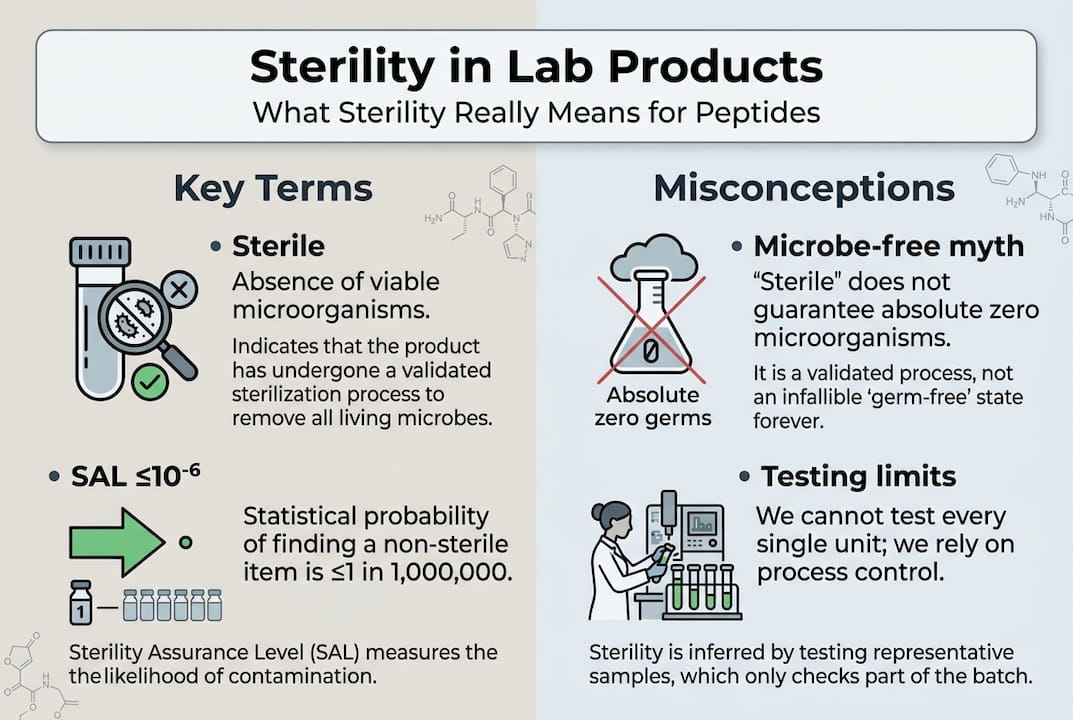
That level is defined by the Sterility Assurance Level, or SAL. A SAL ≤10^{-6} means there is no more than a 1 in 1 million chance that a single viable microorganism remains after sterilization. This is the internationally accepted standard for sterile pharmaceutical and laboratory products. It’s a mathematical framework, not a pass/fail checklist.
Why does this matter for peptide research? Because peptides are biologically active molecules. Even trace contamination can trigger degradation, alter receptor binding data, or produce false results that skew an entire study. Sterility assurance in labs is therefore not a box-ticking exercise. It’s a foundational requirement for data integrity.
| SAL Value | Probability of contamination | Typical application |
|---|---|---|
| 10^{-3} | 1 in 1,000 | Non-critical devices |
| 10^{-6} | 1 in 1,000,000 | Sterile injectables, lab reagents |
| 10^{-9} | 1 in 1,000,000,000 | Implantable devices |
“A SAL of 10^{-6} is the benchmark for products that contact sterile tissue or fluids. It’s a probability statement, not a guarantee of absolute sterility.”
The distinction between a product that simply claims sterility and one that has been validated to SAL ≤10^{-6} is enormous. Always look for lab-grade quality bacteriostatic water and similar products that carry documented SAL validation, not just a label. Suppliers who can’t provide that data are not meeting the standard your research demands.
Understanding SAL also helps you evaluate sterility testing methods more critically. A product can pass a sterility test and still carry a contamination risk if the underlying manufacturing process isn’t properly controlled. The SAL is only as reliable as the process that generates it.
How sterility is achieved and tested: The key protocols
Having defined sterility, let’s see exactly how it’s established and measured in laboratory settings.
Sterility testing follows two primary methods: membrane filtration and direct inoculation. Each has specific applications, and choosing the wrong one can compromise your results before the experiment even begins.
Membrane filtration is the preferred method for most liquid products, including peptide solutions and bacteriostatic water. The 0.45 μm filtration process captures microorganisms on a membrane, which is then transferred to culture media. Fluid Thioglycollate Medium (FTM) supports anaerobic organisms, while Tryptic Soy Broth (TSB) targets aerobic bacteria and fungi. A membrane filtration guide outlines how this process eliminates product inhibition by washing away preservatives before incubation.
Direct inoculation involves adding the product directly to culture media. It’s simpler but carries a higher risk of false negatives if the product itself inhibits microbial growth. For peptide-based products, this is a real concern.
| Method | Best for | Key risk |
|---|---|---|
| Membrane filtration | Liquids, peptide solutions | Requires skilled handling |
| Direct inoculation | Solids, oils | Product inhibition risk |
Both methods are governed by USP <71> (United States Pharmacopeia) and Ph. Eur. 2.6.1 (European Pharmacopoeia). These standards define incubation periods (typically 14 days), temperature conditions, and the organisms used for method suitability testing. Method suitability is critical: it confirms that the product itself doesn’t inhibit microbial growth during the test, which would produce a false-negative result.
Key steps in a compliant sterility test:
- Prepare the test environment under Grade A laminar airflow
- Perform method suitability testing before routine use
- Use validated culture media within expiry
- Incubate at 20 to 25°C for TSB and 30 to 35°C for FTM
- Observe for 14 days and document any turbidity
Pro Tip: When reviewing a supplier’s documentation, ask specifically for method suitability data. If they can’t provide it, their sterility test results may not be reliable for your peptide research.
For researchers sourcing products externally, lab sterilization tips and lab purity for peptides are worth reviewing before finalizing any supplier. Understanding the testing process helps you ask the right questions. Quality control for reagents and lab product certifications are equally important reference points when evaluating compliance.
Manufacturing standards: How European labs guarantee sterility
Understanding protocols is only half the story. Let’s examine how Europe’s strict standards safeguard sterility for lab products.
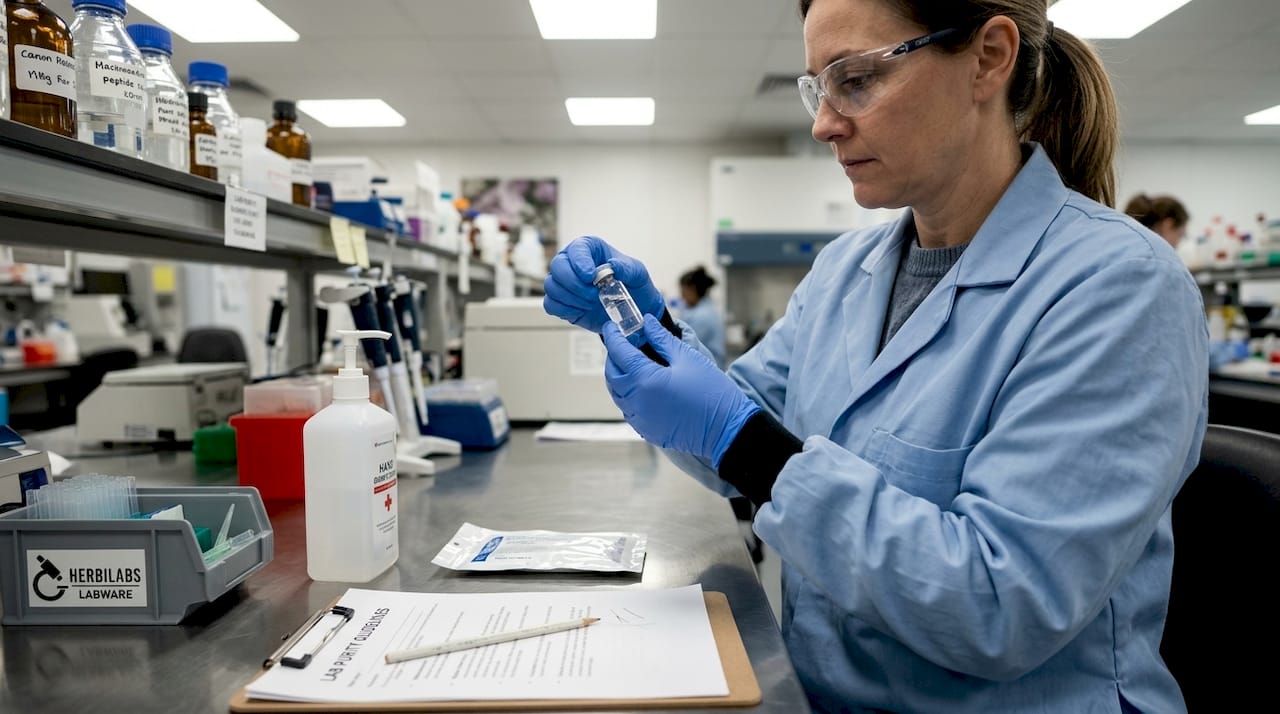
EU GMP Annex 1 is the regulatory backbone for sterile manufacturing in Europe. Revised significantly in 2022 and fully enforced since 2023, it sets requirements that go far beyond basic testing. EU GMP Annex 1 mandates a Contamination Control Strategy (CCS), which is a documented, site-wide approach to identifying and mitigating contamination risks at every stage of production.
Key requirements under Annex 1 include:
- Terminal sterilization where feasible, using heat, radiation, or filtration
- Aseptic processing with barrier technologies such as RABS (Restricted Access Barrier Systems) or isolators
- PUPSIT (Pre-Use Post-Sterilization Integrity Testing) for sterilizing-grade filters
- Bioburden monitoring before and after sterilization steps
- Environmental monitoring of cleanroom grades A through D
- Full batch documentation and certificates of analysis (CoA)
Statistic: Annex 1 compliance requires environmental monitoring at a minimum of Grade A for aseptic fill operations, with particle counts not exceeding 3,520 particles per cubic meter at 0.5 μm.
For independent researchers and private customers, this level of regulatory detail might seem distant from your day-to-day work. But it directly affects the products you use. A supplier operating under Annex 1 compliance has documented evidence that every batch was produced under controlled conditions. A supplier without that framework is offering you a label, not an assurance.
When evaluating European suppliers, always request the CoA for the specific batch you’re purchasing. Look for bioburden results, endotoxin levels, and sterility test outcomes. For guidance on EU lab product sourcing, prioritize manufacturers who publish their quality documentation openly rather than sharing it only on request.
The difference between a compliant and non-compliant supplier can be invisible to the naked eye. Both products may look identical. The distinction lives entirely in the manufacturing record.
Handling, storage, and common sterility pitfalls in peptide research
Once you’ve obtained sterile products, maintaining their purity is an equally critical step. Here’s how to do it and avoid research setbacks.
Sterility doesn’t end at the manufacturer’s facility. From the moment a product leaves the production line, every handling decision either preserves or compromises it. For peptide researchers, this is where many preventable errors occur.
Lyophilized peptides stored at ≤-15°C maintain stability and sterility far longer than peptides kept in solution. Reconstituted peptides begin degrading almost immediately, especially at room temperature. The EMA guideline is clear: avoid long-term storage in solution wherever possible.
“Reconstitution should be performed under aseptic conditions using sterile diluents. Contamination at this stage is irreversible.”
Common sterility pitfalls to avoid:
- Using non-sterile diluents or tap water for reconstitution
- Failing to swab vial stoppers with 70% isopropyl alcohol before needle insertion
- Reusing syringes or needles across multiple vials
- Storing reconstituted peptides in non-sterile containers
- Allowing freeze-thaw cycles that stress the product and introduce condensation
Pro Tip: Always use a dedicated sterile reconstitution solution and follow your lab water handling guide to the letter. A single shortcut at this stage can invalidate results that took weeks to generate.
If a sterility failure does occur, root cause analysis (RCA) is essential. Common causes include media preparation errors, environmental contamination during testing, or genuine product contamination. A structured sterility test troubleshooting process helps separate true failures from testing artifacts. Corrective and Preventive Action (CAPA) documentation should follow every confirmed failure.
For ongoing storage guidance, storing bacteriostatic water and understanding the difference between bacteriostatic vs sterile water are practical starting points that directly affect your day-to-day research decisions.
Why relying solely on sterility testing is a mistake
With application tips covered, here’s an expert viewpoint to help you go beyond the standard advice and genuinely safeguard your research.
Sterility testing is widely treated as the final word on product safety. It shouldn’t be. Sterility testing is qualitative and operates on a small sample size relative to the full batch. A test might examine 20 units from a batch of 10,000. That means 9,980 units are released based on inference, not direct evidence.
This isn’t a flaw in the system. It’s a design reality that makes robust manufacturing controls non-negotiable. The SAL, bioburden limits, environmental monitoring, and GMP documentation are what actually protect your research. The sterility test is a confirmation step, not a safety net.
Our perspective at Herbilabs: researchers who demand supplier data upfront are making a smarter investment than those who trust labels alone. Ask for the full batch record. Ask for environmental monitoring data. Ask whether the facility operates under EU GMP Annex 1. If a supplier hesitates, that hesitation is your answer.
For safe sourcing in the EU, process integrity matters more than any single test result. Build your sourcing decisions on documentation, not packaging.
Find sterile lab solutions for peptide research at Herbilabs
Ready to take action? Discover trusted solutions for your research needs.
At Herbilabs, every product we supply is manufactured to EU GMP standards, with full batch documentation and sterility data available on request. We understand that your research depends on more than a label.
Whether you need a sterile reconstitution solution for lyophilized peptides, guidance on sourcing safe lab products that meet Annex 1 compliance, or simply want to explore our full range, we’re here to support your work. Visit our shop at Herbilabs to browse research-grade sterile products built for the demands of serious peptide research across the UK and Europe.
Frequently asked questions
What does Sterility Assurance Level (SAL) mean for lab products?
SAL defines the probability of contamination after sterilization. A SAL of ≤10^{-6} means no more than a 1 in 1 million chance that a viable microorganism survives, which is the accepted standard for sterile lab and pharmaceutical products.
How should lyophilized peptides be stored to maintain sterility?
Store lyophilized peptides at ≤-15°C in dry conditions and avoid extended storage in reconstituted form. Reconstitution should be performed aseptically immediately before use to minimize contamination risk.
Is sterility testing foolproof for ensuring product safety?
No. Sterility testing is qualitative and uses a small sample relative to batch size, so validated manufacturing controls and process documentation are essential complements to any test result.
What should I look for in a supplier of sterile lab products in Europe?
Prioritize suppliers who meet EU GMP Annex 1 standards, provide batch-specific certificates of analysis, and openly share sterility test data, bioburden results, and environmental monitoring records.
Which sterility testing method is best for peptide lab products?
Membrane filtration is the preferred method for peptides because it physically removes preservatives and potential inhibitors before incubation, reducing false-negative risk and aligning with USP <71> and Ph. Eur. 2.6.1 guidelines.