Private Label, White Label, Wholesale partnerships available - EU, USA and UK - Free shipping from €75

Why reliable labware delivery matters for safe research
Discover why reliable labware delivery is critical for bacteriostatic water and research reagents. Learn cold-chain standards, GDP compliance, and supplier tips.
TL;DR:
- Reliable labware delivery requires strict cold-chain management, tracking, and documentation standards.
- Compliance with EU GDP guidelines ensures product integrity, traceability, and legal safety.
- Choosing certified suppliers with Certificates of Analysis and proper handling minimizes risks and long-term costs.
Many independent researchers and private buyers assume any courier service will do for labware. That assumption is wrong, and it can be costly. A single compromised shipment of bacteriostatic water or research reagents can invalidate weeks of work, introduce contamination, or create compliance gaps that are difficult to explain. The standards governing how sensitive lab supplies move from manufacturer to end user are strict for good reason. This article breaks down what reliable labware delivery actually looks like, which risks you need to manage, and the practical steps that protect both your research and your legal standing.
Table of Contents
- What reliable labware delivery means in 2026
- Regulatory standards: The backbone of safe delivery
- Choosing the right supplier: Beyond price and speed
- Practical steps for safe and traceable deliveries
- Why reliability is now non-negotiable: The overlooked risks and rewards
- Looking for labware you can trust?
- Frequently asked questions
Key Takeaways
| Point | Details |
|---|---|
| Cold-chain is critical | Reliable labware delivery with temperature control protects sensitive reagents from contamination or degradation. |
| Regulations safeguard quality | EU GDP and chemical guidelines make traceable, compliant delivery essential for safe research. |
| Supplier choice impacts results | Choosing certified, RUO-labeled suppliers with COAs reduces the risk of failed experiments and compliance issues. |
| Safety starts on arrival | Always inspect shipments for intact seals and temperature integrity before using labware or reagents. |
What reliable labware delivery means in 2026
Reliable delivery is not just about a parcel arriving on time. For bacteriostatic water and research reagents, it means the product arrives in exactly the same condition it left the facility. That requires a controlled environment throughout the entire journey, not just at the warehouse.
The global cold-chain logistics market is expanding rapidly, driven in part by growing demand for sensitive biological and chemical products. Yet contamination and degradation during transit remain a persistent problem across the supply chain. Cold-chain logistics best practices show that for temperature-sensitive items like bacteriostatic water and reagents, proper cold-chain management is essential to prevent degradation and contamination. A two-degree temperature excursion may seem minor, but for sterile diluents, it can compromise sterility and render a product unusable.
What separates a best-in-class supplier from a basic one comes down to three pillars:
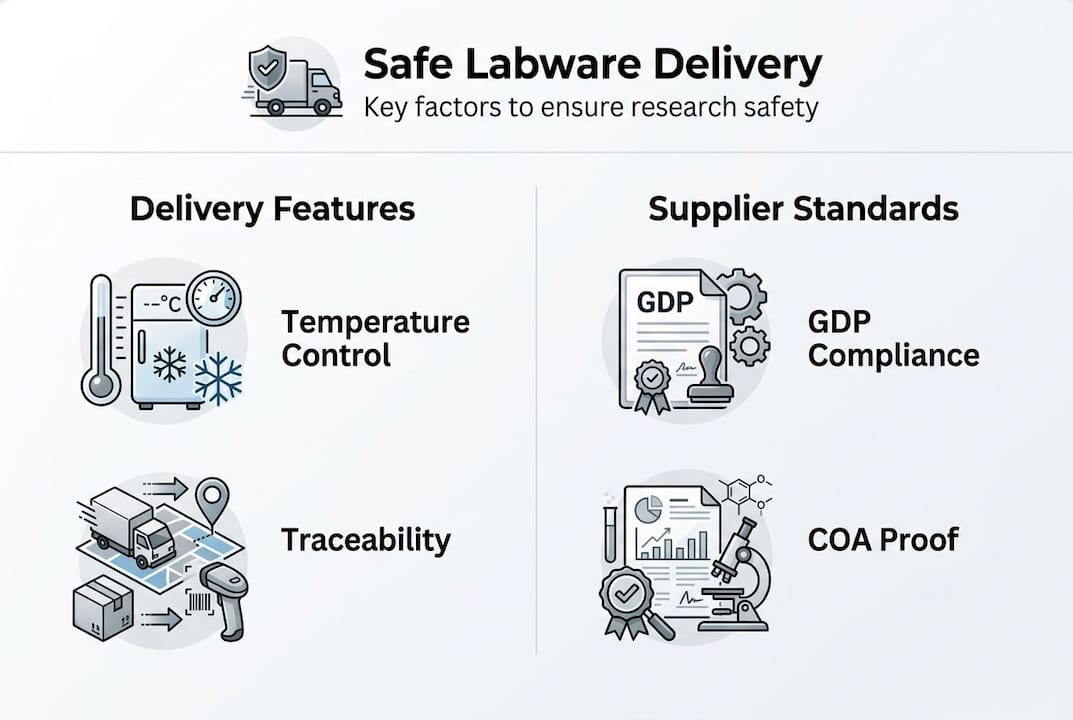
- Consistent cold-chain management: Temperature-controlled packaging, validated shipping lanes, and real-time monitoring
- Full shipment tracking: End-to-end visibility with timestamps at every handoff point
- Certified documentation: Certificates of Analysis, temperature logs, and batch traceability records included with every order
GDP-compliant carriers, those following Good Distribution Practice guidelines, are the standard you should insist on. These carriers use validated processes, trained personnel, and documented procedures that basic couriers simply do not apply. The difference matters enormously when you are working with laboratory water handling protocols that depend on purity from source to use.
| Feature | Basic courier | GDP-compliant carrier |
|---|---|---|
| Temperature control | None or passive | Active, monitored, logged |
| Shipment tracking | Basic GPS | Full chain-of-custody records |
| Documentation | Delivery receipt only | COA, temperature log, batch ID |
| Handling training | General | Specialized for sensitive goods |
| Regulatory compliance | None | EU GDP and carrier-specific standards |
Pro Tip: When your shipment arrives, ask for the temperature log before you open the package. If the supplier cannot provide one, that alone tells you something important about their process.
Regulatory standards: The backbone of safe delivery
With best practices defined, how do regulations make a difference and what standards must you check for?
EU Good Distribution Practice guidelines are the regulatory framework that governs how pharmaceutical and research-grade products move through the supply chain. While originally designed for medicinal products, GDP guidelines mandate controlled storage, transport conditions, and traceability to maintain product quality for lab supplies. For independent researchers and private buyers, this matters because it creates an auditable record from production to your door.

Traceability is the part most buyers overlook. A traceable shipment means every step is documented: who handled it, at what temperature, for how long, and under what conditions. If something goes wrong, you can identify exactly where the failure occurred. Without traceability, you are guessing.
Here is what happens during a compliant shipment:
- Order confirmation: Batch number and COA are assigned and linked to your order
- Pre-shipment check: Temperature packaging is validated and logged before dispatch
- Transit monitoring: Data loggers record temperature at defined intervals throughout delivery
- Handoff documentation: Each carrier handoff is recorded with timestamp and condition notes
- Delivery verification: Recipient confirms intact seals, correct temperature range, and matching documentation
Beyond GDP, new chemical regulations are reshaping what labware is even available. PFAS restrictions and broader chemical regulations may limit labware options, increasing reliance on certified reliable suppliers who have already adapted their product lines to meet updated standards. For researchers sourcing through safe research sourcing channels, this means your supplier’s regulatory awareness is as important as their product catalog.
“Regulatory compliance in distribution is not a box-ticking exercise. It is the mechanism that ensures what you ordered is what you receive, in the condition you need it.”
New EU legislation in 2026 continues to tighten requirements around chemical handling and traceability. Suppliers who have not updated their processes are creating risk for every customer in their chain.
Choosing the right supplier: Beyond price and speed
Standards and regulations matter, but your supplier choice is what ultimately protects your research.
Price and delivery speed are easy to compare. Compliance, documentation quality, and handling standards are harder to evaluate but far more consequential. A supplier who ships fast but skips temperature monitoring is not saving you time. They are creating a liability.
For private customers and independent researchers, RUO-labeled suppliers with COAs are the baseline standard to prioritize for compliance and purity. Research Use Only labeling tells you the product has been manufactured and documented to a defined standard. Without it, you have no formal guarantee of what you are working with.
Certificates of Analysis are your primary protection. A COA documents the product’s composition, purity, batch number, and testing results. It connects your specific vial to a specific manufacturing event. If results are ever questioned, the COA is your evidence. You can review what proper supplier COAs look like and what information they must contain before you place an order.
Here is a practical checklist for evaluating any labware supplier:
- Does the supplier provide a COA for every batch?
- Is the product labeled for Research Use Only where applicable?
- Can the supplier confirm GDP-compliant shipping for your region?
- Do they provide temperature logs or cold-chain documentation on request?
- Is there a clear returns or rejection policy for damaged shipments?
- Are manufacturing standards and facility certifications publicly available?
The quality control for labware process behind each product is as important as the product itself. A supplier who cannot answer basic questions about their QC process is one you should not trust with sensitive reagents.
Pro Tip: Before placing a first order, email the supplier and ask specifically for proof of GDP compliance and evidence of temperature monitoring during transit. A reliable supplier will respond with documentation. A non-compliant one will deflect or offer vague reassurances.
Practical steps for safe and traceable deliveries
Knowing what to look for in a supplier, here is how to put safe labware delivery into practice from start to finish.
The process begins before you click order. Confirm your supplier uses GDP-compliant carriers with temperature monitoring, including data loggers for reagents. Intra-EU shipments have a practical advantage here: they avoid customs delays that can leave temperature-sensitive packages sitting in uncontrolled environments for hours or days. If you are ordering from within the EU, prioritize suppliers who ship domestically or within the single market.
Here is a step-by-step process for every order:
- Confirm shipping method: Verify GDP-compliant carrier and cold-chain packaging before checkout
- Save order confirmation: Record batch numbers and expected delivery window
- Track the shipment actively: Use the tracking link to monitor handoff points and flag delays early
- Prepare your receipt area: Have a clean, temperature-appropriate space ready before the parcel arrives
- Inspect before signing: Check outer packaging for damage, temperature indicators, and intact seals
- Review documentation: Match the COA and temperature log to the batch number on the vial
- Log receipt conditions: Record the time, temperature, and condition in your own lab records
When your delivery arrives, run through this checklist before accepting it:
- Outer packaging intact, no visible damage or moisture
- Temperature indicator (if included) within acceptable range
- Seals unbroken on all vials or containers
- Batch number on vial matches COA
- No unusual odors or discoloration
If anything fails this check, do not use the product. Refer to your lab safety steps protocol and contact the supplier immediately. A reliable supplier will have a clear process for handling damaged or out-of-spec deliveries. Also review the safety checklist for bacteriostatic water handling to make sure your post-receipt procedures match the product’s requirements.
Why reliability is now non-negotiable: The overlooked risks and rewards
Here is something the standard advice rarely says out loud: choosing a cheaper, non-compliant delivery option does not save money. It defers costs and amplifies them.
A ruined batch of reagents means repeating experiments, reordering supplies, and losing time that cannot be recovered. A non-traceable shipment means you cannot verify what you received, which creates a compliance gap that compounds over time. European laboratories are already under pressure from budget cuts and regulatory scrutiny, and the instinct to cut costs on logistics is understandable. But it is exactly the wrong place to cut.
GDP principles, while pharma-focused, apply directly to research reagents. Labs facing budget constraints often find that prioritizing lab-grade quality over the cheapest available option actually reduces total costs by eliminating failed runs and compliance incidents.
The regulatory environment in 2026 is tightening, not loosening. Suppliers who are not already compliant will struggle to keep pace. Researchers who have built relationships with reliable, documented suppliers are insulated from those disruptions. The reward for prioritizing reliability is not just better results today. It is a supply chain that holds up when regulations shift, budgets tighten, and scrutiny increases.
Looking for labware you can trust?
If you have spent time building rigorous protocols, your supply chain deserves the same rigor. Herbilabs was built specifically to serve independent researchers and private customers who need documented, compliant, research-grade products delivered reliably across Europe.
Start with the bacteriostatic water guide to understand exactly what you should expect from a quality product, then review safe storage for bacteriostatic water to make sure your post-delivery handling matches the product’s standards. When you are ready to order, the Herbilabs Shop carries research-grade bacteriostatic water and reagents with full COA documentation and GDP-aligned shipping, so you know exactly what you are getting and how it got to you.
Frequently asked questions
What is cold-chain logistics, and why is it important for labware delivery?
Cold-chain logistics control shipment temperatures throughout transit to prevent reagent and bacteriostatic water degradation. Even brief temperature excursions can compromise sterility and render sensitive products unusable.
What does EU GDP mean for labware buyers?
EU GDP standards require controlled storage, traceability, and careful transport to maintain labware quality and legal compliance. They create an auditable record from production to delivery that protects both supplier and buyer.
How can I check if my labware supplier is reliable?
Ask for COAs, review temperature control evidence, and confirm the supplier follows GDP guidelines. RUO-labeled suppliers with COAs are the baseline standard for compliance and purity verification.
Do PFAS and chemical regulations affect my labware orders?
Yes. PFAS restrictions and new chemical regulations can limit available labware options and cause supply delays, making certified reliable suppliers more important than ever.
What should I do if a shipment arrives warm or unsealed?
Reject the shipment and contact your supplier immediately. Proper cold-chain failures create direct contamination risk, and using a compromised product can invalidate your research and create compliance issues.