Private Label, White Label, Wholesale partnerships available - EU, USA and UK - Free shipping from €75

Lab-grade injectables: What quality means and how to verify it
Discover what defines lab-grade injectables and learn vital verification methods to ensure safety and integrity in your research.
TL;DR:
- Most lab supplies marketed as “lab-grade” do not guarantee sterility or quality controls necessary for parenteral use. Genuine injectable safety depends on verified standards like sterility, endotoxin limits, and particulate assessments, supported by detailed batch documentation. Relying solely on purity percentages or supplier claims without reviewing comprehensive certificates can compromise research safety and validity.
Most researchers working with injectables assume that “lab-grade” is shorthand for sterile and pure. It isn’t. True lab-grade quality for parenteral use is a matrix of interlocking controls, and any one weak link can render even a visually clear, apparently sterile product genuinely hazardous. Understanding the full picture isn’t just academic rigor. It’s the difference between meaningful data and compromised results.
Table of Contents
- What does ‘lab-grade injectable’ actually mean?
- Core attributes: Sterility, endotoxins, particulates, and more
- Beyond the test: Sterility assurance and manufacturing controls
- Pharmaceutical-grade vs. research-grade injectables: Legal and compliance differences
- How to verify true lab-grade: Certificates of Analysis and documentation
- Lab-grade injectables: Why most definitions fall short (and what to do about it)
- Optimize your research confidence with lab-verified solutions
- Frequently asked questions
Key Takeaways
| Point | Details |
|---|---|
| Quality is multi-dimensional | Lab-grade injectables require sterility, low endotoxins, minimal particulates, and validated documentation—not just purity. |
| Sterility test is not enough | True sterility assurance depends on validated aseptic processing and not just a pass on lab sterility tests. |
| COA verification is essential | Always confirm Certificates of Analysis detail batch-specific parenteral safety tests before use. |
| Know the compliance context | Research-grade injectables have different safety and legal requirements compared to pharmaceutical-grade—understand the risks for your application. |
| Demand documentation | Ask suppliers for full test data and compliance proof to ensure lab safety and data integrity. |
What does ‘lab-grade injectable’ actually mean?
The term “lab-grade” gets used freely across supplier catalogs, forums, and research documentation, but its meaning shifts depending on context. Some vendors apply it to mean “high chemical purity.” Others use it to signal compliance with cleanroom manufacturing. Neither definition alone is sufficient for anything intended for parenteral use.
Quality expectations for injectables are anchored to pharmacopeial quality attributes covering sterility, endotoxins and pyrogens, particulates, identity, purity, residual solvents, and validated stability. This is the regulatory standard. No universal shorthand replaces it.
For researchers sourcing injectables in Europe, the practical gap matters. What is marketed as “lab-grade” in a peptide supplier’s webshop may be a different category from what a hospital pharmacy means by the same phrase. Context sets the rules. Understanding the importance of lab-grade quality for your specific application is step one.
Key quality attributes you should evaluate for any injectable:
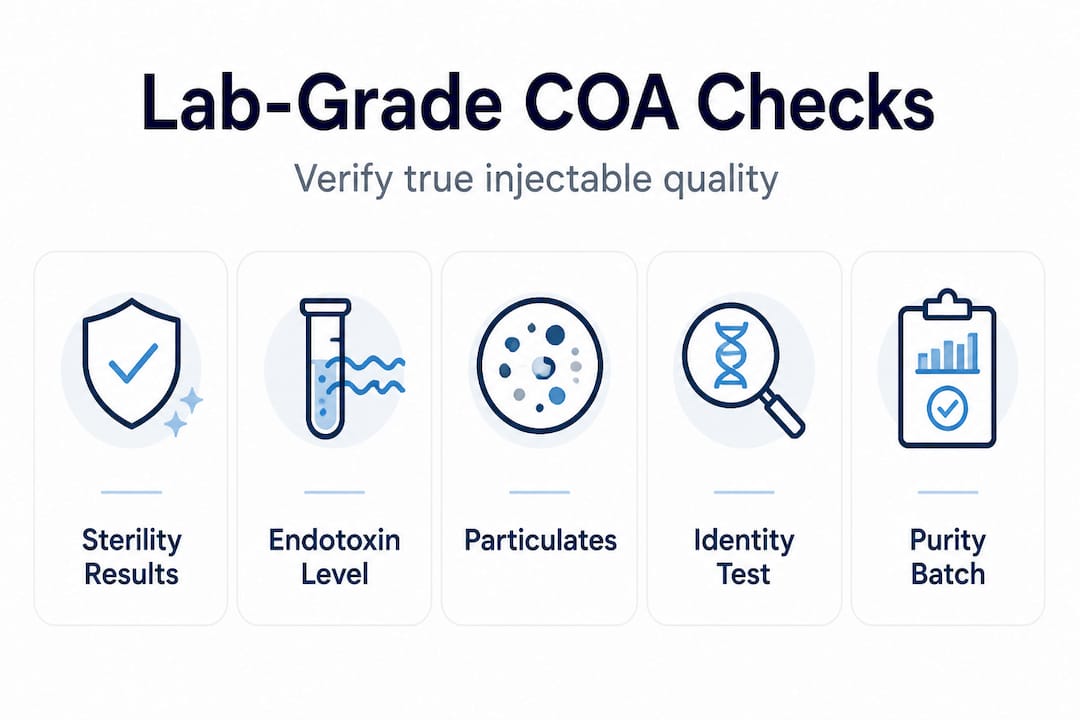
- Sterility: Absence of viable microorganisms, confirmed via validated culture methods
- Endotoxin/pyrogen limits: Controlled to prevent inflammatory response in parenteral use
- Particulate matter: Sub-visible and visible particles assessed to pharmacopeial thresholds
- Identity and purity: Confirmed active substance, absence of degradants or impurities above limits
- Residual solvents: Below ICH Q3C limits appropriate for route of administration
- Stability: Validated storage and shelf-life data matched to your specific conditions
| Term | Typical meaning | Parenteral-ready? |
|---|---|---|
| Lab-grade | Chemical purity emphasis, variable controls | Depends on process and documentation |
| Pharmaceutical-grade | GMP, compendial standards, full batch release | Yes, by definition |
| Research-grade | “RUO” status, purity focus, limited parenteral docs | Requires additional user-level controls |
| Analytical-grade | Chemical purity and identity, no sterility assumed | No |
Pro Tip: Never accept a purity percentage alone as evidence of injectable quality. A 99% pure peptide dissolved in unvalidated water with high endotoxin load remains unsuitable for injection. Ask specifically for sterility, endotoxin, and particulate results on every batch.
Investing in lab compliance standards from the beginning of your sourcing process saves far more time than troubleshooting contamination events downstream.
Core attributes: Sterility, endotoxins, particulates, and more
Each quality pillar for injectable products carries its own testing framework and acceptable thresholds. They are not interchangeable, and they are not optional. You need all of them working together.
Sterility is the most widely recognized requirement, but it is also the most misunderstood. Sterility testing for sterile articles in Europe is defined under European Pharmacopoeia Chapter 2.6.1 (Ph. Eur. 2.6.1) using culture-based methods. Critically, sterility testing confirms what was tested, not every unit in the batch. It is confirmatory, not absolute.
Endotoxins are fragments of the outer membrane of gram-negative bacteria. They survive sterilization. A product can be fully sterile by culture test and still contain endotoxin levels sufficient to trigger significant pyrogenic responses. The European Pharmacopoeia requires bacterial endotoxin testing (BET) for parenteral preparations. For injectables, the BET result must be reported per unit dose.
“A product can fail safety if only one of these attributes is addressed.” Even if sterility is confirmed, inadequate endotoxin or particulate control constitutes a distinct and serious safety failure for injectable products.
Particulates are another underappreciated dimension. Sub-visible particles in the 2 to 100 micrometer range are assessed by light obscuration or microscopy. Visible particle checks are a separate requirement. These standards exist because injected particles can cause emboli, inflammatory reactions, and immune responses.
Standard quality benchmark summary for parenterals:
- Sterility: Ph. Eur. 2.6.1 or equivalent, culture-based confirmation
- Bacterial endotoxins: BET (LAL test), results expressed per mL and per dose
- Particulate matter (sub-visible): Ph. Eur. 2.9.19 or USP <788>
- Visible particles: Ph. Eur. 2.9.20, clear inspection at manufacture
- Identity: Confirmed by appropriate analytical method (HPLC, MS, NMR depending on substance)
- Purity: HPLC area percent or related substances testing with defined limits
- Residual solvents: ICH Q3C, gas chromatography where applicable
- Stability: Accelerated and real-time data supporting claimed shelf life
| Test | Pharmacopeial reference | What failure means |
|---|---|---|
| Sterility | Ph. Eur. 2.6.1 | Microbial contamination, infection risk |
| Bacterial endotoxins | Ph. Eur. 2.6.14 | Pyrogenic response, fever, systemic inflammation |
| Particulates (sub-visible) | Ph. Eur. 2.9.19 | Embolic and immune risks |
| Purity | Ph. Eur. / ICH Q3B | Impurity-related toxicity or reduced efficacy |
Pro Tip: When reviewing supplier documentation, check whether endotoxin results are expressed per mL or per unit dose. Per mL results can look deceptively low if dose volumes are large. Always convert to per-dose values to assess actual exposure risk.
Staying current on contamination control in your own lab environment complements supplier-level quality controls. Both matter.
Beyond the test: Sterility assurance and manufacturing controls
Passing a sterility test is not the same as reliably producing sterile injectables. This distinction matters more than most researchers realize.

A sterility test samples only a fraction of a batch. Typically, fewer than 0.1% of units in a large batch are directly tested. If contamination is sporadic or localized, it can pass undetected through standard testing. This is not a flaw in the test design. It is an inherent statistical limitation of sampling-based confirmation.
The implication is direct: sterility and particle risks for injectables must be controlled through validated manufacturing and aseptic processes, not by purchasing a product labeled “sterile” and relying on a test certificate. Container-closure integrity also plays a role. A perfectly manufactured injectable can be compromised by a faulty seal, a punctured septum, or improper storage.
Sterility testing is confirmatory evidence, not a substitute for validated aseptic processing and GMP controls. Relying on a “pass sterility test” result as the primary quality assurance mechanism is insufficient.
What robust sterility assurance actually requires:
- Validated aseptic fill processes with media fill (process simulation) qualification
- Classified cleanrooms with continuous environmental monitoring (particulate and microbial)
- Closed-system transfers and validated sterilization of containers, closures, and equipment
- Container-closure integrity testing on finished product
- Stability data confirming maintenance of all attributes through shelf life
- Complete batch records and deviation management documentation
When sourcing injectables, ask whether the manufacturer can provide evidence of validated manufacturing, not just a certificate of test results. A supplier who provides only analytical results without process documentation is giving you incomplete assurance.
For practical guidance on maintaining the right conditions in your own workflow, reviewing sterile lab techniques specific to peptide research is worth the time.
Pharmaceutical-grade vs. research-grade injectables: Legal and compliance differences
The legal and compliance distinction between research-grade and pharmaceutical-grade injectables is more than regulatory bureaucracy. It determines what documentation you need, what risks you are accepting, and what your protocol must address.
Pharmaceutical-grade and non-pharmaceutical-grade inputs are distinguished by whether they are FDA-approved or compendial, manufactured under cGMP meeting pharmacopeial standards. Non-pharmaceutical-grade use requires additional justification and protocol controls, and aseptic preparation is required for compounded injectables.
Even when peptide molecules are chemically similar, the quality pathway differs fundamentally between research-grade and pharmaceutical-grade. For injectable use, what matters is compliance context covering sterile processing, release testing, and documentation rather than stated purity alone.
“Pharmaceutical-grade is not just a quality tier. It is a documented, auditable, legally accountable manufacturing system.”
Comparison of grade categories for injectable use:
| Criteria | Pharmaceutical-grade | Research/lab-grade |
|---|---|---|
| GMP manufacturing | Required | Often absent or partial |
| Full batch release testing | Required | Varies by supplier |
| Regulatory approval pathway | Required for therapeutic use | Not required for RUO |
| Documentation for parenteral use | Comprehensive | May require user supplementation |
| Legal context | Licensed medicinal product | Research use only |
Responsible practices when using research-grade injectables:
- Obtain batch-specific COAs and review all parenteral-relevant results yourself
- Document justification for why research-grade material is being used in your protocol
- Implement aseptic handling and reconstitution procedures for every preparation
- Record storage conditions, preparation steps, and any deviations for traceability
- Reassess grade requirements if your protocol evolves toward different use contexts
Understanding lab product certifications helps you read supplier documentation more critically. Sound lab product sourcing practices are equally important for reducing compliance risk over time.
How to verify true lab-grade: Certificates of Analysis and documentation
A Certificate of Analysis (COA) is your primary tool for verifying supplier claims. But not all COAs are equivalent, and knowing how to read one critically is a practical skill that separates experienced researchers from those who get caught out.
In EU and UK research environments, materials marketed as “lab-grade” often correspond to “research use only” status and may not carry the same parenteral-ready release documentation used for pharmaceutical-grade sterile products. Buyers need COAs that explicitly cover parenteral-relevant tests with batch-specific results.
What a COA for injectables must include:
- Unique batch or lot number traceable to manufacturing records
- Manufacturing date and expiry or retest date
- Results for sterility testing with method reference (e.g., Ph. Eur. 2.6.1)
- Bacterial endotoxin result (method, acceptance criterion, actual result per mL and per dose)
- Particulate matter result (sub-visible and visible)
- Identity confirmation method and result
- Purity result with method (HPLC typically) and specification
- Residual solvent data where relevant
- Name and signature of authorized person releasing the batch
A COA lacking endotoxin results is incomplete for any injectable. A COA without a batch-specific result for sterility (only a specification reference) is not batch-specific evidence. If a supplier cannot provide a true batch-specific COA, treat that as a significant quality signal.
You can review documented quality assurance expectations directly through Herbilabs’ Certificate of Analysis page, which illustrates what properly structured batch documentation looks like for research-grade injectables. For broader context on interpreting certifications for lab products, the resource covers common documentation formats and what they imply.
Pro Tip: Cross-reference the batch number on the COA with the label on your vial or packaging. If they don’t match, you have no verified quality evidence for what you actually received. This check takes 10 seconds and can prevent a costly or dangerous mistake.
Lab-grade injectables: Why most definitions fall short (and what to do about it)
Here is an uncomfortable truth from real lab environments: most vendor descriptions of “lab-grade” are optimized for marketing, not for safety assurance. They emphasize purity percentages because those numbers are easy to communicate and easy to compare. Endotoxin data, particulate counts, and process validation records are harder to produce and harder to present compactly. So many suppliers don’t lead with them, or don’t provide them at all.
The researchers most often caught out by this aren’t beginners. They are experienced individuals who have been working with specific suppliers for a long time, have accumulated trust, and stop asking hard questions. Routine breeds assumption. And in injectable research, assumptions about quality are where problems start.
A 99.5% purity figure tells you nothing about whether the reconstitution solution you’re using has an endotoxin content that would produce inflammatory signals in your assay. It tells you nothing about whether the vial seal was compromised in transit. It tells you nothing about whether the batch was manufactured in a qualified cleanroom or in a less controlled environment.
The real-world fix is systematic, not heroic. Demand batch-level COAs for every new batch, not just on first order. Review the endotoxin section specifically on every document. Check that stability data supports your intended storage conditions. Apply advanced sterilization insights consistently in your own reconstitution workflow.
The labs that get this right don’t rely on supplier reputation alone. They verify. Every time.
Optimize your research confidence with lab-verified solutions
Sourcing injectables with confidence means more than reading the label. It means working with suppliers who provide full batch-level COA documentation covering sterility, endotoxins, and particulates, and who can explain their manufacturing controls clearly.

Herbilabs supplies bacteriostatic water and research reagents with documented quality controls designed for the peptide research community across the UK and Europe. Explore the essential labware for peptide research resource to align your equipment choices with verified-quality solutions. For sourcing and handling questions, the bacteriostatic water FAQs covers practical scenarios researchers encounter most often. And if you want to audit your own internal processes, the quality control for reagents guide provides a solid operational framework for ongoing safe research.
Frequently asked questions
What makes an injectable truly ‘lab-grade’?
A truly lab-grade injectable meets verified standards across multiple quality attributes including sterility, low endotoxins, minimal particulates, confirmed identity and purity, and batch-level documentation proving compliance with relevant pharmacopeial and GMP controls, not just a stated purity percentage.
Is sterility testing alone enough to assure injectable safety?
No. Sterility testing is confirmatory but cannot replace validated aseptic manufacturing, endotoxin control, and particulate testing, all of which are separate, required dimensions of injectable safety assurance.
What should a Certificate of Analysis (COA) for injectables include?
A proper COA must contain batch-specific results for sterility, endotoxins, particulates, identity, and purity, using parenteral-relevant test methods with stated acceptance criteria and actual results, not generic specifications.
How do research-grade and pharmaceutical-grade injectables differ?
Pharmaceutical-grade injectables must meet GMP, compendial, and regulatory criteria with full batch release documentation, while research-grade materials may lack equivalent parenteral-specific documentation and require additional user-level justification and controls.
Recommended
- Lab sterilization tips for pure injectable peptides
- Why Lab-Grade Quality Matters When Buying Bacteriostatic Water in 2025 – Herbilabs Labware
- Sterility Explained: High-Quality Lab Products for Peptides
- Quality control for reagents: ensure reliable results
- How to buy tesamorelin: A guide for safe, quality sourcing – Peppy&Me
- Synthetic Peptides Explained: Benefits, Risks & Real Uses