Private Label, White Label, Wholesale partnerships available - EU, USA and UK - Free shipping from €75

How to prepare safe research solutions for peptide studies
Learn how to safely reconstitute, store, and verify peptide solutions using bacteriostatic water. Step-by-step protocols for independent researchers in the UK and Europe.
TL;DR:
- Proper materials, sterile technique, and careful calculations are essential for reliable peptide reconstitution.
- Store solutions at 2-8°C for up to 28 days, and aliquot to prevent contamination and degradation.
- Routine visual inspection and strict lab practices ensure solution sterility and research accuracy.
Contamination, miscalculated concentrations, and poor storage practices are three of the most common reasons peptide research produces unreliable results. A single lapse in sterility during reconstitution can compromise an entire batch, and incorrect dilution math means your dosing data becomes meaningless before the experiment even begins. This guide walks you through every stage of solution preparation, from gathering the right materials to verifying finished product quality. Whether you’re working in a university lab or an independent research setup, the protocols here will help you produce consistent, safe, and reproducible solutions for peptide studies.
Table of Contents
- Essential tools and materials for safe solution preparation
- Step-by-step: Safely reconstituting peptides
- Ensuring sterility, proper storage, and avoiding contamination
- Quality verification and troubleshooting common mistakes
- A practical perspective: What most guides miss about solution safety
- Safe solutions and expert labware: Next steps for researchers
- Frequently asked questions
Key Takeaways
| Point | Details |
|---|---|
| Prepare in sterile conditions | Start with sterile tools, materials, and bacteriostatic water for contaminant-free solutions. |
| Follow concentration formulas | Always calculate mg/mL concentration for accurate dosing and safe peptide research. |
| Store and aliquot properly | Keep solutions at 2-8°C for 28 days, and split into aliquots to avoid contamination and degradation. |
| Inspect for sterility | Regularly check for cloudiness or particles, and use 0.22µm filtration for extra safety. |
| Use expert labware resources | Access specialized guides, FAQs, and labware products to enhance your research safety and efficiency. |
Essential tools and materials for safe solution preparation
Before touching any peptide powder, you need the right environment and equipment. Cutting corners on materials is one of the fastest ways to introduce contamination that’s invisible to the naked eye but devastating to your data.
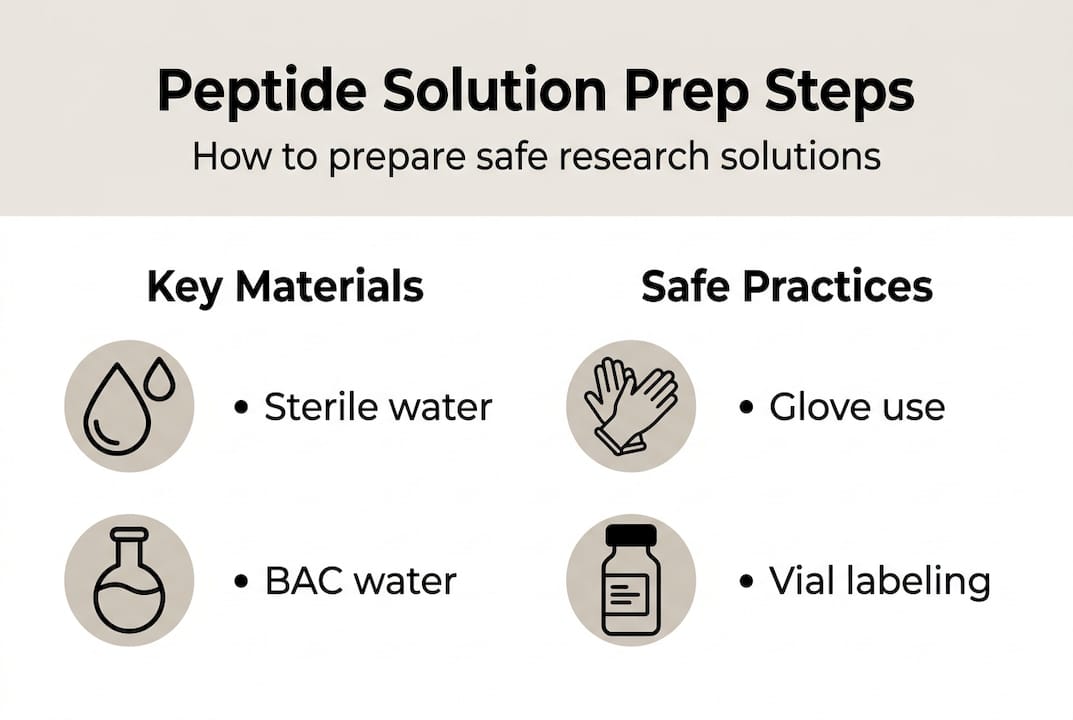
Core materials you’ll need:
- Sterile bacteriostatic water (BAC water) or sterile water for injection
- Lyophilized peptide powder
- Low-bind microcentrifuge vials (1.5mL or 2mL)
- Calibrated micropipettes and sterile tips
- Nitrile gloves and eye protection
- Alcohol wipes (70% isopropyl)
- 0.22µm syringe filters (for added sterility)
- A laminar flow hood or clean bench space
- Permanent marker and labels for vial identification
One of the most important material decisions you’ll make is choosing between sterile water and bacteriostatic water. Sterile water is free of microorganisms but contains no preservative, meaning it must be used immediately after opening. BAC water contains 0.9% benzyl alcohol, which inhibits bacterial growth and extends the usable life of your reconstituted solution significantly. For most peptide research applications where solutions need to be stored and accessed multiple times, BAC water is the practical choice.
| Feature | Sterile water | Bacteriostatic water |
|---|---|---|
| Preservative | None | 0.9% benzyl alcohol |
| Multi-use after opening | No | Yes |
| Shelf life (reconstituted) | Use immediately | Up to 28 days at 2-8°C |
| Best for | Single-use prep | Repeated access/storage |
| Contamination risk | Higher after opening | Lower with proper handling |
Temperature handling matters from the moment you receive your materials. Reconstituted solutions at 2-8°C last up to 28 days with BAC water, while lyophilized peptides should be stored at -20°C. Avoid freeze-thaw cycles by aliquoting into single-use volumes before freezing.
For more on protecting your reagents before and after reconstitution, the safe peptide storage guide covers temperature logs, vial selection, and common storage mistakes. And before you begin any mixing, reviewing lab reagent safety steps will help you set up your workspace correctly.
Pro Tip: Always let lyophilized peptides equilibrate to room temperature before opening the vial. Opening a cold vial introduces moisture from condensation, which can degrade the peptide before you’ve even started reconstitution.
Step-by-step: Safely reconstituting peptides
With your materials ready, here’s how to prepare your solutions step by step.
- Prepare your workspace. Wipe down all surfaces with 70% isopropyl alcohol. Put on nitrile gloves. If you have access to a laminar flow hood, use it. Review lab sterilization tips before starting if you’re new to sterile technique.
- Calculate your target concentration. The concentration formula is straightforward: mg/mL equals peptide mass in mg divided by solvent volume in mL. So 5mg of peptide dissolved in 2mL of BAC water gives you 2.5mg/mL.
- Prepare your vials. Wipe the septum of your BAC water vial and your peptide vial with an alcohol swab. Allow to air-dry for 10 seconds.
- Draw up the BAC water. Using a calibrated micropipette with a sterile tip, draw the calculated volume of BAC water.
- Add solvent to the peptide. Inject the BAC water slowly down the side of the peptide vial. Never shoot the liquid directly onto the lyophilized cake, as this can cause foaming and peptide degradation.
- Mix gently. Roll the vial between your palms for 30 to 60 seconds. Do not vortex. Vortexing introduces air bubbles and can shear fragile peptide structures.
- Inspect the solution. It should be clear and colorless. Any cloudiness or particles are a red flag.
- Label and store. Mark the vial with peptide name, concentration, date of reconstitution, and your initials.
| Peptide mass | BAC water volume | Resulting concentration |
|---|---|---|
| 2mg | 1mL | 2.0mg/mL |
| 5mg | 2mL | 2.5mg/mL |
| 5mg | 5mL | 1.0mg/mL |
| 10mg | 4mL | 2.5mg/mL |
For guidance on water quality and purity standards relevant to your solvent choice, the lab water purity guide is worth bookmarking.
Pro Tip: If your research protocol requires a specific dose per volume (for example, 100µg per 0.1mL), work backward from that target to set your concentration. This avoids awkward pipetting volumes and reduces measurement error at the point of use.
Ensuring sterility, proper storage, and avoiding contamination
After solution prep, maintaining sterility and storage is crucial. Even a perfectly reconstituted solution can be ruined by a single unsterile needle or a vial left at room temperature for too long.
Store all reconstituted solutions at 2-8°C for up to 28 days when using BAC water. Lyophilized stock should remain at -20°C until needed. Never store reconstituted peptides in the freezer unless your protocol specifically calls for it, as repeated freeze-thaw cycles degrade both peptide integrity and BAC water efficacy.
Sterility and contamination checklist:
- Always use a new sterile tip for each draw
- Wipe vial septa with alcohol before every access
- Never leave vials uncapped on the bench
- Discard any solution showing cloudiness, color change, or visible particles
- Use 0.22µm filters when preparing solutions for sensitive applications
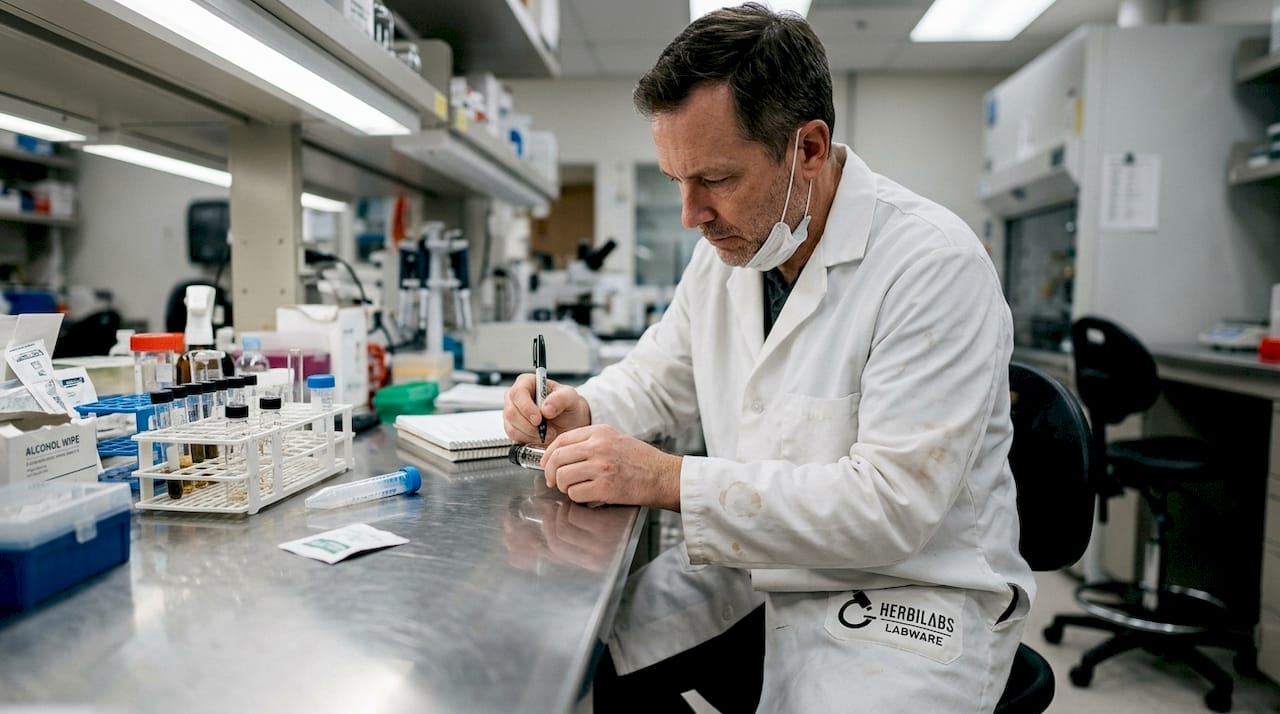
- Label every vial with date, concentration, and storage conditions
- Keep a log of how many times a vial has been accessed
Aliquoting is one of the most underused strategies in independent labs. Instead of drawing from a single large vial repeatedly, divide your reconstituted solution into single-experiment volumes immediately after preparation. This eliminates freeze-thaw cycling and reduces the number of times you breach the vial septum, both of which are major contamination vectors.
Safety note: Edge cases in bacteriostatic water use include sensitivity to benzyl alcohol in certain biological systems. For in vitro work this is rarely relevant, but always inspect for cloudiness or particles before use, and filter through a 0.22µm membrane when extra sterility is required.
For deeper reading on contamination prevention strategies, contamination control tips covers airborne, contact, and cross-contamination risks specific to peptide labs. And for a breakdown of what sterility actually means in a lab product context, lab product sterility is a useful reference.
Pro Tip: Date your vials on the bottom, not the side. Labels on the side peel off in cold storage. A permanent marker on the base survives refrigeration far better.
Quality verification and troubleshooting common mistakes
Once solutions are stored, verify their quality and address issues promptly. A quality check routine doesn’t need to be complex, but it does need to be consistent.
Step-by-step quality check routine:
- Hold the vial up to a bright light source and inspect for particulate matter or cloudiness.
- Check the label against your preparation log to confirm concentration and date.
- Verify the solution is within its 28-day window if stored at 2-8°C.
- If any doubt exists about sterility, inspect for cloudiness and particles and run the solution through a 0.22µm filter before use.
- Confirm the vial septum shows no signs of coring or damage from repeated needle insertion.
Common mistakes and how to fix them:
- Wrong concentration calculated: Recalculate using the mg/mL formula and prepare a fresh batch. Do not attempt to dilute a mislabeled vial without full documentation of the correction.
- Cloudy solution after reconstitution: May indicate peptide aggregation or contamination. Try warming gently to 37°C for 5 minutes. If cloudiness persists, discard and start fresh.
- Vortexed instead of rolled: If the solution foamed heavily, discard it. Foaming indicates potential peptide denaturation.
- Stored at wrong temperature: Solutions left at room temperature for more than 2 hours should be discarded. Don’t assume they’re still viable.
- Unlabeled or mislabeled vials: Discard. Never guess at concentration or preparation date.
For a structured approach to confirming your solution meets research-grade standards, the lab purity check resource provides a practical framework. If you’re working in a regulated or audited environment, lab product certification explains what certifications to look for in your reagents and labware.
A practical perspective: What most guides miss about solution safety
Most protocol guides treat sterility as a binary: either you followed the steps or you didn’t. In practice, it’s more of a spectrum, and the gaps usually show up in habits rather than knowledge.
We’ve seen researchers who know every step of a sterile protocol but still contaminate solutions because they rush the alcohol wipe dry time, or because they reuse a pipette tip “just once.” The composition of bacteriostatic water matters, but it doesn’t compensate for poor bench habits.
The other overlooked factor is visual inspection frequency. Most researchers check a solution once, at reconstitution, and then trust the label. But cloudiness or particles can develop during storage, especially if a vial was breached with a non-sterile needle even once. Inspect every time you access a vial. It takes three seconds and catches problems that would otherwise corrupt your data.
The uncomfortable truth is that most solution failures in independent labs aren’t caused by bad reagents. They’re caused by small, repeated shortcuts that accumulate over time.
Safe solutions and expert labware: Next steps for researchers
If your research depends on consistent, contamination-free reconstitution, the quality of your starting materials is non-negotiable.
At Herbilabs, we manufacture bacteriostatic water and sterile diluents to strict purity standards, specifically for peptide research applications. Every batch is quality-controlled and produced in a dedicated facility. If you want to understand more about what goes into a safe product, start with our guide on bacteriostatic water safety or review safe bacteriostatic water storage for handling best practices. When you’re ready to order research-grade solutions and labware, our full range is available at the labware shop.
Frequently asked questions
How should I store reconstituted peptide solutions with bacteriostatic water?
Store at 2-8°C for up to 28 days and aliquot into single-use volumes before freezing to prevent degradation from repeated freeze-thaw cycles.
What is the correct formula for calculating peptide concentration?
Divide peptide mass in mg by solvent volume in mL to get mg/mL. For example, 5mg peptide in 2mL BAC yields a concentration of 2.5mg/mL.
How can I ensure a sterile reconstituted solution?
Inspect visually for cloudiness or particles before every use, and filter through a 0.22µm membrane when your application demands the highest level of sterility.
What materials are required to reconstitute peptides safely in the lab?
You’ll need sterile bacteriostatic water, lyophilized peptide powder, clean low-bind vials, calibrated pipettes with sterile tips, nitrile gloves, and 0.22µm syringe filters for filtration.