Private Label, White Label, Wholesale partnerships available - EU, USA and UK - Free shipping from €75

Lab compliance standards for research labs explained
Learn which compliance standards apply to your research lab in the UK and EU, from GLP and ISO 17025 to COSHH and drug precursor licensing requirements.
TL;DR:
- Laboratory compliance involves specific frameworks tailored to research context and substances used.
- Independent researchers must follow regulations like GLP, ISO standards, COSHH assessments, and drug precursor licenses.
- Cultivating a culture of compliance ensures reliable data, legal protection, and enhanced lab credibility.
Most independent researchers assume that if they follow basic safety protocols, they’re compliant. That assumption can be costly. Laboratory compliance is not a single rulebook shared across all lab types. It’s a layered system of frameworks, each designed for specific contexts, substances, and research purposes. For EU and UK independent researchers handling bacteriostatic water, sterile diluents, and research reagents, the rules that apply to you may differ significantly from those governing a pharmaceutical company or a hospital laboratory. This article walks through the core frameworks, practical risk assessment requirements, and special licensing obligations that matter most for your work.
Table of Contents
- What is laboratory compliance and why does it matter?
- Key compliance frameworks: GLP, ISO 17025, and more
- Hazardous reagents, risk assessments, and COSHH essentials
- Drug precursors, licensing, and special UK/EU lab requirements
- Why compliance isn’t just about ticking boxes: Our expert perspective
- Discover compliant labware and solutions for your research
- Frequently asked questions
Key Takeaways
| Point | Details |
|---|---|
| Know your standards | Different frameworks—GLP, ISO 17025, COSHH—apply depending on lab status and research type. |
| COSHH is a must | Risk assessments and safe handling of hazardous lab reagents are legally required in the UK. |
| Licensing is essential | Special licenses are needed for drug precursor chemicals in the UK and EU, even for small labs. |
| Voluntary standards boost results | Choosing ISO 17025 can elevate your lab’s credibility and data acceptance. |
| Compliance protects your work | Upholding regulations safeguards quality, reliability, and the defensibility of your research. |
What is laboratory compliance and why does it matter?
At its core, laboratory compliance ensures the quality, reliability, and safety of laboratory operations. But that definition covers a wide range of practical obligations, from how you store reagents to how you document your processes and dispose of waste. For independent researchers, understanding what compliance actually demands is the first step to avoiding costly mistakes.
It helps to separate two related but distinct concepts. Regulations are legally binding requirements. If you handle certain chemicals or conduct regulatory studies, you must meet these standards or face legal consequences. Best practices, on the other hand, are voluntary but carry real weight. Following them strengthens the credibility of your data and makes your work defensible if it’s ever scrutinized.
“Compliance is not just about avoiding penalties. It’s about producing results that hold up under review, whether by a funding body, a regulatory agency, or a peer reviewer.”
For researchers handling bacteriostatic water and reconstitution reagents, the key risk areas include:
- Improper handling: Using reagents outside their specified storage conditions or without appropriate personal protective equipment
- Contamination: Introducing biological or chemical contaminants that compromise experimental integrity
- Documentation gaps: Failing to record lot numbers, preparation dates, or handling procedures
- Legal exposure: Possessing or using certain substances without the required licenses or registrations
Pro Tip: The most overlooked compliance step for small and independent labs is maintaining a proper reagent log. Recording every batch, its source, preparation date, and storage conditions takes minutes but protects you in any audit or incident review. Pair this habit with a safe reagent handling guide to build a solid operational baseline.
Compliance also matters because it directly affects data quality. Contaminated reagents or improperly stored bacteriostatic water can skew results in ways that aren’t immediately obvious. By the time you detect the problem, you may have lost weeks of work.
Key compliance frameworks: GLP, ISO 17025, and more
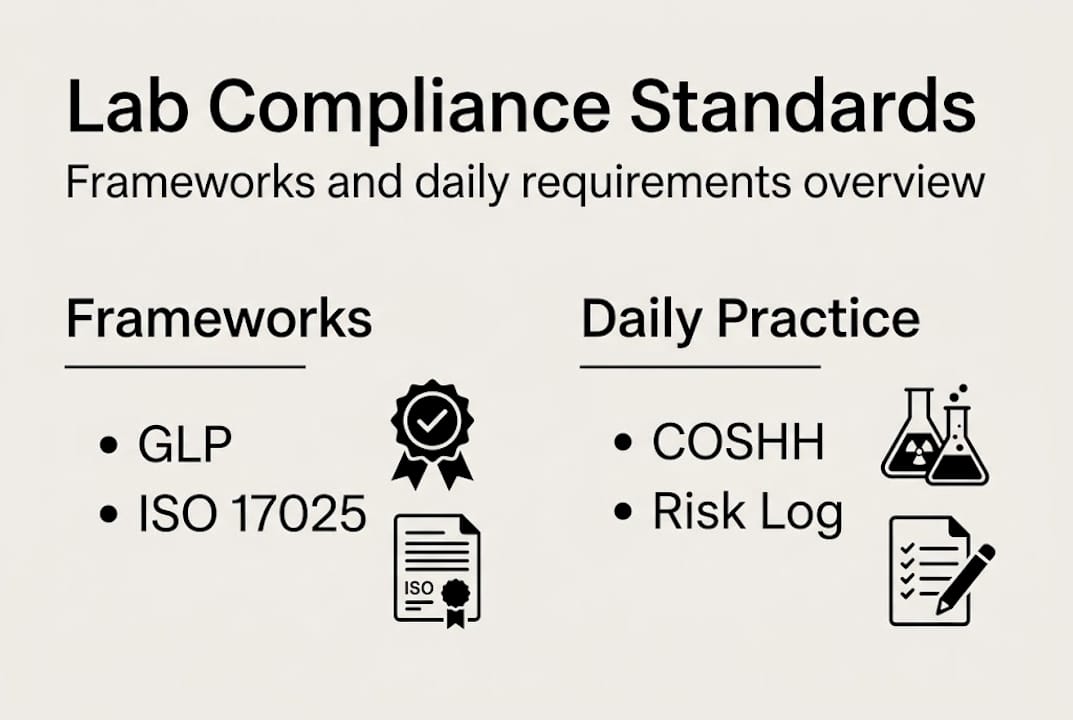
With the fundamental need for compliance established, we turn to what frameworks actually govern your work. Three standards dominate the landscape for UK and European research labs: GLP, ISO 17025, and ISO 15189.
Good Laboratory Practice (GLP) is mandatory for UK facilities conducting regulatory safety tests on chemicals and pharmaceuticals, monitored through the MHRA’s GLP monitoring program. It governs non-clinical safety studies and focuses on process integrity, meaning how studies are planned, conducted, recorded, and reported.
ISO 17025 applies to testing and calibration laboratories. It’s voluntary for most independent researchers, but ISO 17025 accreditation significantly boosts the credibility of your testing data. Regulatory bodies and clients are far more likely to accept results from an accredited lab.
ISO 15189 is specifically designed for medical laboratories, adding a patient safety dimension to the competence requirements of ISO 17025. If your research touches clinical diagnostics, this standard becomes relevant.
| Standard | Scope | Primary focus | Typical application |
|---|---|---|---|
| GLP | Non-clinical safety studies | Process integrity | Pharmaceutical, chemical safety testing |
| ISO 17025 | Testing and calibration labs | Result validity and competence | Independent research, contract labs |
| ISO 15189 | Medical laboratories | Patient safety and diagnostic quality | Clinical diagnostics, hospital labs |
For a first-time lab reviewer, here’s a practical starting checklist:
- Identify whether your research is regulatory (requires GLP) or independent (consider ISO 17025)
- Review your quality control for reagents procedures against the relevant standard
- Audit your documentation: study plans, raw data records, and final reports
- Assess your facility: equipment calibration logs, environmental monitoring records
- Review staff training records and ensure roles are clearly defined
- Check your contamination prevention protocols against the standard’s requirements
One important nuance: GLP and ISO 17025 are not interchangeable. GLP governs the integrity of the study process itself. ISO 17025 focuses on whether your lab is technically competent to produce valid results. A lab can be GLP-compliant but not ISO 17025 accredited, and vice versa.
Hazardous reagents, risk assessments, and COSHH essentials
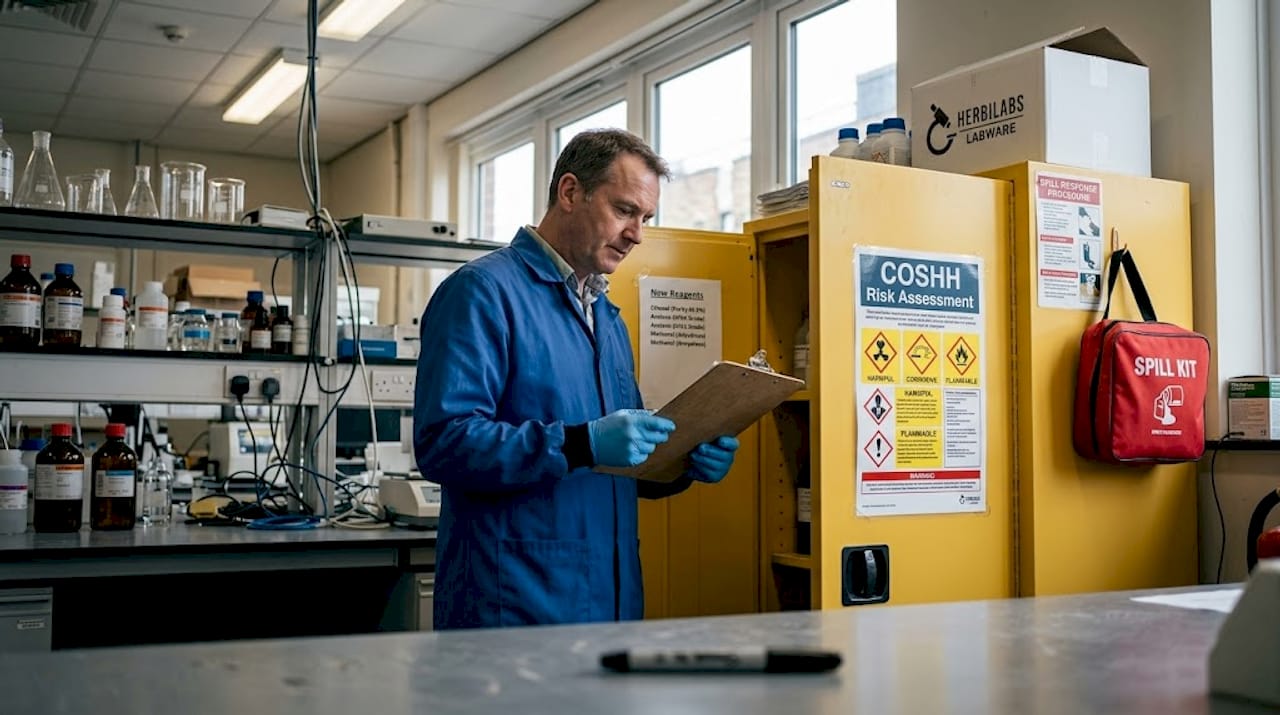
Frameworks provide the “what,” but COSHH and proper risk assessments define the “how” for daily lab work. COSHH stands for Control of Substances Hazardous to Health. It’s the UK regulatory framework that requires employers and researchers to assess and control exposure to hazardous materials, including many common laboratory reagents.
For independent researchers, COSHH compliance is not optional. Even if you’re working outside a formal institutional setting, you are legally required to assess the risks of any hazardous substance you use or store. Bacteriostatic water itself is generally low risk, but the peptides, solvents, and reconstitution agents used alongside it may carry significant hazard profiles.
A proper COSHH risk assessment for your lab should cover:
- Substance identification: Name, form, concentration, and hazard classification of every reagent
- Exposure routes: Inhalation, skin contact, ingestion, or injection risk
- Control measures: Ventilation, personal protective equipment, containment procedures
- Emergency procedures: Spill response, first aid, and incident reporting
- Waste disposal: Segregation, labeling, and licensed disposal routes for hazardous waste
- Review schedule: Regular reassessment, especially when new substances are introduced
As noted in GLP guidance for independent researchers, the focus for non-regulatory labs should be on robust COSHH risk assessments, proper hazardous reagent handling, and documented waste disposal procedures. These three areas are where independent labs most commonly fall short during inspections.
Pro Tip: Don’t write a single COSHH assessment and file it away. Treat it as a living document. Every time you introduce a new reagent or change a procedure, update the assessment. A current, detailed lab safety checklist is far more useful than a perfect document from two years ago.
The most common non-compliance pitfall is underestimating mixture hazards. Researchers often assess each reagent in isolation but fail to consider what happens when two substances are combined or stored together. Always assess the combined hazard profile, not just individual components.
Drug precursors, licensing, and special UK/EU lab requirements
Beyond standard safety and handling, some lab substances carry extra legal risk. Drug precursors are chemicals that can be used in the illicit manufacture of controlled drugs. Their possession, purchase, and use are tightly regulated, and the rules apply regardless of your research intent.
In the UK, Category 1 drug precursors require a Home Office license or registration before you can legally purchase or possess them. Independent researchers must also appoint a responsible person, submit declarations, and maintain detailed records of use and disposal. This is not a bureaucratic formality. Failure to comply can result in criminal prosecution.
Here’s a practical overview of the key compliance steps for drug precursor handling:
| Requirement | Detail | Who applies | Responsible party |
|---|---|---|---|
| Home Office license | Required for Cat 1 precursors | All UK researchers | Principal investigator or lab owner |
| Responsible person appointment | Named individual accountable for compliance | All licensed facilities | Appointed staff member |
| Purchase declarations | Written declaration for each transaction | Buyer and supplier | Researcher and supplier |
| Record keeping | Quantity, use, disposal logs | All licensed holders | Responsible person |
| Loss or theft reporting | Notify Home Office within 24 hours | All licensed holders | Responsible person |
For independent labs, the numbered compliance checklist looks like this:
- Identify whether any substances you use or plan to use are classified as drug precursors
- Apply for the relevant Home Office license before purchasing or possessing Category 1 substances
- Appoint a named responsible person and document this formally
- Establish a purchase declaration process with your supplier
- Implement a logbook for all precursor use, storage, and disposal
- Review your contamination control procedures to ensure precursor handling areas are properly isolated
- Audit your lab product sourcing to confirm suppliers can provide compliant documentation
EU researchers face similar obligations under Regulation (EC) No 273/2004 and its amendments. The categories and licensing thresholds differ slightly from UK rules post-Brexit, so always verify current requirements with your national competent authority.
Why compliance isn’t just about ticking boxes: Our expert perspective
Here’s what experience has taught us: the labs that struggle most with compliance are not the ones that ignore the rules. They’re the ones that treat compliance as a checklist exercise rather than a quality commitment.
A checklist mentality produces labs that pass audits but produce unreliable data. A quality-driven culture produces labs that rarely need to worry about audits because their processes are genuinely sound. The difference is subtle but significant. Researchers who internalize compliance as a standard of work, rather than a burden imposed from outside, tend to catch problems earlier, document more clearly, and make better decisions under pressure.
For independent labs, building credibility is especially important. Without the institutional backing of a university or pharmaceutical company, your reputation rests entirely on the quality and defensibility of your methods. Reliable labware delivery and consistent sourcing from verified suppliers are part of that credibility picture.
What most researchers miss is that compliance failures rarely happen because someone didn’t know the rules. They happen because the culture didn’t support following them consistently. Build the habit first. The documentation will follow naturally.
Discover compliant labware and solutions for your research
Putting compliance into practice starts with sourcing materials you can trust. At Herbilabs, we manufacture bacteriostatic water and research reagents to strict purity standards, with full documentation to support your compliance obligations.
Whether you need answers to common questions about bac water, want to review quality control practices for your reagents, or are ready to stock your lab with verified, research-grade products, we have the resources and the inventory to support your work. Explore our bacteriostatic water FAQs for practical guidance, or visit our shop to find compliant labware built for demanding research environments across the UK and Europe.
Frequently asked questions
Is GLP compliance mandatory for all research labs in the UK and Europe?
GLP is mandatory only for regulatory studies on chemicals and pharmaceuticals, not for all academic or independent labs. If your work does not feed into a regulatory submission, GLP does not apply to you.
What is COSHH and why is it important for handling laboratory reagents?
COSHH is the UK law requiring risk assessments for hazardous materials to protect researchers from exposure. Under COSHH requirements, even independent researchers must assess and document the risks of every hazardous substance they handle.
Do independent researchers need a license to purchase or possess drug precursors?
Yes. For Category 1 precursors in the UK, a Home Office license and a formally appointed responsible person are both required before purchase or possession is legal.
How does ISO 17025 benefit a research lab if it’s not mandatory?
ISO 17025 accreditation increases the credibility of your testing results and makes them more likely to be accepted by regulatory bodies, funding agencies, and clients. For independent labs, this voluntary standard can be a significant competitive advantage.