Private Label, White Label, Wholesale partnerships available - EU, USA and UK - Free shipping from €75

Lab safety checklist: 5 essential steps for bac water
A practical lab safety checklist for independent researchers handling bacteriostatic water and reagents, covering GLP, aseptic technique, storage, and self-audits.
TL;DR:
- Independent researchers must follow structured safety protocols to ensure reliable, uncontaminated results.
- Engineering controls like biosafety cabinets and proper storage are essential priorities over PPE.
- Strict aseptic techniques and diligent labeling reduce contamination risk and lab mishaps.
When you work outside an institutional lab, there is no safety officer checking your protocols, no QA department reviewing your storage logs, and no colleague catching a mislabeled vial before it causes a problem. Independent researchers and scientific professionals across Europe carry that responsibility alone. A structured lab safety checklist is not a bureaucratic formality in that context. It is the difference between clean, reproducible results and a contaminated experiment that costs you time, money, and credibility. This guide walks you through the most critical steps for safe handling of bacteriostatic water and research reagents, from foundational principles to daily execution.
Table of Contents
- Understand and apply good laboratory practice (GLP) fundamentals
- Engineering controls: The first defense in your lab safety checklist
- Aseptic technique and reagent handling: Minimize contamination risk
- Storage, labeling, and self-audit: Don’t neglect the basics
- The real challenge: Building a safety culture when you work alone
- Reliable sources and tools for your safest lab
- Frequently asked questions
Key Takeaways
| Point | Details |
|---|---|
| Rely on engineering controls | Fume hoods and ventilation protect you better than PPE when handling hazardous agents. |
| Flawless aseptic technique | Strict technique for multi-use vials reduces contamination and conserves reagent. |
| Routine self-audits matter | Without external oversight, checking your own procedures maintains safe practices. |
| Label everything clearly | Redundant, error-proof labeling of all containers and shelves prevents deadly mix-ups. |
Understand and apply good laboratory practice (GLP) fundamentals
Good Laboratory Practice, commonly abbreviated as GLP, is a formal quality system that governs how non-clinical research studies are planned, performed, monitored, and reported. Most researchers associate GLP with large pharmaceutical companies or government-funded institutions. That association is a mistake. The principles apply just as meaningfully to independent labs, and arguably more so, because you have no external system catching your errors.
At its core, GLP requires that every procedure be documented, every material be traceable, and every deviation from protocol be recorded and explained. For independent researchers handling bacteriostatic water and sensitive reagents, this means writing Standard Operating Procedures (SOPs) for every routine task, from reconstituting peptides to cleaning your workspace. SOPs are not just paperwork. They create a repeatable, auditable record that protects your research integrity.
One of the most overlooked GLP requirements is physical separation. GLP principles require separate storage for test and reference items, with SOPs governing all handling steps. In practice, this means your bacteriostatic water should never share a storage space with chemical reagents, solvents, or unlabeled materials. Cross-contamination often starts with proximity, not carelessness.
Self-audits are the institutional equivalent of a QA review, and for independent researchers, they are non-negotiable. Schedule them monthly. Walk through your lab as a skeptical outsider would. Ask whether every container is labeled, every SOP is current, and every piece of equipment is functioning as expected.
Here is what a basic GLP compliance checklist should include:
- Written SOPs for all reagent handling, storage, and disposal
- Separate, clearly designated storage zones for different reagent classes
- A logbook or digital record for every batch of bacteriostatic water received and used
- Scheduled self-audit dates recorded in advance
- Documented deviations with corrective actions noted
“Engineering controls like fume hoods and biological safety cabinets should be prioritized over PPE. Independent researchers must self-audit because no institutional QA exists to catch gaps.”
For guidance on selecting and vetting your input materials, lab sourcing best practices are worth reviewing before you build your SOP framework.
Engineering controls: The first defense in your lab safety checklist
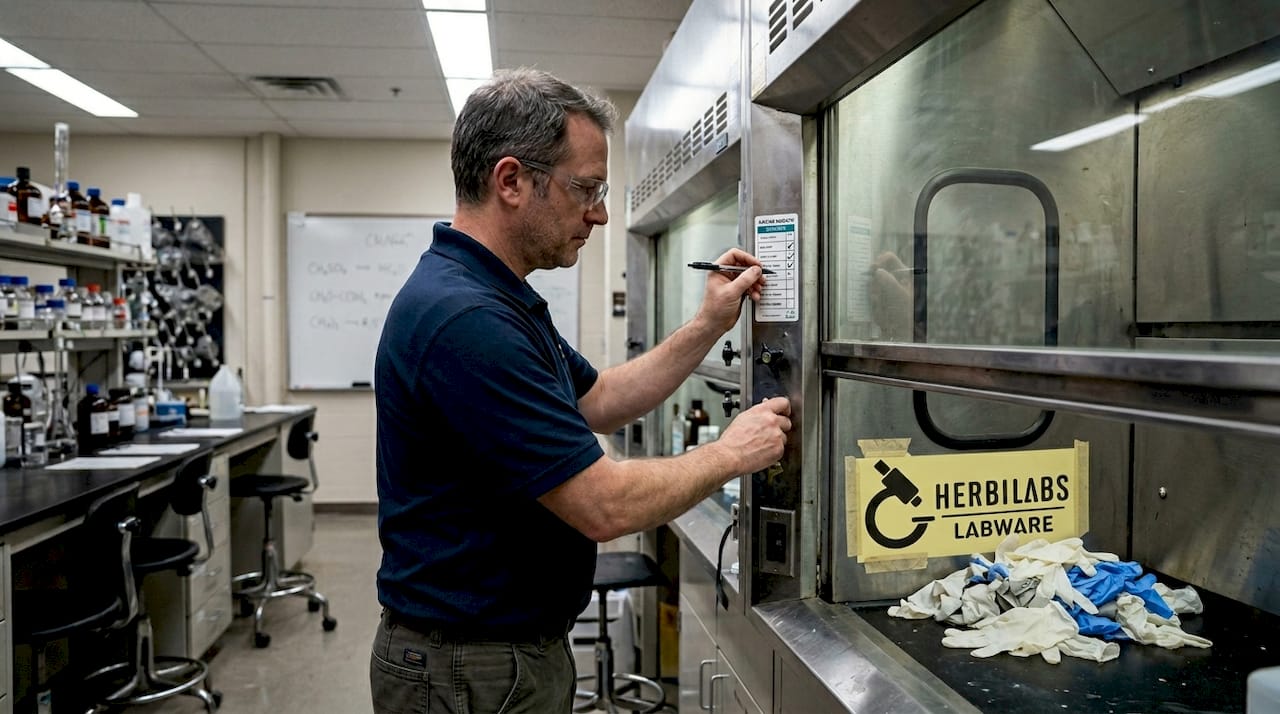
Engineering controls are physical modifications to your workspace that reduce or eliminate exposure to hazards. They sit at the top of the safety hierarchy for a reason: they work independently of human behavior. A fume hood removes airborne contaminants whether or not you remember to hold your breath. A biological safety cabinet (BSC) protects your sample from environmental contamination regardless of how tired you are at the end of a long session.
For labs handling bacteriostatic water and biological reagents, the most relevant engineering controls include:
- Class II biological safety cabinets for open manipulation of sterile reagents
- HEPA-filtered ventilation systems to maintain clean air in the workspace
- Dedicated sharps containers positioned within arm’s reach
- Sealed, lockable storage units for chemical reagents
- Spill containment trays under all liquid storage areas
Engineering controls over PPE is the correct priority order, and independent researchers must self-audit to verify these controls remain functional. PPE is your last line of defense, not your first.
Here is a practical comparison to clarify the distinction:
| Control type | Example | Effectiveness | Key limitation |
|---|---|---|---|
| Engineering control | Biological safety cabinet | High, passive, continuous | Upfront cost, requires maintenance |
| Administrative control | SOP documentation | Moderate, depends on compliance | Relies on human behavior |
| PPE | Gloves, lab coat, goggles | Low to moderate, last resort | User-dependent, can fail |
Budget is a real constraint for independent researchers. A certified Class II BSC is expensive, but second-hand units from decommissioned labs are often available and can be recertified. At minimum, a laminar flow hood significantly reduces contamination risk when working with sterile reagents.
Pro Tip: Inspect your ventilation and safety equipment every 30 days. Check airflow indicators on hoods, verify HEPA filter replacement schedules, and confirm that BSC certification dates have not lapsed. A five-minute inspection prevents months of compromised results.
For a structured walkthrough of workspace setup, step-by-step lab safety covers the sequencing in detail. When your focus is specifically on aqueous reagents, lab water handling addresses purity maintenance across the full workflow.
Aseptic technique and reagent handling: Minimize contamination risk
Aseptic technique is the set of practices that prevent microorganisms from contaminating sterile materials. When you are working with bacteriostatic water, which contains 0.9% benzyl alcohol as a preservative, aseptic technique is what allows safe multi-use of a single vial across multiple draws. Without it, the preservative alone cannot prevent contamination from repeated needle insertions or airborne exposure.
The core steps of aseptic technique for reagent handling are:
- Disinfect the vial septum with 70% isopropyl alcohol before every insertion
- Use a new, sterile needle and syringe for each draw
- Never leave needles inserted in a septum between uses
- Work inside a BSC or laminar flow hood whenever possible
- Avoid talking, coughing, or sneezing over open containers
Aseptic multi-use of bac water reduces waste but demands strict technique, and edge-case chemicals like peroxide-formers require additional testing before reuse. Peroxide-forming reagents, such as certain ethers and tetrahydrofuran, can accumulate explosive peroxides over time. These must be tested with peroxide test strips before opening or reuse, and disposed of according to local hazardous waste regulations if they exceed safe thresholds.
| Practice | Single-use vial | Multi-use vial (bac water) |
|---|---|---|
| Contamination risk | Lowest | Low if technique is strict |
| Cost efficiency | Lower | Higher |
| Protocol complexity | Minimal | Requires full aseptic workflow |
| Suitable for | High-risk reagents | Bacteriostatic water, preserved solutions |
For ongoing assurance that your reagents remain uncompromised, reagent quality control outlines the testing and verification steps worth integrating into your routine. More specific guidance on vial integrity and storage conditions is available at storing bac water.
Pro Tip: To reduce reagent waste without sacrificing safety, pre-calculate your draw volumes before opening any vial. Fewer insertions mean fewer contamination opportunities and a longer usable vial life.
Storage, labeling, and self-audit: Don’t neglect the basics
Storage and labeling failures are responsible for a disproportionate share of lab incidents. The reason is simple: they feel administrative, so researchers deprioritize them when time is short. That is exactly when mistakes happen.
Every container in your lab must carry a label that includes the substance name, concentration, date of preparation or receipt, expiration date, and your initials or identifier. Redundancy matters. If a label falls off or becomes illegible, a secondary label on the storage box or shelf prevents confusion.
GLP principles require separate storage for test and reference items, with SOPs governing all handling. In practical terms, this means:
- Assign fixed, dedicated zones for bacteriostatic water, sterile diluents, chemical reagents, and waste
- Use color-coded storage bins or shelf labels to make zones visually distinct
- Never place a new reagent in storage without completing its label first
- Dispose of expired materials on a fixed schedule, not when space runs out
- Keep an up-to-date inventory log that matches physical stock
Your self-audit checklist should cover these areas at minimum:
- All containers labeled correctly and legibly
- Expiration dates checked and expired stock removed
- Storage zones free of cross-contamination
- SOPs current and accessible
- Equipment inspection logs up to date
- Waste disposal records complete
Understanding the functional differences between reagent classes helps you design smarter storage systems. Lab reagent types provides a practical breakdown. For labs working with injectable preparations, contamination control tips covers the specific risks that arise in peptide research environments.
“A label written in haste is a hazard waiting to happen. Treat every container as if someone unfamiliar with your lab will need to identify it safely.”
The real challenge: Building a safety culture when you work alone
Here is something most safety guides will not tell you: the checklist is the easy part. The hard part is following it consistently when no one is watching, when you are under deadline pressure, and when the shortcut feels harmless just this once.
Institutional labs use peer accountability, mandatory training cycles, and external audits to enforce safety culture. Independent researchers have none of that. What they do have is autonomy, and that is actually a significant advantage if you use it deliberately.
We have seen researchers who maintain higher standards than institutional counterparts precisely because they chose to. They built digital checklists into their workflow using tools like Notion or Google Sheets, set calendar reminders for monthly self-audits, and recorded short video walkthroughs of their lab setup to review later with fresh eyes. These are not complicated systems. They are consistent ones.
The uncomfortable truth is that safety culture is not about knowledge. Most researchers already know what they should do. It is about designing your environment so that the safe choice is also the easiest choice. Put your SOP binder where you cannot miss it. Set your audit reminder before you need it. Order your reagents from sources you have already vetted for purity and traceability, as outlined in resources on ensuring lab purity. Autonomy without structure is just risk with a different name.
Reliable sources and tools for your safest lab
Every step in this checklist depends on starting with materials you can trust. Contaminated or mislabeled reagents undermine even the most rigorous technique.

At Herbilabs, we manufacture bacteriostatic water and sterile diluents to strict purity standards, with full traceability from production to delivery. Our resources on storing bacteriostatic water and the differences between bac water vs sterile water help you make informed decisions at every stage of your research. When you are ready to source products that match your safety standards, the Herbilabs labware shop offers research-grade options with secure ordering and reliable European delivery.
Frequently asked questions
What is the most important step in a lab safety checklist when using bacteriostatic water?
No single step works in isolation. Combining engineering controls, aseptic technique, and rigorous labeling gives you overlapping layers of protection that compensate for any single point of failure.
How can independent researchers safely perform self-audits?
Use a fixed digital or paper checklist and schedule audits in advance. GLP guidance recommends reviewing all storage, labeling, and handling SOPs at regular intervals, not just when something goes wrong.
What is the biggest risk when multi-using bacteriostatic water vials?
The primary risk is contamination introduced through repeated needle insertions or poor septum disinfection. Aseptic multi-use demands strict technique every single time, with no exceptions for convenience.
Why does labeling matter so much for lab safety?
A missing or incorrect label can cause a researcher to use the wrong reagent, the wrong concentration, or an expired material. GLP storage principles treat accurate labeling as a non-negotiable baseline, not an optional extra.