Private Label, White Label, Wholesale partnerships available - EU, USA and UK - Free shipping from €75

Why research reagent quality matters for reliable results
Discover why is quality important for research reagents in achieving reliable, reproducible results. Learn how to enhance your experiments today!
TL;DR:
- True reagent quality involves purity, contaminant profile, batch consistency, and functional validation.
- High-quality reagents reduce variability, contamination risk, and improve reproducibility of experiments.
- Selecting reliable suppliers requires evaluating their quality systems, batch-specific documentation, and validated analytical methods.
Assume for a moment that two labs run the same experiment with reagents both labeled “95% purity, research grade.” One lab gets clean, reproducible data. The other gets inconsistent signals and can’t replicate its own results after three attempts. The reagents looked identical on paper. The difference? What that purity label didn’t say. High-quality research reagents ensure accurate, reliable, and reproducible scientific results by minimizing experimental variability and contamination risks. This guide breaks down what quality actually means, where assumptions go wrong, and how to protect your research from the ground up.
Table of Contents
- What does ‘quality’ in research reagents actually mean?
- How reagent quality drives accuracy, reproducibility, and reliability
- Common pitfalls: Misconceptions about purity and validation
- Minimizing risks: Strategies for sourcing reliable reagents
- What most lab procurement guides overlook about reagent quality
- How Herbilabs supports reliable research with high-quality reagents
- Frequently asked questions
Key Takeaways
| Point | Details |
|---|---|
| Quality impacts results | Even small differences in research reagent quality can dramatically affect accuracy and reliability in lab experiments. |
| Purity isn’t everything | A high purity percentage does not guarantee that reagents are free from bioactive or harmful impurities. |
| Source from verified suppliers | Carefully evaluate suppliers and require clear quality documentation to minimize risks and maximize reproducibility. |
| Validation matters | Over a quarter of lab methods can suffer from huge uncertainty if validation is inadequate. |
| SOPs reduce errors | Implementing standard procedures for sourcing, handling, and storage helps protect experimental integrity. |
What does ‘quality’ in research reagents actually mean?
With the stakes clarified, it’s essential to understand what the term ‘quality’ actually captures in the lab. It’s tempting to reduce quality to a single number on a certificate of analysis. Purity percentage is easy to compare, easy to quote, and gives a false sense of certainty. But that number is only one dimension of a much more complex picture.
True reagent quality covers several interdependent factors:
- Purity refers to the proportion of the intended compound in the sample, but this says nothing about what makes up the remaining fraction.
- Contaminant profile describes the identity and concentration of everything else in the sample, whether residual solvents, synthesis byproducts, or microbial agents.
- Batch consistency confirms that each production run delivers the same material within tight tolerances, not just one validated batch that sets the standard for all future shipments.
- Functional testing verifies that the reagent behaves as expected under actual experimental conditions, not just analytical conditions.
Here’s the critical part that most researchers overlook: two 95% peptides differ dramatically if their impurities are bioactive in one and inert in the other. A single purity percentage hides the impurity profile entirely. You could be working with a compound where 5% of the sample is biologically active contamination, which is enough to skew dose-response curves, generate false-positive signals, or suppress expected activity altogether.
When you review quality control for reagents at the supplier level, you want to see evidence that impurity profiling is part of their standard release testing, not just a purity assay run on a single HPLC column. The type of equipment used, the validation status of the analytical methods, and the reference standards employed all shape whether that percentage means anything in practice.
Understanding the distinction between different labware types and purity requirements also matters here. Reconstitution solutions and diluents interact directly with your active compounds. If those products carry their own impurities, the problem compounds at every stage of sample preparation.
Pro Tip: Ask your supplier for a full impurity profile alongside the purity percentage. If they can only provide a single chromatogram peak area, that’s a red flag for inadequate characterization.
How reagent quality drives accuracy, reproducibility, and reliability
Now that you know what defines reagent quality, let’s see exactly why this matters for your research outcomes. This is where abstract quality concepts translate into real experimental consequences.
Variability is the silent killer of good science. When a reagent’s composition shifts between batches, or contains undisclosed trace components, every data point you generate carries an unknown error. You might not notice immediately because individual experiments look plausible. The problem surfaces when you try to reproduce your own results, compare across time points, or hand the protocol to a colleague in another lab.
| Factor | High-quality reagent | Low-quality reagent |
|---|---|---|
| Batch-to-batch consistency | Tight tolerance, documented | Variable, undocumented |
| Impurity profile | Fully characterized | Unknown or partial |
| Contamination risk | Minimized, tested | Elevated, inconsistent |
| Reproducibility | High across runs | Unpredictable |
| CoA documentation | Batch-specific, detailed | Generic or absent |
| Analytical validation | Method-validated | Often unvalidated |
The downstream cost of poor reproducibility is significant. Experiments get repeated. Timelines extend. In some cases, entire datasets get questioned when variability can’t be explained by the protocol alone. Reliable scientific supplies matter not just for data quality but for research efficiency and cost control.
The benefits of working with high-grade materials are concrete:
- Reduced inter-assay coefficient of variation (CV), meaning your replicates actually agree
- Cleaner baselines in assays that depend on low background signal
- Fewer confounding signals in cell-based or in vivo studies where even trace endotoxin can alter inflammatory responses
- Greater confidence in dose-response relationships because the compound concentration is actually what you think it is
Solid quality control in reagent production at the manufacturing stage is what makes all of this possible. A supplier that releases batches without systematic impurity analysis or endotoxin testing is passing that risk directly to you. And that risk doesn’t always announce itself clearly. Sometimes it just looks like unexplained variability that you spend weeks troubleshooting.
Contamination is often invisible until it isn’t. Endotoxin contamination in peptide solutions is a classic example. You won’t see it, smell it, or detect it with standard lab equipment. But in any experiment involving immune-related pathways, cell viability, or protein expression, endotoxin will silently confound your results. High-quality research reagents minimize contamination risks precisely because reputable suppliers build endotoxin and sterility testing into their release criteria as standard, not as an optional extra.
Common pitfalls: Misconceptions about purity and validation
Even with high-purity labels, assumptions can lead to major mistakes. Let’s explore the most common pitfalls researchers encounter when sourcing and working with research reagents.
Pitfall 1: Treating purity percentage as a complete quality descriptor. A 95% purity label tells you that 95% of the material is the intended compound. It tells you nothing about whether the remaining 5% is a biologically inert byproduct or a pharmacologically active fragment that will interfere with your assay. This distinction matters enormously in peptide research, where truncated sequences and racemized amino acids can still bind receptors with altered affinity.

Pitfall 2: Assuming ‘research grade’ equals validated quality. The term “research grade” is not a regulated designation. Any supplier can apply it. Without independent analytical validation, it signals intent, not verified performance.
Pitfall 3: Accepting generic certificates instead of batch-specific documentation. A certificate of analysis that applies to a product class rather than a specific batch gives you no information about the material you actually received. This is surprisingly common and easily overlooked.
Pitfall 4: Ignoring the analytical method’s own limitations. Even with genuine batch-specific CoAs, the test method itself may be flawed. Research into analytical quality models found that 28% of methods had over 100% uncertainty at the linearity start due to inadequate validation. That means the number on the certificate could be meaningless, not because the supplier was dishonest, but because the method used to generate it lacked the necessary precision.
“A certificate of analysis is only as reliable as the analytical method used to generate it. Method validation is not an optional step—it is the foundation of any meaningful quality claim.”
This insight shifts how you should evaluate supplier documentation. You’re not just asking “what does the CoA say?” You should also be asking “how was this measurement made, and has that method been properly validated?”
Strategies for ensuring lab purity start at the procurement stage, before the reagent ever reaches your bench. Understanding what to look for in supplier documentation is a core competency, not just a nice-to-have. Similarly, knowing how to avoid lab contamination requires understanding where contamination is introduced, and for many researchers, that starts with the reagent itself before handling practices even come into play.
Pro Tip: When reviewing a CoA, check whether the document specifies the analytical method used and its validation status. A CoA without method references is incomplete documentation.
Minimizing risks: Strategies for sourcing reliable reagents
To prevent these errors and protect your research investment, use these smart sourcing and validation strategies. Knowing what can go wrong is useful. Knowing what to do about it is what actually protects your work.
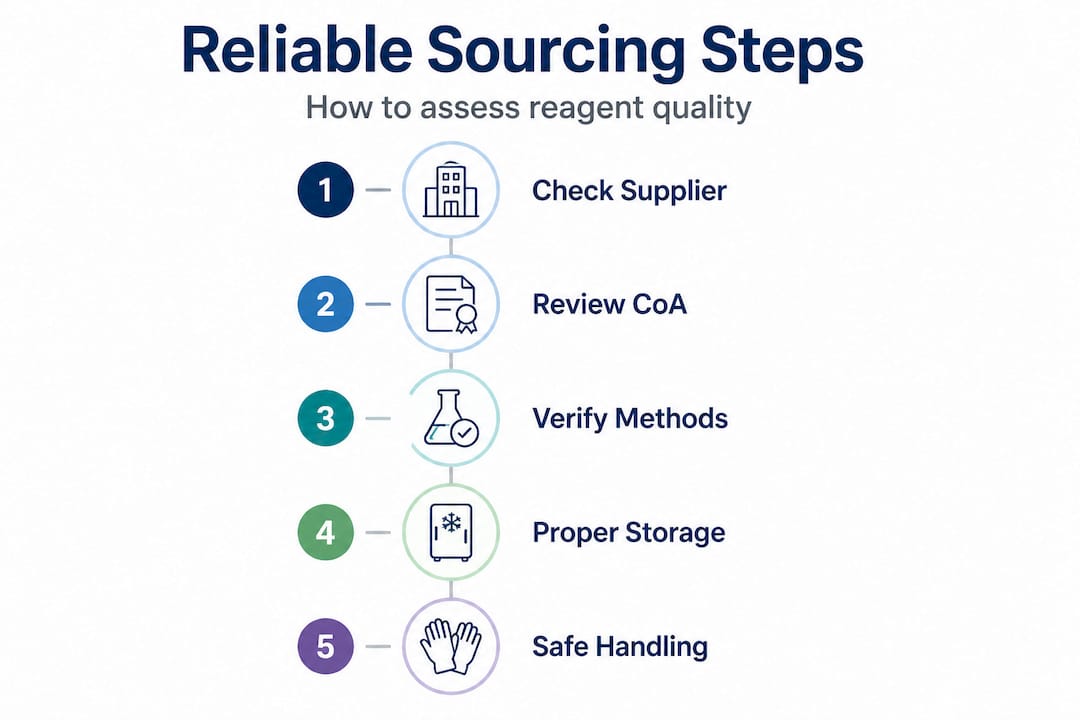
Step 1: Evaluate supplier quality systems before ordering. Don’t start with price. Start by understanding whether the supplier operates under a documented quality management system, conducts batch-specific release testing, and maintains traceability from raw material to finished product. Ask for their quality documentation directly.
Step 2: Request batch-specific CoAs, not product-level certificates. Every batch you receive should come with its own certificate detailing the specific analytical results for that lot. This is non-negotiable for any work where reproducibility matters.
Step 3: Verify the analytical methods described. Where possible, confirm that the methods listed on CoAs are validated and appropriate for the compound type. For peptides, HPLC purity and mass spectrometry identity confirmation together provide much stronger evidence than chromatographic purity alone.
Step 4: Implement consistent storage and handling SOPs. Even high-quality reagents degrade under poor storage conditions. Proper labeling, cold chain maintenance, and reconstitution protocols preserve compound integrity after delivery. Follow peptide lab storage tips relevant to your specific compounds and diluents.
Step 5: Apply safe handling protocols at every step. Review safe reagent handling procedures to minimize introduction of contaminants during preparation and use. Technique matters, but it cannot compensate for starting with a substandard material.
| Sourcing checkpoint | What to verify | Why it matters |
|---|---|---|
| Supplier quality system | ISO or GMP documentation | Ensures systematic controls exist |
| CoA type | Batch-specific vs. generic | Confirms data applies to your lot |
| Analytical methods | HPLC, MS, endotoxin testing | Validates measurement reliability |
| Impurity profile | Identity and bioactivity of impurities | Prevents hidden experimental interference |
| Storage conditions | Temperature, light, moisture specs | Protects compound integrity on receipt |
| Reconstitution solution quality | Sterility, purity of diluent | Eliminates contamination at preparation |
Reliable sourcing is ultimately what high-quality research reagents depend on. The documentation, the validation, and the supplier accountability structures all combine to give you reagents you can actually trust in your experiments.
Pro Tip: Build a short supplier evaluation checklist and apply it consistently before placing any order. This takes ten minutes and can save weeks of troubleshooting later.
What most lab procurement guides overlook about reagent quality
Stepping back, it’s striking how often even advanced labs underestimate some critical nuances of reagent sourcing. Most procurement conversations center on price per milligram and headline purity percentage. Those two numbers are easy to compare, easy to put in a spreadsheet, and almost completely inadequate as quality indicators.
The real issue is that supplier validation practices are rarely visible at the point of purchase. You can read a product page, review a sample CoA, and still have very little insight into whether the analytical methods used were properly validated, whether the impurity profile is characterized at a level relevant to your work, or whether batch-to-batch variation is being actively monitored. These are the things that determine whether your results are trustworthy, and they’re exactly what gets missed when procurement is treated as a purchasing task rather than a scientific decision.
What genuinely experienced researchers learn over time is that the conversation before the order matters as much as the certificate after it. Engaging directly with supplier technical teams, asking specific questions about method validation, requesting historical batch data to assess consistency, and understanding what release criteria actually trigger a batch rejection are all practices that separate reliable sourcing from optimistic purchasing.
In peptide research specifically, this vigilance is not optional. A peptide is not a single molecule in isolation. It arrives in a matrix of residual synthesis reagents, potential oxidation products, and aggregation artifacts that a single purity percentage will never reveal. Even certificates described as “fit for purpose” may not guarantee your project’s specific reliability requirements. The benefits of clean lab products go beyond compliance. They translate directly into data you can defend, results you can reproduce, and science you can build on.
The uncomfortable truth is this: trusting a label is a choice that comes with real risk. Understanding your supplier’s quality infrastructure is what actually gives you confidence, not the number printed at the top of a certificate.
How Herbilabs supports reliable research with high-quality reagents
If you want to avoid unreliable sources and streamline your workflow, Herbilabs offers practical support to help boost your research confidence. Herbilabs provides verified, quality-controlled reagents and bacteriostatic water manufactured to strict purity standards, with a clear focus on supporting independent researchers across the UK and Europe.
Every product is backed by rigorous quality control and transparent sourcing practices, so you know exactly what you’re working with. Whether you need reconstitution solutions, sterile diluents, or specific research reagents, Herbilabs makes it easy to access quality control resources and documentation that gives you genuine confidence in your materials. You can also browse reliable lab reagents directly and find options suited to your research requirements, with wholesale pricing available for professionals and resellers who need consistent supply.
Frequently asked questions
How does poor reagent quality affect reproducibility?
Low-quality reagents introduce experimental variability and contamination, meaning results cannot be reliably repeated across runs or labs. Minimizing these risks starts with sourcing reagents from suppliers with documented quality systems.
What’s the difference between impurity percentages and functional reagent quality?
Impurity percentage alone doesn’t reveal whether impurities are biologically inert or bioactive. Two 95% pure peptides can behave very differently in experiments if one contains active impurities that interfere with receptor binding or assay signals.
How can researchers verify reagent quality before use?
Request batch-specific certificates of analysis, review the supplier’s quality management documentation, and where possible validate new reagent batches against known reference experiments before committing full study datasets.
Why do some products with the same label purity perform differently?
Because purity labels hide impurity profiles. Two samples at 95% purity may contain completely different impurities, and if one of those impurity sets is biologically active, experimental outcomes will differ even with identical protocols.
What proportion of analytical methods may be unreliable due to poor validation?
Research shows that over 28% of analytical methods can have greater than 100% uncertainty at the start of the linearity range, meaning the quality values on certificates generated by those methods may not reflect reality.